

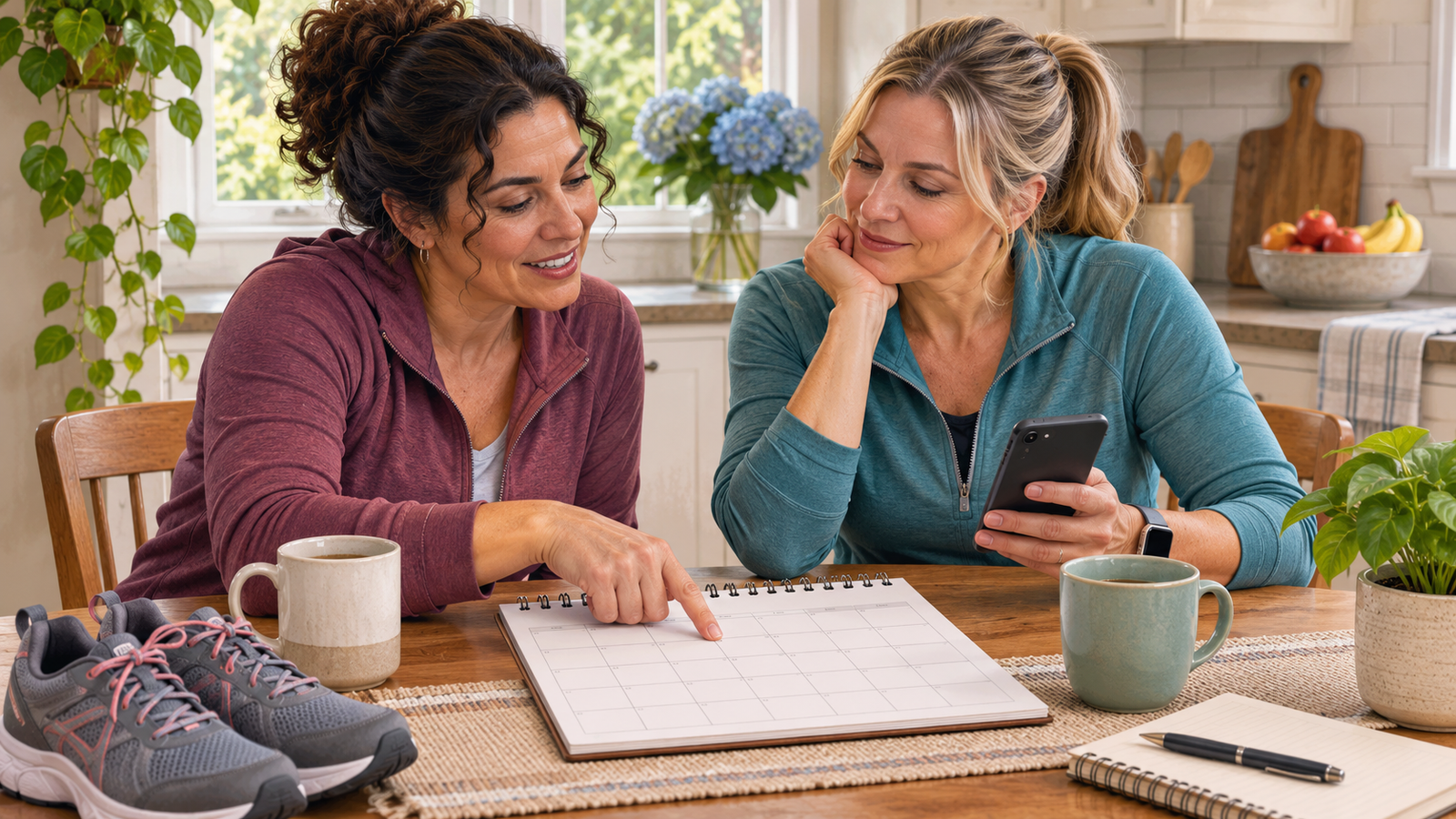
Featured image: AI-generated illustration: Choose a shared outing that suits both partners. This is not a documented local route. Credit: Mohawk Valley Voice.
A good walking partnership starts with clear expectations. Agree on the route, pace, timing and backup plan before setting out.
By David LaGuerre
Two people can both want to walk more and still struggle to arrange a single outing. One imagines a quick morning loop. The other expects a long conversation after dinner. Neither is wrong, but the missing details can keep the walk from happening.
A walking partner can offer company and encouragement. The Centers for Disease Control and Prevention identifies buddy systems and walking groups as social supports that can help people begin, maintain or increase physical activity. That does not mean every friendship needs a shared exercise schedule.
The practical goal is to create an arrangement that works for the people involved. Use the following planning prompts to settle the details, try an outing and adjust without blame. These are organizing suggestions, not a prescribed workout.
Ask what kind of company each person wants
Begin with an invitation that names a modest first step. Ask a friend, neighbor or relative whether they would enjoy planning a walk together. Make it easy to decline. You are inviting participation, not assigning responsibility for your fitness.
Talk about the experience each person hopes to have. Does one want conversation and the other quiet company? Is the priority getting outdoors, keeping an appointment or exploring a familiar neighborhood? You do not have to share every goal, but it helps to know which expectations matter.
A useful first agreement might be to try one outing and discuss it afterward. Avoid promising a year of early mornings before learning whether your schedules fit. A trial gives both people room to say what worked.
Choose someone whose practical needs fit yours
Compare availability, transportation and preferred setting. A reliable friend across the county may be less practical than someone nearby if every outing requires a long drive. Talk about what happens when work, caregiving or a school pickup changes the day.
Ask about access needs without making assumptions. Discuss the route surface, places to pause and how each person will get to the meeting point. CDC emphasizes inclusive, accessible activity opportunities for people with different abilities. The person using a route is the best starting point for understanding their own preferences.
If you have a disability or a health condition that affects activity, seek advice about suitable types and amounts from your health care professional. The National Institute of Diabetes and Digestive and Kidney Diseases recommends that conversation for people with relevant health problems or limitations. A walking partner supplies company, not medical supervision.
Put the appointment into plain language
Write the day, start time, exact meeting point and expected finish time in a shared message. Include who will confirm the outing. A message saying Tuesday at the park is incomplete if the park has several entrances and each person has a different Tuesday in mind.
Use the location name both people recognize. Describe the entrance or landmark rather than relying on a dropped map pin alone. Decide whether you will wait if someone is late and how you will communicate. Keep any necessary contact details private.
For example, your plan could identify a particular public entrance, a time to confirm and a finish before an existing appointment. The point is the detail, not a universal time or distance that readers should copy.
Agree that either person can shorten the outing
Before starting, say explicitly that turning around or finishing early is acceptable. No one should have to explain a private health concern to earn permission to stop. Decide how you will check in during the outing without making the conversation feel like a performance review.
NIDDK advises starting slowly and building activity gradually. Keep the first shared outing within each person’s abilities rather than trying to match the more experienced walker. If the two of you want different workloads, discuss separate activity at another time instead of turning every meeting into a compromise that frustrates someone.
A helpful question is whether the plan allows both people to return comfortably to the agreed finish point. Avoid an arrangement where one person feels abandoned or pressured to continue. Discuss that possibility before choosing a route.
Check the route instead of assuming it is suitable
Look at the actual setting before relying on it. Consider crossings, surface condition, access, lighting and places where you could end the outing. Do not choose a route only because an old photograph looks attractive.
For a Mohawk Valley plan, make weather and surface checks part of the confirmation message. Ask whether the route is currently usable, not whether it was usable last month. Do not treat a standing appointment as an obligation to walk on ice or in other unsafe conditions.
If you want an indoor alternative, contact the facility before going. Confirm whether walking is permitted, when the public may enter, any cost and whether the available route meets your needs. This guide does not establish that a particular local building offers public walking access.
Make cancellation easy and specific
Decide how to cancel before the first cancellation happens. Choose a message method and a reasonable confirmation point. If either person cannot attend, the other should know whether the outing is off or whether they are free to make a separate plan.
Keep the language simple. Explain that you cannot make the appointment and identify when you will revisit the calendar. You do not need a detailed excuse. Avoid turning a missed walk into a judgment about commitment.
When cancellations repeat, investigate the arrangement. Is the meeting time too close to work? Is transportation uncertain? Would an occasional weekend outing fit better? Changing the plan may be more useful than sending more reminders.
Keep encouragement separate from pressure
Ask what support the other person actually wants. Some people like a reminder; others prefer to handle their own calendar. Some enjoy discussing goals; others want a break from numbers and advice. Agree before sharing a partner’s progress with anyone else.
Do not comment on weight, food choices or medical information unless the person has invited that discussion. Praise the shared experience or a practical success, such as finding a meeting time that worked. The partnership does not require comparing bodies or tracking each other’s results.
If competition makes the outing uncomfortable, name that problem early. A friendship can continue even if shared exercise is not the right fit. You can choose occasional company rather than a recurring commitment.
Review one outing before expanding the plan
Afterward, ask what you would repeat and what you would change. Choose one practical adjustment for next time: a clearer meeting point, a different start time or a route with easier access. Do not change everything at once unless the original arrangement clearly failed.
Keep a short shared note with the next appointment and any agreed change. Leave personal health details out unless the person wants them recorded. A useful plan should be understandable without becoming an elaborate tracking project.
Book the next outing only when both people want it. The most useful walking partnership is one that respects changing needs, makes logistics clear and gives each person a reason to look forward to showing up.
Primary guidance checked November 4, 2026: CDC and NIDDK. Scheduling examples and partnership prompts are practical suggestions. Images are AI-generated editorial illustrations.