The free Everson plaza exhibition shows three short works. A separate project by the filmmaker follows a freedom seeker who escaped slavery in Syracuse in 1839.
The Tamika Galanis films in Syracuse don’t require a theater ticket. After dusk, Light Work projects the Bahamian-American artist’s short films on an outside wall of the Everson Museum of Art. The exhibition, “Dream Deep Enough to Remember,” runs Thursdays through Saturdays until Dec. 19, from dusk to 11 p.m.
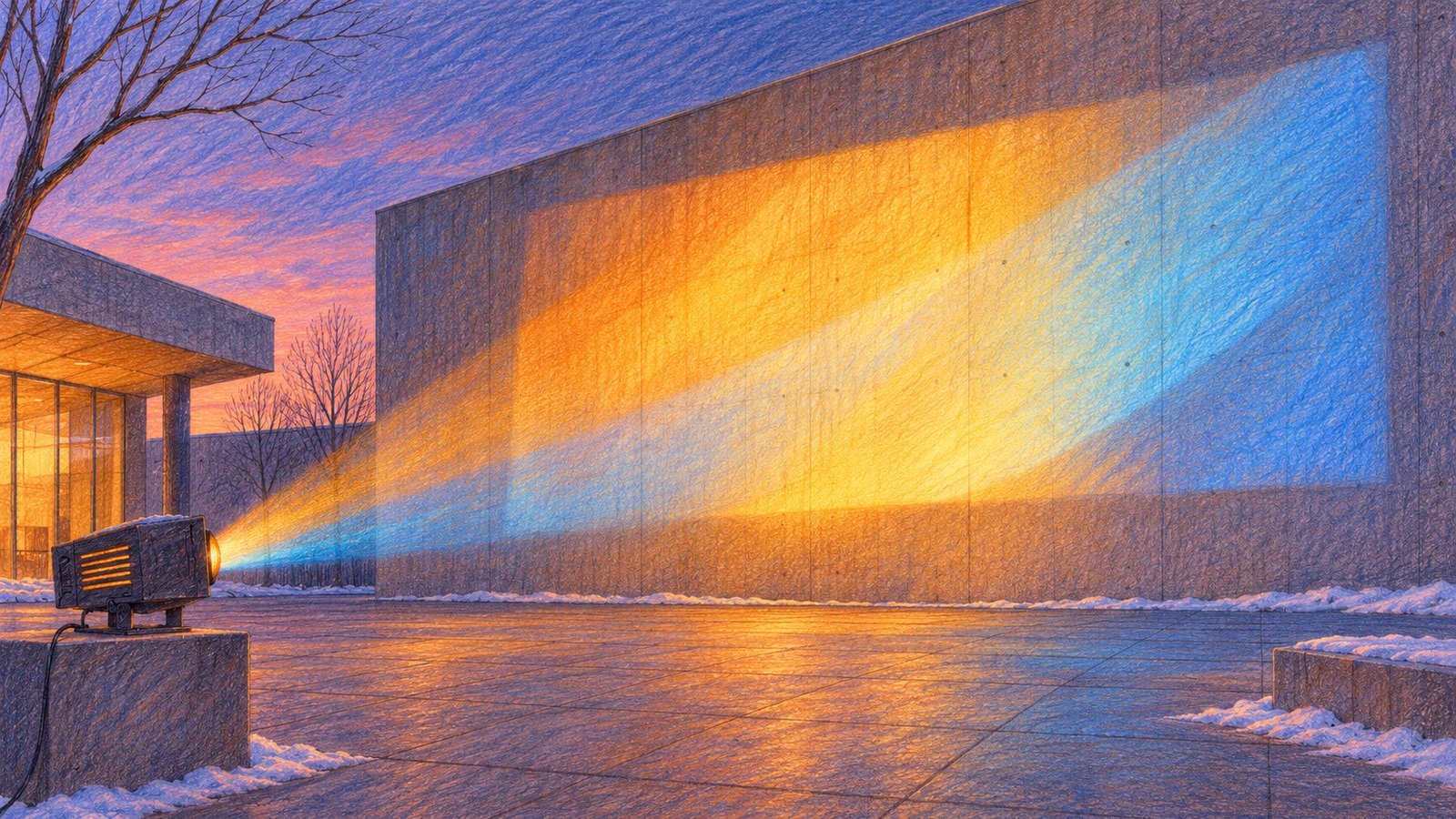
Outdoor film projection at dusk. AI-generated editorial illustration, not a view of the Everson or a still from Galanis’ films. Credit: VoiceMV archive.
The Nov. 27 arts listing gives the Friday show a 5 p.m. start and lists it as free. The plaza is at 401 Harrison St. This is an outdoor screening, not part of a paid visit to the galleries. You can make a short stop after dinner instead of planning a whole evening around it.
Three films, three ways to look at a record
Galanis teaches film at Syracuse University and works in both Upstate New York and The Bahamas, according to Light Work. The three works in the outdoor exhibition run about five or six minutes apiece. Each asks a different question about what images can show, and what they leave out.
Catching Shadow (2021) draws on Caribbean spiritual traditions. In Light Work’s description, a woman seeks to free a spirit held in a silk cotton tree, and discovers that she may have released more than she intended. The film uses photographs to represent spirits. The organizers also connect its use of shadows to the way Sojourner Truth used her own portrait to support herself.
When the Lionfish Came (2015) uses an invasive fish as a metaphor. Images of reefs and Junkanoo, a Bahamian festival tradition, put environmental change and cultural loss in the same frame. Light Work says Galanis combined footage she shot with material she found.
Returning the Gaze (2018) places old films of women in the West Indies beside new footage shot in The Bahamas. Light Work says Galanis made the film after a 2016 vote failed to change citizenship rules. The contrast asks viewers to notice who controls the camera and how differently people can appear when they are able to tell their own stories.
For an introduction from the organizer, watch Light Work’s Tamika Galanis video.
The Syracuse story behind her related project
The series also brought attention to a separate Galanis project, By the Skin of Her Teeth, which imagines parts of Harriet Powell’s 1839 escape from enslavement. It was listed for the Oct. 15 indoor event. Light Work’s current outdoor exhibition page lists the three works above, so don’t plan your plaza visit around seeing the Powell film.
What historians can trace starts in Syracuse. According to the National Historic Landmark documentation for the Gerrit Smith Estate, Powell was brought to a Syracuse hotel by a family from Mississippi. Tom Leonard, a Black waiter, learned that she wanted to escape and put her in touch with people who could help. The record traces her through Marcellus and DeWitt to Gerrit Smith’s estate in Peterboro before she reached Canada.
The Syracuse University Libraries exhibit includes a reward notice for Powell’s return and a later letter from Charlotte Hales in Kingston, Ontario. The notice tells readers what the man claiming ownership wanted the public to believe; the letter preserves Powell’s wish to hear from her mother and sister. They offer different views of the same life, but neither is a full account in Powell’s own words. Galanis’ film is an interpretation of those gaps, not a reconstruction of everything that happened.

Plan a visit or keep reading
Check Light Work’s schedule before heading out, and dress for an outdoor stop. The Everson visitor page lists directions and parking options. For more reading, the Onondaga Historical Association’s Freedom Bound exhibit explains Syracuse’s role in the Underground Railroad. VoiceMV’s story on Florence’s Black farming settlement looks at a different part of Central New York’s abolition history, in Oneida County.