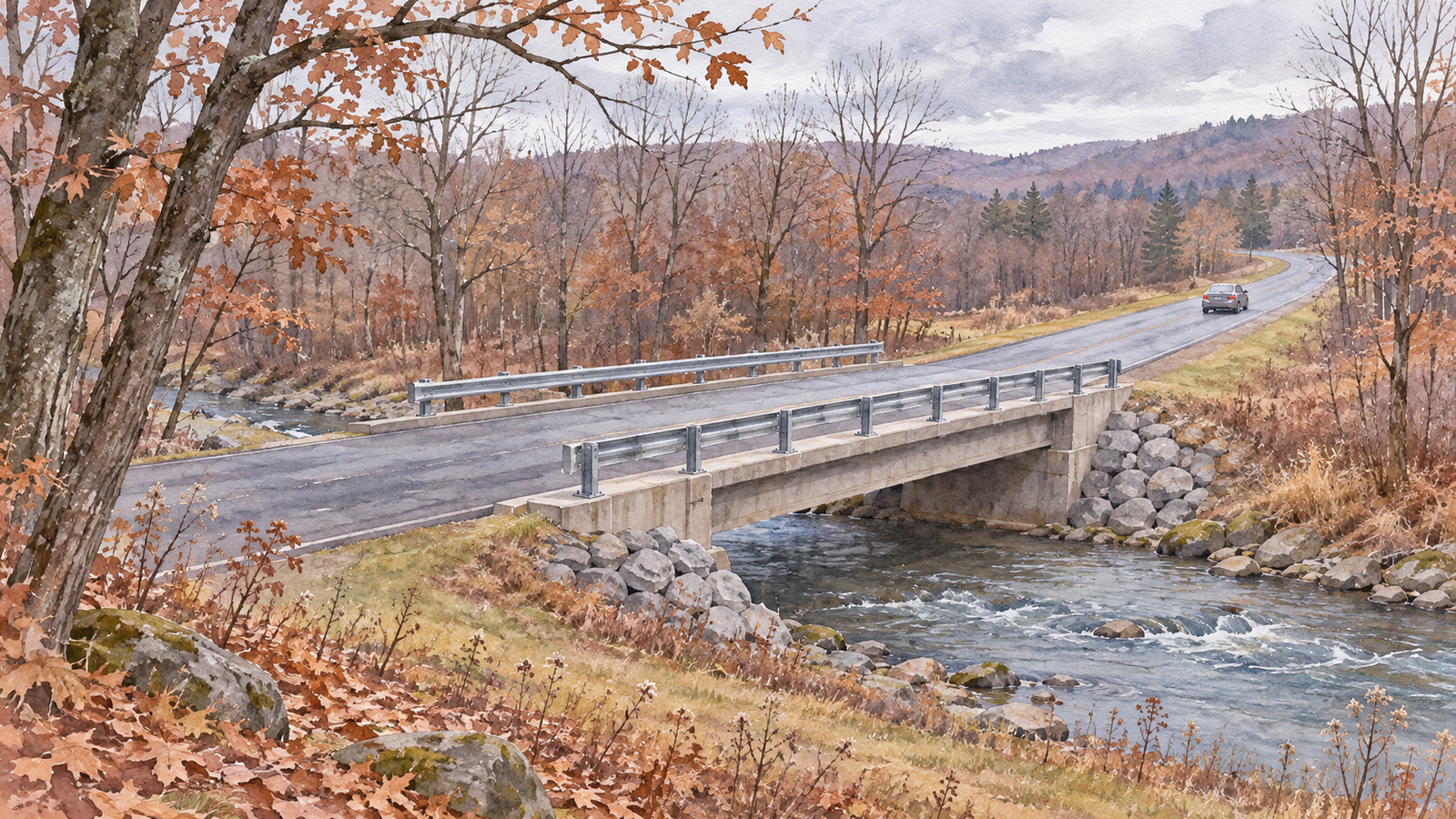
The Stuyvesant crossing over Mill Creek is open again, but striping and roadside work will continue.
Featured image: AI-generated editorial illustration for Mohawk Valley Voice. It does not depict the actual Route 9J bridge.
State Route 9J in Stuyvesant reopened after flood damage kept the Columbia County road closed for months, restoring a travel link between the Hudson Valley and the Capital Region.
Governor Kathy Hochul announced the reopening Friday, November 13. WNYT reported that traffic returned Thursday afternoon, November 12. The distinction matters for drivers: Friday’s announcement describes a road already back in service, rather than a reopening still to come.
The state Department of Transportation used stockpiled, interlocking concrete blocks to rebuild support for the bridge over Mill Creek. The governor’s office said the repair restored the route less than four months after a severe late-July rainstorm.
What drivers should know
The road is open, but crews still have work to finish. The state says striping and roadside landscaping will continue in the coming weeks and asks motorists to use caution through the area.
The announcement does not give a final completion date or a daily schedule for the remaining work. Drivers should follow signs and directions at the site and check current state transportation notices before making a trip.
For Mohawk Valley readers, this is a travel update for trips toward Columbia County and the Hudson Valley. It does not announce a closure or repair project in Utica. Route 9J serves travel between the Hudson Valley and the Capital Region, including access to businesses and fishing, boating and camping destinations, according to the state.
Floodwater damaged the bridge supports
The July storm dropped more than 11 inches of rain in parts of the region. Floodwater eroded the foundation and supporting structure of the Mill Creek bridge, forcing the long-term closure, the governor’s office said.
The state’s repair account describes work to stabilize and support the damaged bridge, rather than the construction of an entirely new crossing. That distinction helps explain why crews focused on the structure beneath the roadway and the nearby embankment.
DOT used prefabricated concrete units it calls superblocks. The blocks fit together to form support structures. The agency had been ordering and storing them in advance so they could be sent quickly to locations damaged by severe weather.
At Route 9J, crews used the blocks to create new foundation and support structures and to support the roadway embankment. The governor’s office described the project as one of the first uses of this system in New York.

A long disruption for residents
State officials credited the approach with speeding repairs. That is an agency assessment, not a finding that every earlier target date was met.
WNYT’s November 12 report also described months of detours and traffic disruptions. Its reporting said an early estimate put the work at at least a month, while the actual closure lasted into November. The reopening ends that extended disruption even as finishing work continues.
The announcement did not provide the project’s final cost or a detailed comparison with the time a different repair method would have required. Those figures should not be assumed from the state’s description of faster construction.
Part of a wider recovery
The Mill Creek crossing was one of several routes damaged by the summer storms. The governor’s office listed other repair and reopening work across Columbia, Rensselaer, Greene and Albany counties.
Those projects included Route 23B in Greenport, Route 22 in Hillsdale, Route 295 in Chatham and U.S. 9 in Kinderhook. The state’s wider list is a summary of storm recovery, not a notice that all those roads reopened on the same day as the Stuyvesant crossing.
Separate from this emergency repair, New York has announced new road resurfacing planned for spring 2027. VoiceMV’s Mohawk Valley paving report explains that regional project list and its remaining questions.
Sources and reporting limits
This report draws on the governor’s November 13 reopening announcement and WNYT’s November 12 report. The official release establishes the repair method and remaining work; WNYT supplies the Thursday-afternoon reopening timing. The final project cost and a date for completing the remaining work were not provided.