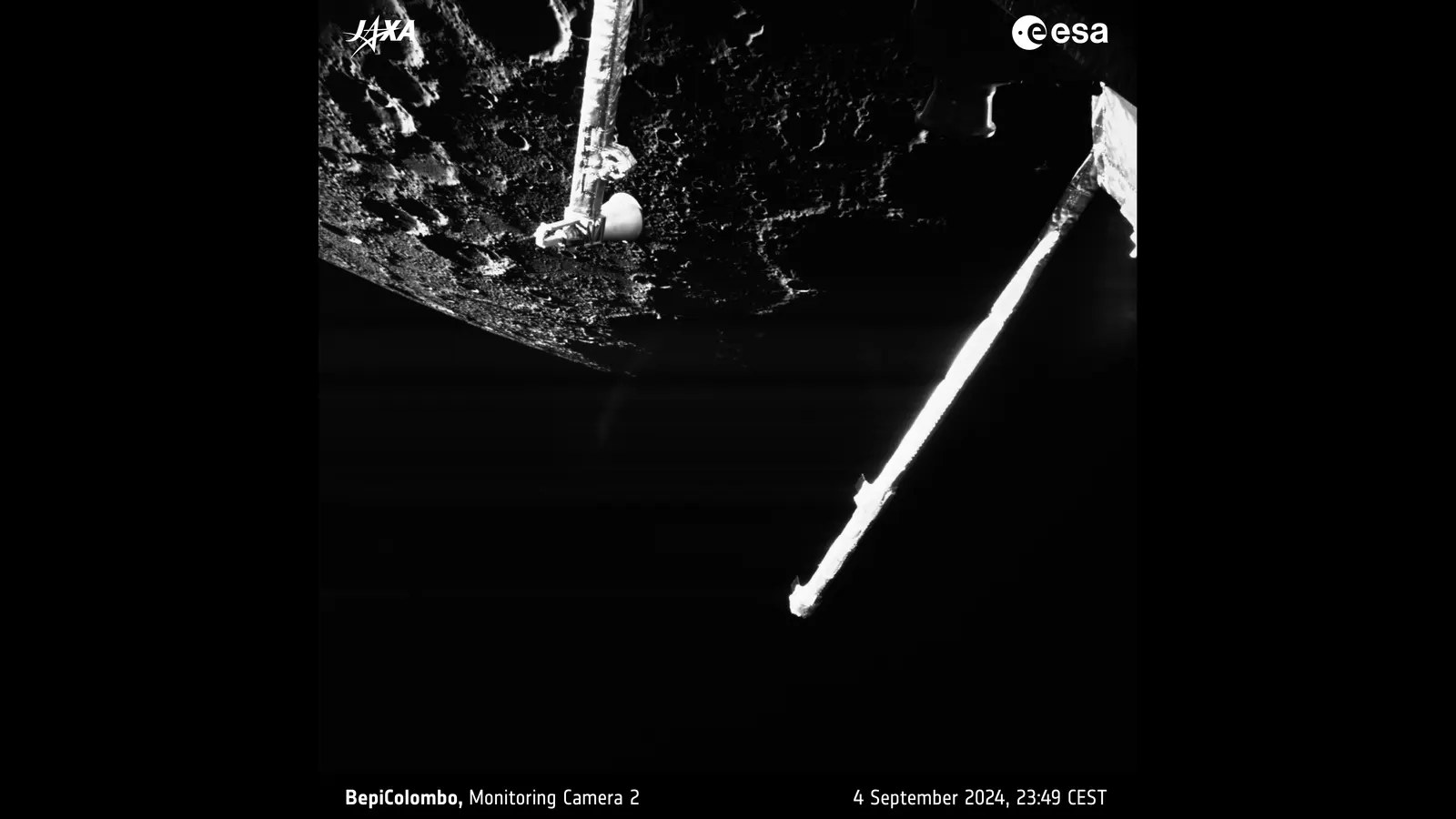
The European and Japanese mission reached orbit after nine planetary flybys. Its two orbiters are still joined, with separation planned for December.
BepiColombo is in orbit around Mercury, the first spacecraft to circle the solar system’s innermost planet since NASA’s MESSENGER mission ended in 2015. Flight controllers confirmed the capture Saturday, Nov. 21, after the spacecraft reestablished contact with Earth. The European Space Agency’s operations team said it was checking telemetry after the maneuver. The Associated Press reported the arrival after an eight-year journey.
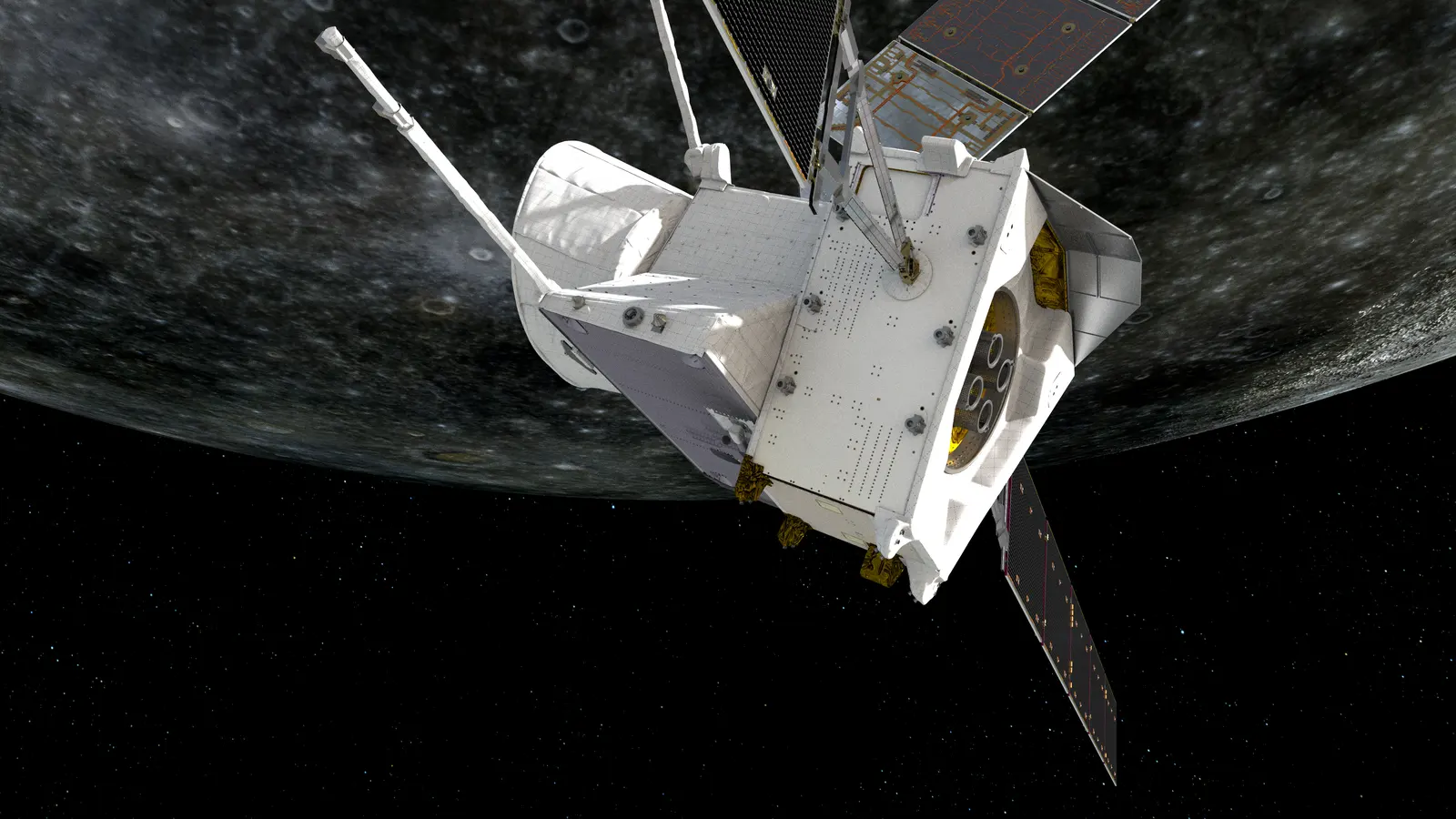
The joint European Space Agency and Japan Aerospace Exploration Agency mission actually carries two science spacecraft. For now, ESA’s Mercury Planetary Orbiter and Japan’s Mercury Magnetospheric Orbiter, called Mio, are stacked together. Getting captured by Mercury’s gravity was the milestone this weekend. Flying separately and starting routine science are still ahead.
Why getting to Mercury took eight years
Distance alone does not determine how long an interplanetary trip takes. Earth and Mercury both move around the Sun. A spacecraft leaves Earth already moving around the Sun, too. As it falls toward the inner solar system, the Sun’s gravity tends to speed it up. If the spacecraft reaches Mercury moving too fast relative to the planet, it passes by rather than staying in orbit.
That is why a Mercury mission spends so much of its trip slowing down. BepiColombo used two tools: an electric propulsion system for gradual adjustments and carefully planned swings past planets. A flyby can bend a spacecraft’s path and change its speed around the Sun. The effect depends on how the spacecraft approaches the moving planet. With each pass, the team could set up the next leg without having to do all the braking with fuel.
The route included one flyby of Earth, two of Venus and six of Mercury after launch in October 2018. BepiColombo had seen Mercury up close before Saturday. What changed this time is that the spacecraft stayed. ESA’s arrival animation shows how the stacked orbiters used a braking burn to enter orbit. It is a simulation, not footage taken during the arrival.
What two orbiters can learn
NASA says Mercury makes a trip around the Sun in just 88 Earth days. Yet it is one of the least explored of the rocky planets. Before spacecraft could map its surface from orbit, much of what researchers knew up close came from brief passages rather than sustained observation.
The two spacecraft will study different parts of the same planet. ESA’s mission overview describes the European orbiter’s work on Mercury itself, including the surface, its composition and its interior. Japan’s Mio will study the space around the planet, including its magnetic field and how it responds to charged particles flowing from the Sun.
ESA says measurements from both orbiters at the same time will help separate changes over time from differences between locations. If one spacecraft sees a change in the magnetic field, for example, the other can help scientists tell whether the change was happening in more than one place. The mission won’t settle those questions with one new image. It needs repeated readings from different positions.
What happens next
The ESA timeline calls for the orbiters to separate Dec. 9–10. The European spacecraft is expected to reach its final science orbit in March 2027, and the mission’s routine science phase is expected to begin in April. Those are planned milestones, not steps completed this weekend.
The milestone picks up where NASA’s MESSENGER mission left off. That spacecraft became the first to orbit Mercury in 2011 and ended its mission in 2015. BepiColombo is the next mission to reach orbit, with the added ability to observe Mercury from two spacecraft once they are separated.
Follow the mission through ESA’s arrival updates, or see more reporting in Health & Science.
Featured image: Mercury’s cratered surface and part of BepiColombo during the Sept. 4, 2024 flyby, not the November 2026 orbit insertion. Credit: ESA/BepiColombo/MTM; CC BY-SA 3.0 IGO. Resized and fitted to a wide canvas without cropping. Original ESA image.