On Thursday, some people could not get their work email. On Friday, many travelers could not get off the ground. And in the middle of it, the founder of one of the most important companies in artificial intelligence stepped down. Each story had its own facts. Taken together, they raised a question anyone who relies on a flight, a paycheck or an online account can understand: Who is responsible when a system you depend on fails?
That question hangs over the week of Nov. 12–17. A Microsoft 365 outage interrupted work across the world. The Federal Aviation Administration halted departures nationwide after parts of its network became unstable. NVIDIA announced that Jensen Huang had resigned. Meanwhile, AI researcher Geoffrey Hinton was warning that future systems could become difficult for people to control. The disruptions and the warning describe different risks, and each calls for a different kind of oversight.
Microsoft’s outage reached well beyond the inbox
Microsoft 365 users had trouble sending and receiving email and using other services on Nov. 12 and 13. In a Nov. 16 statement to the British Parliament, minister Ian Murray said the incident affected businesses, public services and parts of the health sector in the United Kingdom. Emergency calls to 999 remained available. Microsoft reported no indication of malicious activity, according to the statement.
Microsoft initially pointed to elevated demand on its infrastructure. Its later incident report described several contributing factors, including a software defect present in a networking gateway update that had been rolling out since July. The problem emerged under conditions the company’s testing had missed. The gateway serves multiple Microsoft 365 products, which helps explain why trouble in one part of the system could reach people using more than email.
That reach matters to a small employer or public office. A shared platform can put email, documents and schedules within easy reach. When it goes down, an appointment reminder, a payroll question and a deadline can all be harder to handle at once. The outage gives employers and public agencies a concrete question to ask: How will people reach us if the system we use to send updates is the one that fails?
What the FAA and Homeland Security said
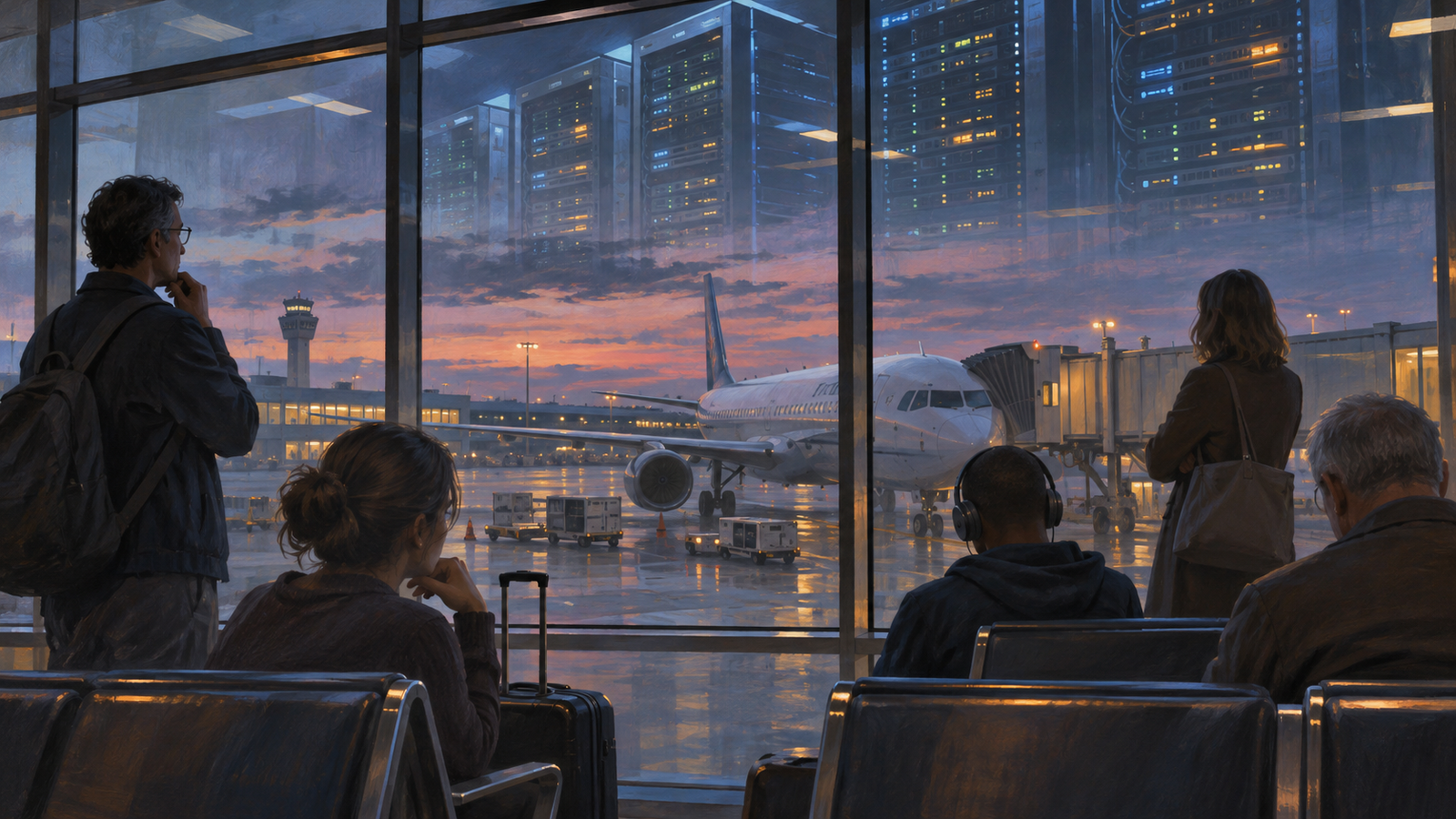
The FAA’s account puts the start of the aviation disruption at about 3:30 p.m. Eastern on Friday, Nov. 13. The agency said 17 of its 22 en route control centers experienced instability, which spread to some facilities that handle aircraft approaching and leaving airports. Some radar feeds and radio frequencies remained available. The FAA said about 3,500 aircraft landed safely and that it allowed departures to resume at 8:15 p.m.
The agency said a surge in network traffic destabilized older equipment. Investigators identified sites in Texas and Arkansas as possible sources of the unusual traffic. The network stabilized after its service provider isolated the two locations, and the agency said the root-cause investigation was continuing. A ground stop can end before the people affected by it are back on schedule. Aircraft and crews may be out of place, and travelers still have missed connections to sort out.
Homeland Security Secretary Markwayne Mullin said on Friday that there was no connection between the FAA disruption and the Microsoft outage. On Tuesday, Reuters reported that Mullin attributed recent disruptions to technical issues involving aging systems and said they were unrelated to cyberattacks. Reuters also cited disruptions involving United Airlines and JPMorgan Chase. The FAA’s public account says it found no indication of an outside attack. For travelers, the ground stop showed the value of a safety procedure that can slow the whole system while controllers and pilots bring aircraft down safely.
Jensen Huang’s departure puts oversight at NVIDIA in focus
On Nov. 12, NVIDIA announced that Huang had stepped down as president, CEO and a board member, effective immediately. Chief Financial Officer Colette Kress took over as interim CEO while retaining her finance role. The board named Harvey C. Jones as chair and said it would consider internal and external candidates for a permanent successor.
On Tuesday, The Associated Press reported that NVIDIA was creating a board committee to oversee national security and global trade compliance. NVIDIA supplies chips that companies use to build and run advanced AI systems. Its leadership transition puts attention on how the board handles national-security responsibilities and who is accountable for those decisions as the company searches for a new chief executive.
Geoffrey Hinton’s warning and what Americans say they fear
Geoffrey Hinton, whose research helped lay the groundwork for modern AI, spoke publicly about his concerns earlier this month and again on the Nov. 13 edition of Firing Line. On the program, he warned about the possibility of AI becoming more capable than humans and discussed cooperation between the United States and China on safety. His warning concerns what more powerful systems might do in the future. The FAA and Microsoft have described specific technical problems in systems people already use.
Public concern goes beyond the possibility of losing control of a future system. In a June survey of U.S. adults, Pew Research Center found that 52% were more concerned than excited about the growing use of AI in daily life. Pew also found growing concern among younger adults and reported that many worry about job losses. The polling predates these outages, so it gives a picture of unease that was already there before last week.
What readers should be able to ask
In the Mohawk Valley, questions about technology can be practical. How does a school notify families if its email platform goes down? Where can a county resident get a deadline confirmed when the usual office system is unavailable? When an employer starts using AI to sort job applications, can an applicant reach a person if the system gets something wrong?
The answers depend on the institution, but the public can ask for the same basics: a clear account of what happened, a way to reach someone while a service is down and a named person or office responsible for putting things right. The events of the past week make those questions especially timely as public agencies and employers consider where to put more authority in the hands of software.