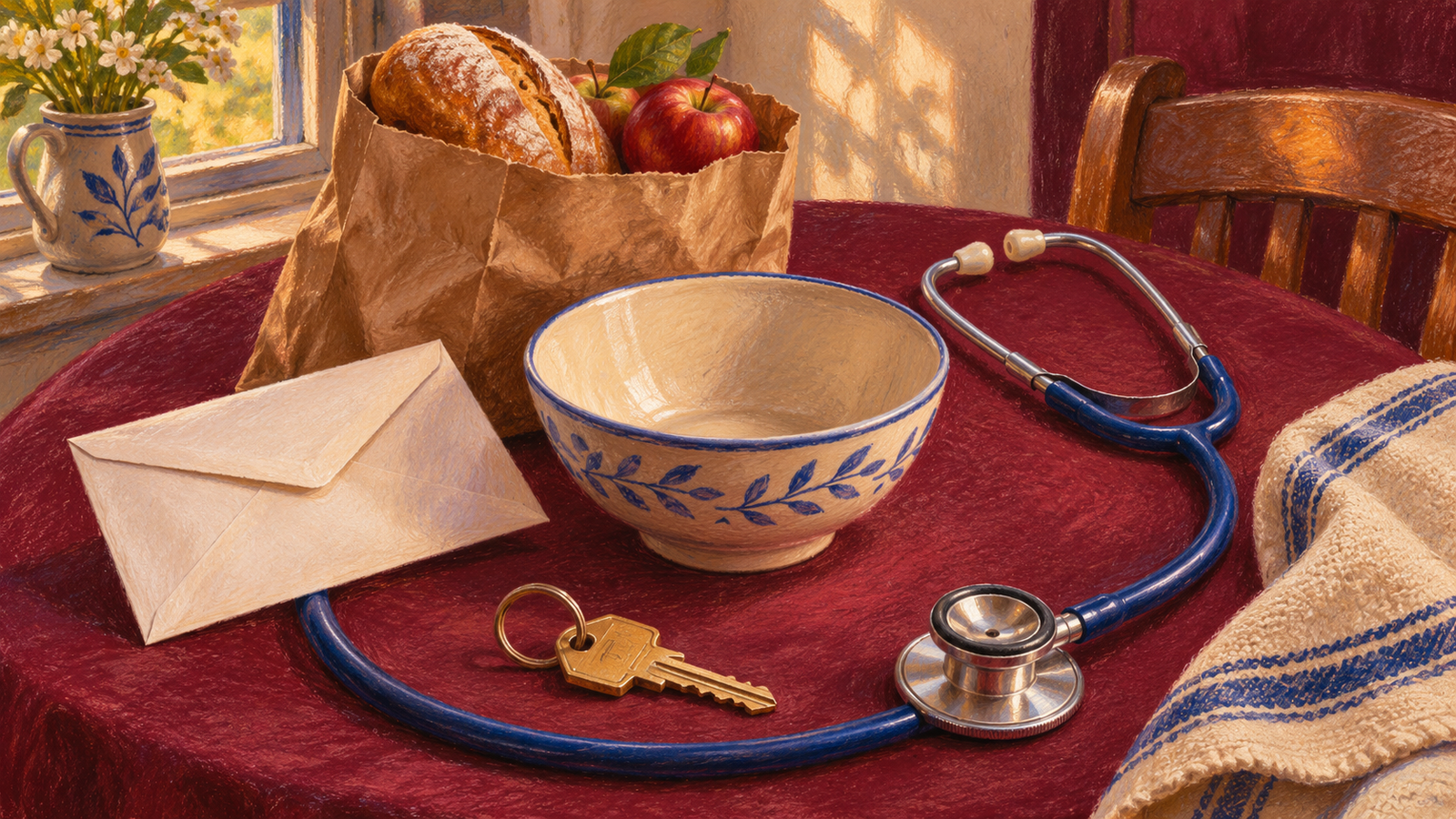
Featured image: AI-generated conceptual illustration for Mohawk Valley Voice. Healthcare and everyday necessities compete within a household budget; this is not a photograph of an actual household.
OPINION | By David LaGuerre
Healthcare should be a right, not another bill that forces a family to decide which basic need can wait.
There is something deeply wrong with telling people they have done everything right, then asking them to prove they can afford to get sick.
Work hard. Pay your bills. Take care of your family. That is the bargain so many Americans were raised to believe in. But what does that bargain mean when a doctor’s appointment competes with the grocery money? What does responsibility look like when the responsible choice is supposed to be getting care, but the bill makes you afraid to go?
My position is simple: Healthcare should be a right. Not a prize for having the right employer. Not a privilege that disappears between jobs. Not a luxury reserved for people who can absorb another unexpected expense.
The frustration deserves attention. The facts still matter.
A video titled “The Concerning New Reality of Living in America” collects accounts of people struggling with insurance, housing and everyday costs. It captures frustration that deserves to be heard. But a compilation of personal accounts is not a national survey, and the speakers’ individual bills have not been independently verified for this column. The video also refers to 2025; it is not a report of new events in Utica today.
We do not need to turn every claim in a viral video into a fact to make a strong case for change. The documented numbers are serious enough.
The Federal Reserve’s report on household finances in 2025, released in May 2026, found that 26% of adults went without some medical care because they could not afford it. That was an improvement from 28% in 2024, and we should acknowledge it. It still means more than one in four adults reported cost standing between them and some form of care.
The same survey found that 18% of adults had debt from their own medical care or a family member’s. And 16% said they had not paid all their bills in full in the month before the survey.
Those are national findings, not a measurement of Utica alone. They are not evidence that every household is getting worse off. They are evidence that financial hardship is real, even when an economic headline sounds reassuring.
A household is not a collection of separate problems
We talk about healthcare, housing, groceries, childcare and transportation as if they live in different worlds. They do not. They meet at the same kitchen table.
A person cannot spend the same dollar twice. A family cannot solve a large insurance bill by pretending the rent is optional. A worker cannot simply stop needing transportation to get to a job. Telling people to budget more carefully is not a complete answer when the problem is the cost of the necessities themselves.
This is not an argument against personal responsibility. It is an argument that responsibility should also apply to the institutions setting prices and the officials writing the rules.
Nor is this an argument that doctors, nurses and other healthcare workers should work for nothing. They deserve fair pay, safe staffing and the resources to care for patients. We should demand a system that supports the people providing care without making the people receiving it afraid of financial ruin.
We already spend enormous sums. Demand better results.
The Centers for Medicare & Medicaid Services reports that national health spending reached $5.3 trillion in 2024, or $15,474 per person, accounting for 18% of the economy. That per-person figure is an average across the system, not a bill handed to each patient.
My conclusion is not that care is free, or that a new system could be built without difficult choices. My conclusion is that we should expect much more from what we already spend.
I want universal access to necessary care. I want coverage people can actually use, with costs they can understand. And I want elected officials to explain their proposals in terms of what a family would pay and what care it could receive, not just which slogan tests best.
If a proposal requires new taxes, say so. Explain who pays, how much, and what existing premiums or out-of-pocket costs would change. Explain how patients would keep access to care during a transition. Explain how rural communities would maintain enough clinicians. If an official rejects that proposal, ask for an alternative that meets the same test: Can people get the care they need without being priced out?
We can debate the design. We should not accept avoidable hardship as the design.

Turn frustration into specific demands
Do not let this end with another angry comment online. Call. Write. Attend public meetings. Ask for a response you can keep and compare with an official’s actions.
Ask three direct questions: What will you support to make necessary healthcare affordable? How will your proposal affect a household’s total costs? When will you act?
Then ask the same kind of questions about housing, childcare, utilities and wages. Demand measurable commitments, realistic funding and an honest timetable. Be persistent and respectful. Criticize decisions and policies without threatening the people involved.
You do not have to share your diagnosis, account number or private medical documents to explain why affordability matters. A short account of the practical problem, your community and the action you want is enough to begin.
Where to make your voice heard
These are official contacts checked for this draft. District boundaries vary across the Mohawk Valley, so use the lookup tools to confirm who represents your address.
- U.S. Sen. Chuck Schumer: 202-224-6542; official contact page.
- U.S. Sen. Kirsten Gillibrand: 202-224-4451; official contact page.
- U.S. Rep. John Mannion, New York’s 22nd District: 202-225-3701; official contact page.
- State Sen. Joseph Griffo, Senate District 53: Utica office, 315-793-9072; griffo@nysenate.gov; official contact page.
- Assemblywoman Marianne Buttenschon, Assembly District 119: Utica office, 315-732-1055; buttenschonm@nyassembly.gov; official contact page.
Elsewhere, use the U.S. House representative lookup, the U.S. Senate contact directory, New York’s state senator lookup and Assembly member lookup.
Our elected officials should hear more from the people trying to hold a household together. We are not asking for a life without effort. We are asking for a country where effort has a fair chance to produce security.
Being able to see a doctor should not be a measure of how lucky you were this month. It should be part of the basic dignity of living here.
Related reading: Minimum Wage Gap: The Hidden Cost of Buying the Same American Life.