
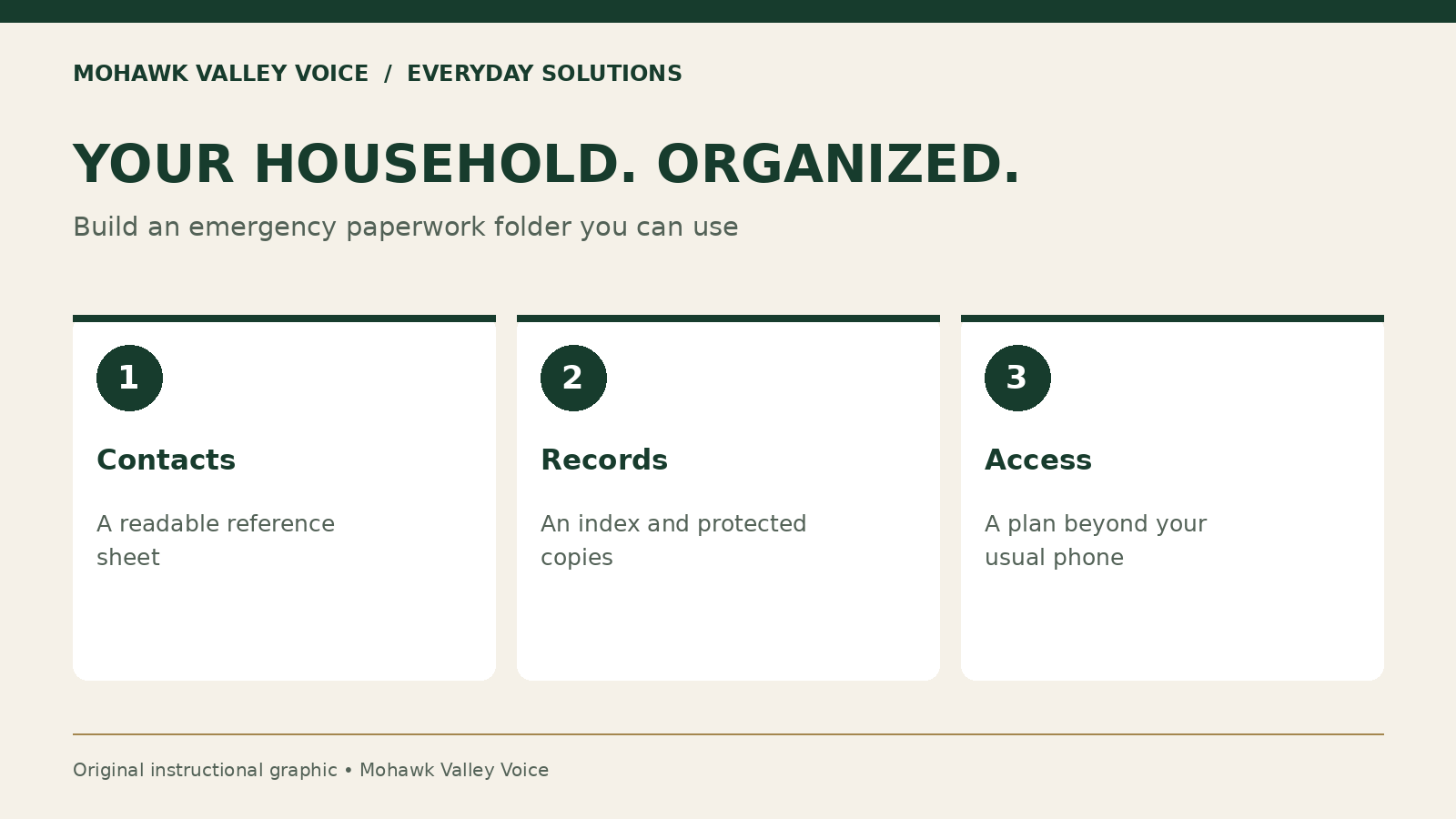
Create an emergency paperwork system you can actually use, with a contact sheet, organized records, secure backups and a short household practice run.
By David LaGuerre
Emergency paperwork is easy to ignore until a phone is lost, a household has to leave home or an insurance question needs an answer right away. A manageable folder can put the information you need within reach without turning your kitchen table into a permanent filing station.
For Mohawk Valley households, this is a useful project to complete before busy travel weeks or winter weather. You do not need an expensive binder or a perfect archive. Start with an ordinary folder, a contact sheet and a list of missing items. The aim is to make important information easier to locate while keeping private records secure.
Build a system with three parts
Use three parts: a short reference sheet, organized copies of important records and a secure place for originals. The reference sheet should be easy to read quickly. The copies should help you contact providers or identify the right policy or record. Originals should remain protected according to their importance and the instructions that apply to them.
Do not assume a photocopy replaces an original legal document. If you are unsure what an organization will accept, ask it. Your folder is a tool for finding and accessing records, not a substitute for the legal or administrative requirements attached to those records. Write the location of an original in your index rather than moving everything into a bag.
Begin with a one-page contact sheet
Write the household’s most important contacts in large, clear type. Consider an out-of-area contact, the landlord or property manager, insurance representative, pharmacy and regular health care providers. Include a trusted person who knows how to help locate records if you are unavailable.
Keep sensitive identification numbers off the basic sheet. A phone number for your insurer and the location of a policy copy may be enough for this quick reference. Ask another household member to read the sheet and explain who they would call for a sample problem. If they cannot find the right entry, simplify the headings. A usable page is more valuable than a crowded page no one can scan.
Sort records into four broad groups
FEMA’s Emergency Financial First Aid Kit offers a more complete checklist. Freddie Mac’s emergency document guidance describes four broad groups: household identification, financial and legal records, medical information and household contacts.
Use these as folder dividers. Begin with what your household already has. Set aside a separate sheet labeled Missing or Needs Review. If a record cannot be found, note the issuing organization and the step needed to request a replacement. You can work through the list in small sessions instead of postponing the whole project until you have a free weekend.
Use an index rather than stuffing the folder
Make an index with the record name, location, date last checked and person responsible for updates. For example, you might list the renters insurance policy, its renewal month and where the current copy is stored. Another line might identify the location of vehicle records.
The index should help you find things, not expose every private detail. Avoid copying full account numbers onto a sheet you plan to leave in an open drawer. If a document includes information you do not need for quick reference, store it securely and put a simple location note in the index. Mark older copies clearly so they do not get confused with current records.
Create a practical household inventory
The Federal Trade Commission’s paperwork guidance recommends making a household inventory. Start with one room at a time. Take clear pictures of important belongings and any identifying details you can safely record. Keep receipts or purchase records you already have.
Our suggested approach is to narrate a short room-by-room video for your own files, then add a basic written list of higher-value items. Do not post this inventory publicly. Record what is actually there and avoid guessing replacement values as though they were confirmed insurance estimates. Ask your insurer what documentation it finds useful and how coverage applies. A photo collection can support recordkeeping; it does not guarantee payment on a claim.
Keep medical information current and limited
Include a current medication list, relevant allergy information and the contacts needed to ask a medical question. If someone uses medical equipment, consider adding the supplier’s contact and the location of its instructions. Have the person involved, or an appropriate caregiver, check the information for accuracy.
Avoid treating an old medication list as current. Put the review date on it and replace it after changes. Your folder should point people toward accurate information and professional advice, not invite someone to change treatment on their own. If you are helping a relative, agree on what you may keep and who may access it. Respect privacy within the household as well as outside it.
Protect both paper and digital copies
The IRS recommends protecting records with backup copies and documenting valuables as part of emergency planning. Keep copies where a single household incident is less likely to remove all access. A folder and a digital copy sitting beside each other are not much help if both are damaged together.
Choose storage that fits the sensitivity of the records. For electronic copies, use a secure account or encrypted storage you understand, with a strong unique password and an available recovery method. For paper records, consider a suitable protective container and a location that trusted household members can find. Follow product limitations; a container labeled water-resistant should not be assumed to survive every flood.
Make a separate plan for getting to the records
Write down how you would retrieve the most important information if your usual phone or computer were unavailable. A cloud account is useful only if you can access it. Do not place all recovery information inside the one account it is meant to recover.
Keep emergency contact information available without relying entirely on a device. If a trusted person has a copy of selected records, decide exactly what they should hold, how they should protect it and when you will update it. Do not distribute a full document archive to several people simply to feel prepared. Share only what is needed and make the arrangement clear.
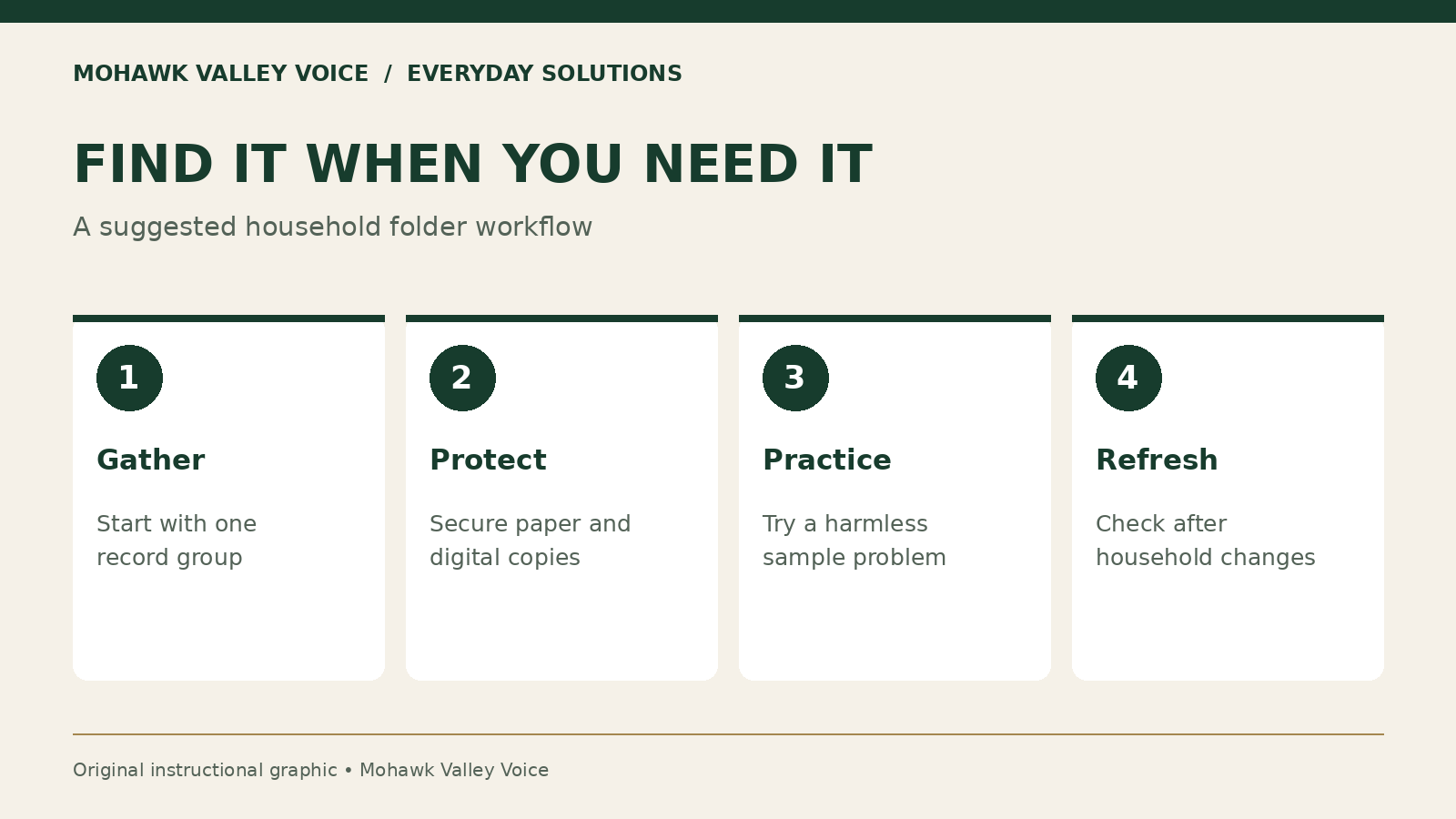
Try a ten-minute practice run
Use a harmless scenario: imagine that you need to contact your insurer from another phone. Can you find the right number? Can you identify the current policy record? Does a second household member know where the reference sheet is?
Do not call emergency services to test your folder. Instead, walk through the steps together and note any missing information. Another practice scenario is replacing a lost document. Find the issuing agency’s official instructions and record where to start. The point is to discover confusing labels and inaccessible storage while there is time to fix them calmly.
Make updates a small routine
Choose a regular review date and also update after a move, a new insurance policy, a changed phone number or another important household change. New York’s Emergency Financial First Aid Kit resource can help you expand your checklist as needed.
Finish today by preparing the contact sheet and sorting just one group of records. Put the missing-item list beside the index, then schedule a short second session. An emergency folder does not need to be impressive. It needs to be current, protected and understandable to the people who may have to use it.
Resource links checked October 8, 2026. This organizing guide does not replace advice from an insurer, attorney or health care professional about particular records.

