


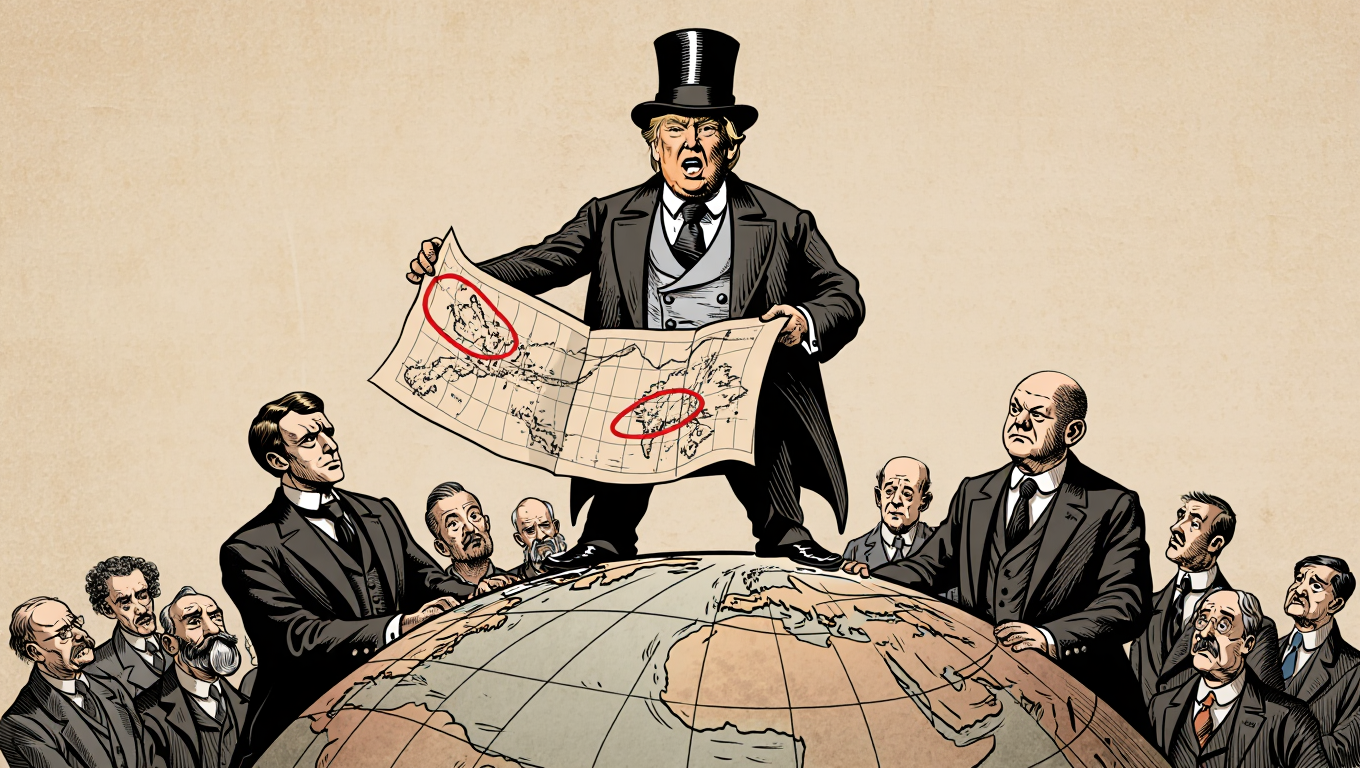
Trump’s Territorial Ambitions: A New Era of American Imperialism?
From Venezuela to Greenland, the White House Signals a Dramatic Shift in U.S. Foreign Policy
The United States has entered uncharted territory. President Donald Trump’s recent military operation in Venezuela and renewed threats to annex Greenland signal a dramatic shift in American foreign policy that has alarmed allies and emboldened critics worldwide. This isn’t just about one country or one operation. It’s about a fundamental reimagining of America’s role on the global stage.
What Just Happened in Venezuela?
On January 3, 2026, U.S. special forces conducted a stunning overnight raid in Caracas, Venezuela. The operation captured President Nicolás Maduro and his wife, Cilia Flores, from their heavily fortified compound. According to Reuters, the raid began at 2:01 a.m. local time and involved nearly 200 U.S. personnel on the ground.
The captured Venezuelan leader was transported to the USS Iwo Jima before being flown to New York. He now faces drug trafficking charges in a Manhattan federal court. But the operation didn’t stop with Maduro’s arrest.
At a press conference at Mar-a-Lago, Trump made a shocking declaration. “We will run the country until such time as we can do a safe, proper and judicious transition,” he announced. The president repeatedly emphasized Venezuela’s vast oil reserves, suggesting U.S. companies would soon move in to “refurbish badly degraded oil infrastructure.”
The Justification: Drugs, Democracy, or Oil?
The Trump administration has offered multiple, sometimes conflicting, rationales for the Venezuela operation. Attorney General Pam Bondi emphasized drug trafficking charges. Trump himself spoke about protecting Americans from “savage and murderous gangs” like Tren de Aragua.
However, a National Intelligence Council report from April contradicted Trump’s claims about Venezuelan government cooperation with criminal gangs. The report stated that “the Maduro regime probably does not have a policy of cooperating with TDA and is not directing TDA movement to and operations in the United States.”
What became clear during Trump’s press conference was his focus on oil. He mentioned Venezuela’s petroleum resources repeatedly, claiming the operation “won’t cost us anything” because oil revenues would fund U.S. involvement. Energy experts quickly disputed this claim.
Samantha Gross of the Brookings Institution explained that Venezuela’s oil industry is “a shambles.” Production has plummeted from 3.2 million barrels per day in 2000 to about 1 million today. Restoring production would require “years and billions of dollars in investment,” she noted.
Greenland: The Next Target?
Fresh from the Venezuela operation, Trump immediately turned his attention to Greenland. Speaking aboard Air Force One on January 5, the president declared, “We need Greenland from the standpoint of national security.”
This isn’t new rhetoric. Trump has coveted the Arctic island since his first term, even suggesting in 2019 that the U.S. should buy it. But the recent statements carry new weight given the administration’s willingness to use military force in Venezuela.
Denmark’s Prime Minister Mette Frederiksen issued her strongest rebuke yet. “If the United States decides to militarily attack another NATO country, then everything would stop. That includes NATO and therefore post-second world war security,” she told Danish television.
Greenland’s Premier Jens-Frederik Nielsen was equally direct. “Enough is enough,” he said in a statement. “No more pressure. No more innuendo. No more fantasies about annexation.”
The situation escalated when Katie Miller, wife of Trump’s deputy chief of staff Stephen Miller, posted a map of Greenland draped in the American flag with the caption “SOON.” The post drew immediate condemnation from Danish officials.
Stephen Miller’s Vision: Might Makes Right
Perhaps no one has articulated the administration’s new worldview more clearly than Stephen Miller. In a fiery CNN interview, Trump’s deputy chief of staff laid out a stark vision of American power.
“We live in a world that is governed by strength, that is governed by force, that is governed by power,” Miller declared. “These are the iron laws of the world.”
When asked about Greenland, Miller questioned Denmark’s right to the territory. “What right does Denmark have to assert control over Greenland?” he asked. “What is the basis of their territorial claim?”
Miller’s comments represent a fundamental rejection of the post-World War II international order. The Atlantic Charter, signed by President Franklin Roosevelt and British Prime Minister Winston Churchill in 1941, explicitly rejected the notion that powerful nations could impose their will on weaker ones. This principle became foundational to the United Nations and NATO.
The Legal Questions Mount
Constitutional scholars and international law experts have raised serious concerns about the Venezuela operation. Senator Tim Kaine stated bluntly, “Maduro is terrible. But Trump put American servicemembers at risk with this unauthorized attack.”
The War Powers Resolution of 1973 requires presidents to notify Congress within 48 hours of introducing U.S. military forces into hostilities. The administration did not provide advance notice to any congressional leaders, citing concerns about leaks.
Secretary of State Marco Rubio defended this decision, saying, “It’s just not the kind of mission that you can pre-notify because it endangers the mission.” However, this breaks with decades of precedent for notifying at least the “Gang of Eight” senior congressional leaders about sensitive operations.
International law presents even thornier questions. Professor Marc Weller of Chatham House’s International Law Programme noted, “International law prohibits the use of force as a means of national policy. Short of a UN Chapter VII mandate, force is only available in response to an armed attack.”
Venezuela did not attack the United States. The drug trafficking charges against Maduro, while serious, do not provide legal justification under international law for invading a sovereign nation and capturing its leader.
What About Venezuela’s Democratic Opposition?
One of the most troubling aspects of the operation is who the Trump administration chose not to empower. María Corina Machado, Venezuela’s Nobel Peace Prize-winning opposition leader, has fought courageously for democracy. According to a March 2025 poll, she enjoyed a 72% approval rating among Venezuelans.
Yet Trump dismissed her at his press conference. “She doesn’t have the support or the respect within the country,” he claimed without evidence.
Instead, the administration appears willing to work with Delcy Rodríguez, Maduro’s vice president and a close regime ally. This decision has baffled Venezuela experts and democracy advocates.
Marcela Escobari of the Brookings Institution warned, “Maintaining Delcy Rodríguez as president indefinitely would not only undermine the clearly expressed will of the Venezuelan people but likely prevent the reestablishment of rule of law.”
The Venezuelan people voted overwhelmingly for opposition candidate Edmundo González Urrutia in the July 2024 election. Maduro’s regime rejected the results and clung to power through force. Now, with Maduro gone, the Trump administration seems poised to keep much of his authoritarian apparatus in place.
The “Donroe Doctrine” Takes Shape
Trump has explicitly invoked the Monroe Doctrine, the 1823 policy asserting U.S. influence over the Western Hemisphere. He’s even suggested calling an updated version the “Donroe Doctrine.”
But this goes far beyond the original Monroe Doctrine, which warned European powers against colonizing the Americas. Trump’s vision appears to embrace direct U.S. control over sovereign nations.
The administration’s December 2025 National Security Strategy embraced what it calls a “Trump Corollary” to the Monroe Doctrine. This document warned of “civilizational erasure” and elevated culture war rhetoric to a central tenet of U.S. foreign policy.
Laurel Rapp, Director of Chatham House’s US and North America Programme, noted the historical parallels. “The United States has a highly mixed record, at best, at leading regime-change operations across the globe,” she wrote. “Cautionary tales from Iran, Vietnam, Iraq and Afghanistan loom large.”
The Reaction From America’s Allies
European leaders have responded with alarm. On January 6, the leaders of France, Germany, Italy, Poland, Spain, and the UK issued a joint statement defending Greenland’s sovereignty.
“Greenland belongs to its people,” the statement read. “It is for Denmark and Greenland, and them only, to decide on matters concerning Denmark and Greenland.”
The European Union’s lead foreign policy spokesperson, Anitta Hipper, was equally direct. “The EU will continue to uphold the principles of national sovereignty, territorial integrity and the inviolability of borders,” she said. “These are universal principles, and we will not stop defending them.”
Even traditional U.S. allies in Latin America have expressed concern. Brazil’s President Luiz Inácio Lula da Silva said the Venezuela operation crossed “an unacceptable line.” Mexico condemned the intervention, though President Claudia Sheinbaum has been careful not to provoke Trump’s ire.
The Domestic Political Calculation
Trump’s aggressive foreign policy presents a political paradox. He was elected partly on promises to end “forever wars” and focus on America First. Yet here he is, threatening to run Venezuela indefinitely and eyeing territorial expansion.
Some of Trump’s most loyal supporters have expressed concern. Representative Marjorie Taylor Greene, a Georgia Republican who has broken with Trump in recent months, wrote on social media, “This is what many in MAGA thought they voted to end. Boy were we wrong.”
However, polling suggests many Americans support the Maduro operation. The administration has framed it as tough action against drug trafficking and a corrupt dictator. For voters frustrated by fentanyl deaths and immigration, this message resonates.
The real test will come if U.S. involvement in Venezuela drags on. If American troops face casualties, if costs mount, if the promised oil revenues fail to materialize, public opinion could shift quickly.
What Comes Next?
Trump has already hinted at further action. At his press conference, he warned Colombian President Gustavo Petro to “watch his ass,” calling him a drug trafficker without evidence. He said Mexico needs to “get their act together.” He threatened Iran with being “hit very hard” if it kills protesters.
The question is whether Trump will follow through. Does he have the military resources, diplomatic capacity, and political capital to pursue multiple interventions simultaneously?
Michael O’Hanlon of the Brookings Institution expressed skepticism. “Constitutionally, Congress should have been asked for authorization in advance,” he wrote. “Moreover, international law cannot sanction the decision of one government to use its own legal system as a basis for attacking the government of another country.”
The administration faces practical challenges too. Venezuela’s economy has contracted roughly 80% over the last decade. Basic infrastructure is severely deteriorated. Stabilizing the country would require, according to experts, an IMF-anchored package of over $50 billion over 18-24 months.
Where will that money come from? Trump claims oil revenues will cover costs, but experts say that’s fantasy. Venezuela’s oil industry needs massive investment before it can increase production. And with global oil prices falling, profit margins for expensive-to-produce Venezuelan crude are narrowing.
The Precedent That Worries the World
Perhaps the most concerning aspect of these developments is the precedent they set. If the United States can invade Venezuela and capture its president, what stops Russia from doing the same in Ukraine? What prevents China from seizing Taiwan’s leaders?
Senator Mark Warner raised exactly this concern. “If the U.S. can take out Maduro, why can’t Russia take out Ukraine’s Volodymyr Zelenskyy?” he asked.
The Trump administration’s response is essentially: because we’re stronger. Miller made this explicit in his CNN interview. “Nobody is going to fight the United States militarily over the future of Greenland,” he said.
This is the logic of empire, not alliance. It’s the worldview of the 19th century, not the 21st. And it fundamentally undermines the rules-based international order that has, for all its flaws, helped prevent great power conflicts for 80 years.
A Turning Point for America
We stand at a crossroads. The Trump administration is openly embracing a vision of American power that rejects international law, dismisses congressional oversight, and prioritizes territorial expansion over alliance building.
This isn’t just about Venezuela or Greenland. It’s about what kind of country America wants to be. Do we want to be a nation that respects sovereignty and works through international institutions? Or do we want to be an empire that takes what it wants because it can?
The answers to these questions will shape not just Trump’s presidency, but America’s role in the world for generations to come. As citizens, we have a responsibility to pay attention, ask questions, and demand accountability from our leaders.
The world is watching. History is being written. And the choices we make now will echo far into the future.
What You Can Do
This moment demands engagement from all of us. Here’s how you can make your voice heard:
- Contact your representatives in Congress and demand they assert their constitutional authority over war powers
- Stay informed by following credible news sources and fact-checking claims from all sides
- Support organizations working to defend democracy and international law
- Share this story with friends and family to spark important conversations
- Vote in the 2026 midterm elections to hold leaders accountable
Democracy requires active participation. The time to engage is now.


