


When President Donald Trump posted a demand for $1 billion in damages from Harvard University on Truth Social this February, it wasn’t just another political broadside—it was the latest escalation in a high-stakes battle that threatens to reshape the relationship between the federal government and America’s most prestigious institutions of higher learning. The demand, which came just hours after The New York Times reported negotiations had softened, signals a White House strategy that’s less about resolution and more about political theater. For families in the Mohawk Valley and across upstate New York who’ve watched their own public universities struggle with funding cuts, this billion-dollar showdown raises urgent questions about government accountability, political overreach, and what happens when higher education becomes a weapon in culture war battles.
Key Takeaways
- Trump escalated demands to $1 billion after rejecting Harvard’s proposed $500 million workforce development program, calling it a “convoluted job training concept” designed to avoid a cash settlement[1]
- Federal courts have blocked the administration’s attempts to cut off approximately $2.7 billion in research grants and revoke Harvard’s ability to enroll international students[1]
- Negotiations have stalled repeatedly despite Trump claiming deals were imminent in July, October, and November 2026, with talks proceeding “only in fits and starts”[1]
- Other Ivy League institutions have struck deals to preserve their federal funding, suggesting Harvard’s resistance to cash payments sets it apart from peer institutions
- The dispute centers on allegations that Harvard mishandled antisemitic harassment following the October 7, 2023 attacks, though Trump has not specified what “Criminal, not Civil” wrongdoings he claims occurred[1]
The $1 Billion Demand: From Negotiation to Confrontation
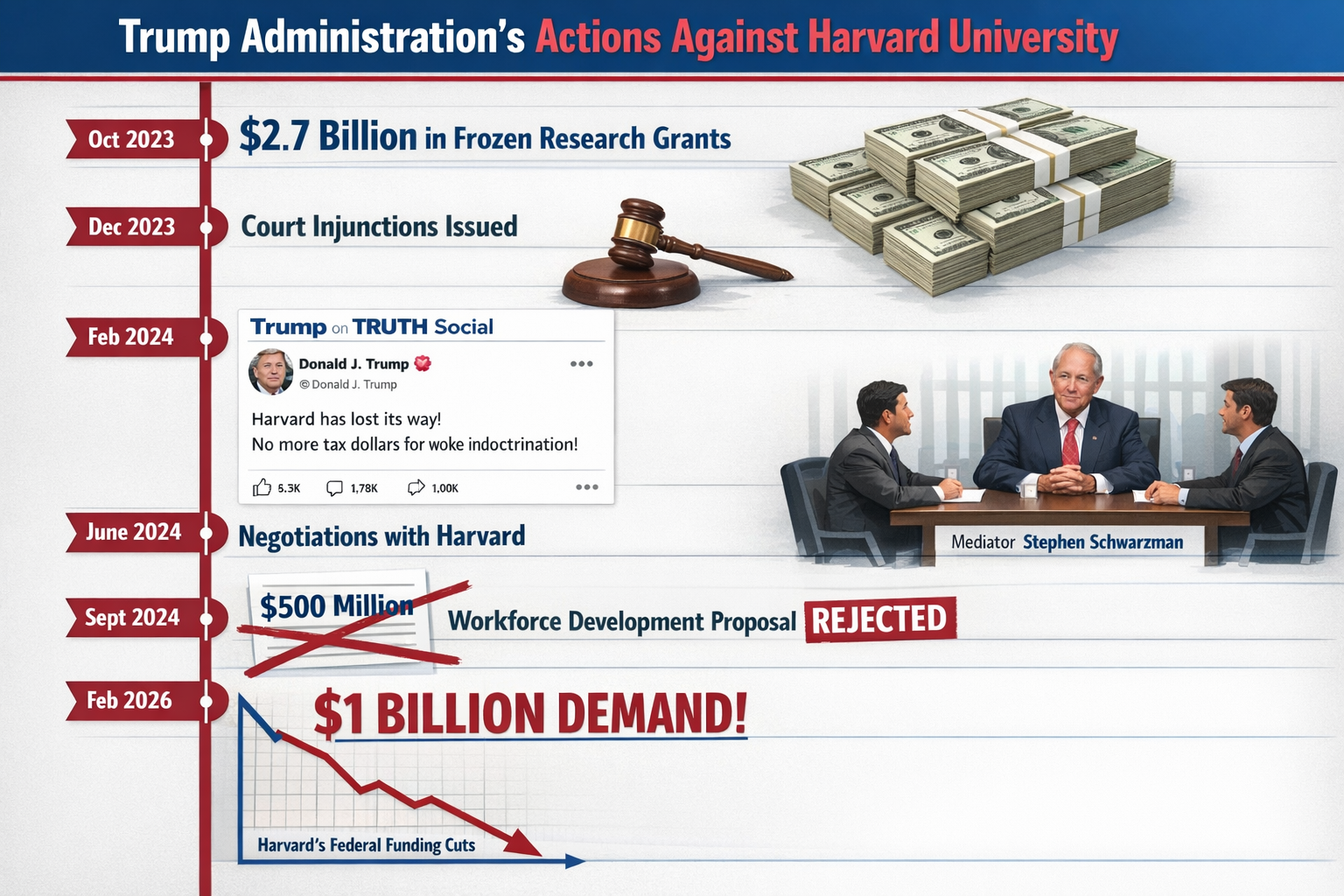
On February 2, 2026, President Trump took to Truth Social with a message that sent shockwaves through the higher education community: “We are now seeking One Billion Dollars in damages, and want nothing further to do, into the future, with Harvard University.”[1]
The timing was striking. Just hours earlier, The New York Times had reported that the White House would no longer condition a settlement on a cash payment, citing four unnamed sources who suggested negotiations were moving toward resolution. Trump’s public rejection of those reports wasn’t just a contradiction—it was a deliberate escalation that transformed what might have been a quiet settlement into a very public confrontation.
What prompted this dramatic shift? According to reporting from The Harvard Crimson, Harvard administrators had been steadfastly refusing any deal that included a cash payment. Instead, they proposed a workforce development agreement worth up to $500 million—a technical education program designed to benefit communities while avoiding the appearance of capitulating to federal pressure.[1]
Trump wasn’t having it. He characterized the proposal as a “convoluted job training concept” that was “wholly inadequate,” claiming it was merely Harvard’s attempt to escape “a large cash settlement of more than 500 Million Dollars, a number that should be much higher.”[1]
The Pattern of False Starts
This wasn’t the first time Trump claimed a Harvard deal was imminent. In July 2026, he told reporters the parties were set to reach resolution “over the next week or so.” By October, he announced he had “reached a deal” with the university. November brought similar claims of impending settlement.[1]
Yet here we are in 2026, with negotiations having proceeded “only in fits and starts in recent months,” according to sources familiar with the discussions.[1] The pattern suggests either genuine difficulty finding common ground or—more likely—a White House strategy that benefits more from prolonged conflict than actual resolution.
For progressive observers, this raises uncomfortable questions about government transparency and accountability. When does legitimate oversight of federal funding recipients cross the line into political harassment? When do settlement negotiations become performance art designed to score points with a political base?
Federal Research Grants Frozen: The $2.7 Billion Hammer
The Trump administration’s crusade against alleged antisemitism at Harvard has resulted in freezing approximately $2.7 billion in federal research funds as of mid-2026.[1] To put that in perspective, that’s more than the entire annual budget of many state university systems—including institutions that serve working families across upstate New York and the Rust Belt.
These aren’t discretionary grants for campus beautification projects. Federal research funding supports:
- Medical research that develops treatments for cancer, Alzheimer’s, and rare diseases
- Scientific studies that advance our understanding of climate change and environmental protection
- Technology development that drives innovation and creates jobs in communities like Utica and Rome
- Graduate student stipends that make advanced education accessible to students from working-class backgrounds
When the federal government freezes billions in research grants, the impact ripples far beyond Cambridge, Massachusetts. Research collaborations with regional universities get disrupted. Clinical trials that might benefit patients in Oneida County get delayed. Graduate students from the Mohawk Valley who earned spots in Harvard programs find their funding in jeopardy.
The Courts Push Back
Recognizing the potential harm, a federal judge blocked the administration’s efforts to cut off the research grants while litigation continues.[1] The administration has appealed, but the judicial intervention reveals an important truth: even sympathetic judges recognize that using federal funding as a cudgel raises serious constitutional and procedural concerns.
The administration also attempted to revoke Harvard’s ability to enroll international students—an extraordinary measure that would have crippled the university’s academic programs. Harvard won injunctive relief on both actions, though the federal government continues to appeal.[1]
These legal defeats matter. They demonstrate that the administration’s tactics, whatever their political appeal, struggle to withstand judicial scrutiny. For citizens concerned about government overreach and the rule of law, that’s a crucial check on executive power.
The Mediator, The Meetings, and The Money
The New York Times reported that Harvard’s governing board met Monday as negotiations, mediated by billionaire Stephen A. Schwarzman, showed Trump had previously dropped a $200 million demand before escalating to the current $1 billion figure.[1]
Who is Stephen Schwarzman? The Blackstone Group CEO and major Republican donor has deep ties to both Harvard (he’s donated hundreds of millions to various institutions) and the Trump administration. On paper, he’s an ideal mediator—someone with credibility in both camps and a vested interest in preserving elite institutions while maintaining political relationships.
Yet even Schwarzman’s involvement hasn’t produced results. The fact that Trump dropped a $200 million demand only to later escalate to $1 billion suggests the negotiations aren’t following a logical progression toward compromise. Instead, the numbers seem almost arbitrary—figures chosen for their political impact rather than their relationship to any actual damages Harvard might owe.
What Other Ivy League Schools Did Differently
Here’s what makes Harvard’s situation particularly notable: other Ivy League schools struck deals to preserve their federal funding.[1] While specific terms of those agreements haven’t been made public, the fact that peer institutions found acceptable compromises while Harvard remains locked in conflict suggests two possibilities:
- Harvard’s leadership believes it has stronger legal and moral ground to resist federal pressure, particularly around cash payments that might set dangerous precedents
- The administration views Harvard as a particularly valuable political target, making compromise less attractive than continued confrontation
For progressive advocates, Harvard’s resistance to cash settlements deserves recognition. Paying the federal government to make politically motivated investigations disappear would establish a troubling precedent—one that could be weaponized against any institution that displaces those in power.
Beyond Harvard: Threats to Tax-Exempt Status and University Patents
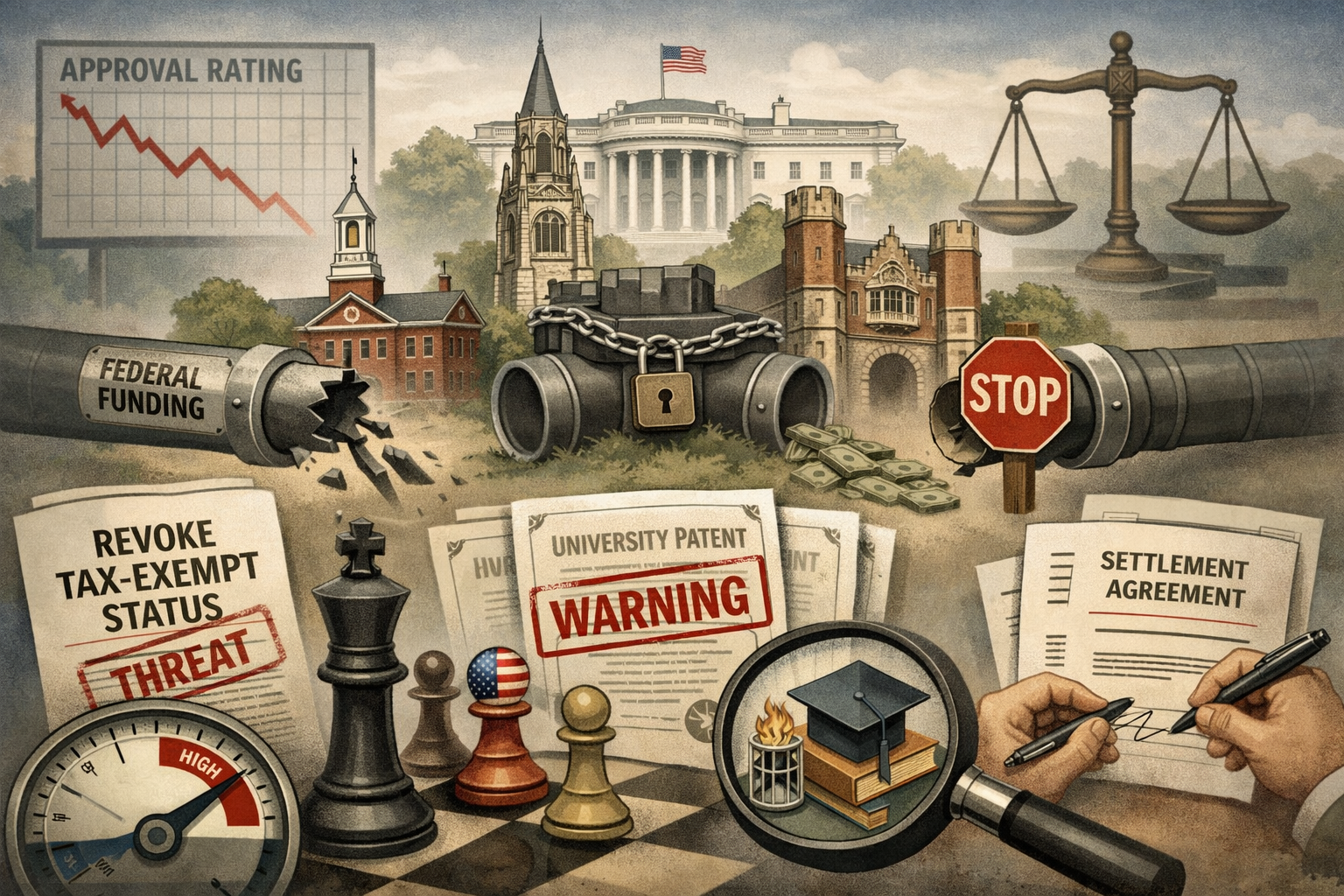
The dispute with Harvard isn’t happening in isolation. Threats to tax-exempt status and university patents reveal the White House’s higher-education campaign extends far beyond one institution’s handling of antisemitism complaints.[1]
Consider what’s at stake:
Tax-Exempt Status: Universities’ 501(c)(3) status allows them to accept tax-deductible donations and avoid paying federal income tax on most revenue. Revoking this status would fundamentally alter higher education’s financial model, potentially making college even less affordable for working families.
University Patents: Research universities hold patents on discoveries made through federally funded research. These patents generate revenue that funds additional research and student support. Threatening these intellectual property rights raises questions about whether research conducted with public funds can be weaponized for political purposes.
Accreditation and Federal Student Aid: While not explicitly mentioned in current threats, the administration’s broader higher education campaign could extend to accreditation—the process that determines whether students can use federal financial aid at specific institutions.
The Political Calculation
Why pursue such an aggressive campaign against elite universities? The answer lies in political strategy rather than policy goals. Threats to tax-exempt status and university patents show the White House’s higher-education campaign aims for a political win, with a deal seen as a victory amid sagging approval ratings.[1]
Polling consistently shows that Trump’s approval ratings have declined throughout 2026, particularly among independent voters and suburban moderates. Elite universities—especially Ivy League institutions perceived as bastions of liberal ideology—make convenient targets for a base that’s been primed to view higher education with suspicion.
A “victory” over Harvard, whether through a cash settlement or continued conflict that energizes supporters, serves immediate political needs even if it undermines long-term policy coherence or institutional stability.
The Antisemitism Allegations: Legitimate Concerns or Political Weaponization?
At the heart of this dispute lies a serious question: Did Harvard mishandle antisemitic harassment following the October 7, 2023 attacks?[1]
This question deserves thoughtful consideration separate from the political theater surrounding it. Jewish students on college campuses have reported genuine increases in antisemitic incidents, harassment, and feelings of unsafety since the October 2023 Hamas attacks on Israel and the subsequent war in Gaza. These concerns are real, documented, and demand institutional responses that protect all students’ safety and dignity.
Universities have a legal and moral obligation to address harassment and discrimination. Title VI of the Civil Rights Act prohibits discrimination based on race, color, or national origin at institutions receiving federal funding—and courts have recognized that this extends to antisemitic harassment.
However, Trump’s characterization of Harvard’s alleged violations as “Criminal, not Civil” wrongdoings—without specifying what illegal conduct occurred—raises red flags.[1] Criminal violations require evidence of intentional lawbreaking, not merely inadequate administrative responses to campus incidents.
What Trump Hasn’t Explained
Trump’s public statements have been long on accusations and short on specifics:
- What criminal statutes does he claim Harvard violated? Federal criminal law doesn’t typically criminalize university administrators’ responses to campus incidents unless there’s evidence of conspiracy, fraud, or obstruction of justice.
- What evidence supports criminal charges? Investigations into civil rights violations can lead to enforcement actions, consent decrees, and funding conditions—but criminal prosecution requires a much higher evidentiary standard.
- Why target Harvard specifically? If the concern is genuinely about protecting Jewish students, why haven’t similar actions been taken against the dozens of other universities where antisemitic incidents have been documented?
The lack of specificity suggests the antisemitism allegations, while potentially rooted in legitimate concerns, have been weaponized for political purposes that extend beyond protecting students.
Trump’s Criticism of Harvard President Alan Garber
In his Truth Social post, Trump directly criticized Harvard President Alan M. Garber, questioning why he was “hired AFTER the antisemitism charges were brought” and claiming Garber failed to rectify “a very bad situation.”[1]
This criticism reveals either a misunderstanding of Harvard’s leadership timeline or a deliberate mischaracterization. Garber became interim president in January 2024 following Claudine Gay’s resignation—a resignation that itself resulted from controversy over her congressional testimony about antisemitism and subsequent plagiarism allegations.
Garber inherited a crisis he didn’t create. By the time he took office, the controversies over Harvard’s response to antisemitism were already national news. Criticizing him for not fixing problems that predated his tenure—while he’s simultaneously dealing with unprecedented federal pressure—seems designed more to undermine Harvard’s leadership than to achieve any specific policy goal.
For observers concerned about government accountability and fair dealing, this personalized attack on a university president raises concerns. Effective federal oversight focuses on institutional policies and practices, not personal attacks on administrators trying to navigate complex challenges.
What This Means for Higher Education Across America
While Harvard can afford expensive lawyers and has an endowment that provides some insulation from federal pressure, the precedents being set in this dispute will affect institutions across the country—including regional universities that serve communities like the Mohawk Valley.
Consider these potential implications:
📚 Federal Funding as Political Weapon: If the administration can freeze billions in research grants based on allegations that haven’t been proven in court, what prevents future administrations from using similar tactics against any institution that displaces them politically?
💰 Cash Settlements as Precedent: If Harvard eventually agrees to a cash payment, it establishes a model where universities pay the federal government to resolve politically charged disputes—creating a financial incentive for administrations to manufacture controversies.
🎓 Academic Freedom Under Pressure: When universities must constantly worry about federal retaliation for how they handle controversial campus issues, it creates a chilling effect on academic freedom and institutional autonomy.
🔬 Research Disruption: Freezing research grants doesn’t just hurt universities—it delays scientific progress, disrupts collaborations, and harms graduate students and early-career researchers who depend on that funding.
Local Impact: What Upstate New York Should Watch
For Mohawk Valley residents, this dispute might seem distant from daily concerns about affordable housing, healthcare access, and good-paying jobs. But higher education policy has direct local impacts:
- SUNY Polytechnic Institute and other regional universities depend on federal research grants for programs that drive economic development
- Utica University and other private institutions could face similar federal pressure if they’re perceived as insufficiently responsive to political demands
- Local students who attend elite universities on financial aid could find those institutions less stable and less able to provide support
- Regional research partnerships that connect Mohawk Valley institutions with larger universities get disrupted when federal funding becomes unpredictable
The principle at stake—whether federal funding comes with reasonable strings attached or becomes a tool for political coercion—matters everywhere, not just in Cambridge.
The Path Forward: What Happens Next?
As of February 2026, the Harvard dispute remains unresolved despite nearly three years of conflict. Several scenarios could play out:
Scenario 1: Judicial Resolution
Federal courts continue to block the administration’s most aggressive tactics, eventually forcing a settlement that preserves Harvard’s research funding in exchange for specific policy changes around campus safety and antisemitism prevention. This outcome would establish judicial limits on executive overreach while addressing legitimate concerns about student safety.
Scenario 2: Political Compromise
Harvard agrees to a modified version of the workforce development program—perhaps with some face-saving elements that allow Trump to claim victory—avoiding a cash payment but making concrete commitments that address the administration’s stated concerns. This would end the immediate conflict but might not resolve underlying tensions about university autonomy.
Scenario 3: Continued Stalemate
The dispute drags on through the 2026 midterm elections and potentially into 2027, with neither side willing to compromise. Research grants remain frozen pending litigation, Harvard continues operating with reduced federal support, and the uncertainty damages both parties while serving primarily political purposes.
Scenario 4: Escalation
The administration follows through on threats to revoke tax-exempt status or take other extraordinary measures, triggering a constitutional crisis about separation of powers and government overreach. This seems least likely given judicial pushback so far, but remains possible if political calculations change.
What Citizens Can Do
For Mohawk Valley residents and concerned citizens across upstate New York, this dispute offers opportunities for civic engagement and informed action:
✅ Contact Your Representatives: Reach out to Congresswoman Elise Stefanik and Senators Chuck Schumer and Kirsten Gillibrand. Ask them to:
- Conduct oversight hearings on federal research grant freezes
- Investigate whether funding decisions are being made based on evidence or political considerations
- Protect academic freedom and institutional autonomy while ensuring universities meet civil rights obligations
✅ Support Local Higher Education: Recognize that threats to elite universities today could become threats to regional institutions tomorrow. Advocate for:
- Stable, predictable federal research funding
- Protection of university tax-exempt status from political manipulation
- Academic freedom and institutional autonomy
✅ Stay Informed: Follow developments through credible news sources. The Mohawk Valley Voice will continue tracking this story and its implications for our region.
✅ Engage in Community Conversations: Talk with neighbors, colleagues, and fellow community members about what role government should play in higher education oversight. These conversations help build informed public opinion that can influence policy.
✅ Support Student Safety: Whatever the political dimensions of this dispute, the underlying concerns about antisemitism and student safety are real. Support efforts to:
- Combat antisemitism and all forms of discrimination
- Ensure campus environments where all students feel safe
- Hold institutions accountable through appropriate channels
Conclusion: Politics, Precedent, and Principle
The Trump administration’s demand for $1 billion from Harvard University represents more than a dispute between one president and one university. It’s a test case for how federal power can be wielded against institutions that depend on government funding, a precedent that could reshape higher education for decades, and a political strategy that prioritizes short-term wins over long-term institutional stability.
For progressive observers, the dispute raises fundamental questions about government accountability, institutional autonomy, and the appropriate use of federal power. While legitimate concerns about antisemitism on campus deserve serious attention and meaningful responses, the pattern of escalating demands, false claims of imminent deals, and personalized attacks on university leadership suggests motivations that extend beyond student protection.
The stakes extend far beyond Cambridge. When federal research grants become political weapons, when cash settlements become expected responses to government investigations, and when university autonomy becomes conditional on political compliance, we risk transforming higher education from a public good into a political football.
As this dispute continues to unfold in 2026, citizens across the Mohawk Valley and upstate New York should watch carefully. The precedents being set today will shape tomorrow’s educational landscape—determining whether universities remain spaces for independent inquiry and academic freedom or become institutions that must constantly calculate political risk before making difficult decisions.
The path forward requires balancing legitimate government oversight with protection against political overreach, addressing real concerns about student safety while preserving institutional autonomy, and recognizing that some principles—like academic freedom and the rule of law—matter more than any individual political victory.
Harvard may be wealthy enough to weather this storm, but the smaller institutions that serve working families across upstate New York might not be. That’s why this fight matters to all of us, not just those with Ivy League degrees.
References
[1] Trump Harvard 1 Billion Claim – https://www.thecrimson.com/article/2026/2/3/trump-harvard-1-billion-claim/


