


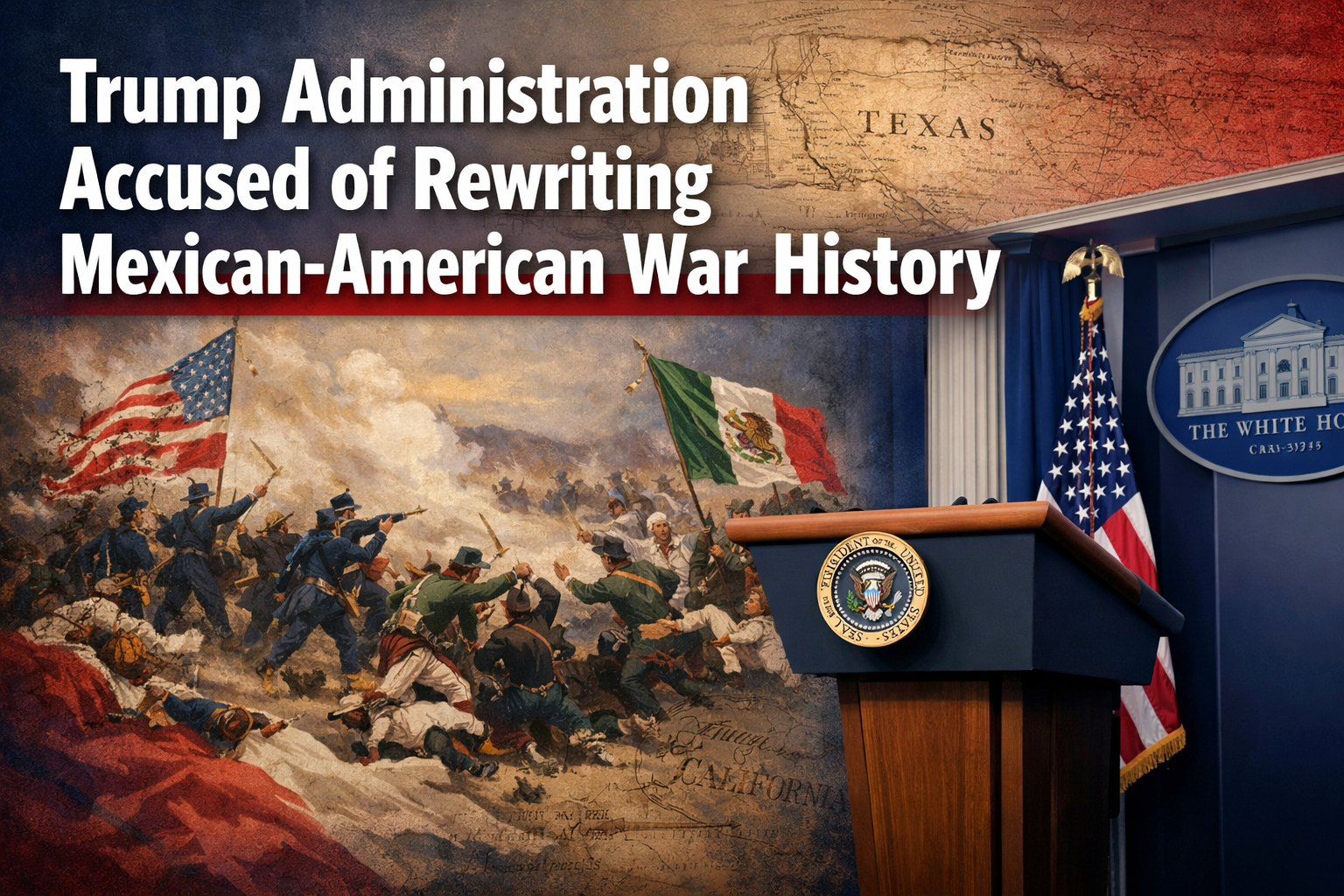
When the White House released an unsigned statement in 2026 describing the Mexican-American War as a “legendary victory,” historians across the country immediately recognized something deeply troubling: the administration wasn’t just celebrating history—it was rewriting it. Historians and observers have accused the Trump administration of rewriting history regarding the Mexican-American War, calling it a “historically inaccurate” portrayal to justify foreign policy actions in Latin America. The White House referred to the Mexican-American War as a “legendary victory” without mentioning slavery’s role, which has drawn criticism from historians like Alexander Aviña. Aviña emphasized that the White House’s framing is an example of U.S. imperialism, contrasting it with how political leaders have viewed the war as a negative part of history. Mexican President Claudia Sheinbaum responded by emphasizing Mexico’s sovereignty, reminding Trump that, “we have to defend sovereignty.”[1]
The controversy reveals more than just a disagreement about events from 178 years ago. It exposes a deliberate effort to reshape America’s historical narrative to support aggressive contemporary foreign policy—and it’s happening right now, in 2026, with real consequences for international relations and democratic accountability.
Key Takeaways
- Historical distortion for policy goals: The Trump administration released a White House statement glorifying the Mexican-American War while omitting slavery’s central role and the displacement of Native Americans, drawing sharp criticism from leading historians.[1]
- Academic consensus rejected: Scholars like Alexander Aviña (Arizona State University) and Albert Camarillo (Stanford University) describe the statement as “historically inaccurate” imperialism that erases generations of historical scholarship.[1]
- Contemporary policy justification: The statement explicitly connects the 1846-1848 war to current Trump administration interventions in Latin America, including actions in Venezuela and Mexico.[1]
- International pushback: Mexican President Claudia Sheinbaum directly challenged the framing, emphasizing Mexico’s sovereignty in response to what she views as historical revisionism.[1]
- Broader pattern of revision: The statement reflects wider administration efforts to rewrite federal historical narratives, including at the Smithsonian Institution and across government websites.[1]
The White House Statement: A “Legendary Victory” Without Context

The unsigned White House statement released in early 2026 described the Mexican-American War as a “legendary victory that secured the American Southwest, reasserted American sovereignty, and expanded the promise of American independence across our majestic continent.”[1] The language is sweeping, patriotic, and deliberately incomplete.
What the statement included:
- Glorification of territorial expansion
- Praise for “Manifest Destiny” ideology
- Claims the war was defensive, preventing Mexican invasion
- Explicit parallels to current Latin America policies[1]
What the statement omitted:
- Slavery’s central role in the war’s origins
- Displacement of hundreds of thousands of Native Americans
- The war’s controversial nature even among contemporaries
- Generations of historical scholarship documenting U.S. imperialism[1]
This isn’t just selective storytelling—it’s what historians call historical revisionism: the deliberate reshaping of the past to serve present political purposes.
Why Slavery Matters to This Story
The Mexican-American War (1846-1848) was fundamentally connected to slavery’s expansion. Southern slaveholders pushed for the annexation of Texas and the conquest of Mexican territories specifically to create new slave states and maintain political power in Congress. Mexico had abolished slavery in 1829, making these territories particularly attractive to pro-slavery expansionists.
By erasing slavery from the narrative, the White House statement removes the moral complexity that has led U.S. political leaders for generations to view this war as “an ugly aspect of U.S. history,” according to Alexander Aviña.[1] It transforms a controversial imperial conquest into a simple tale of American triumph.
Historians Respond: “Distorted, Ahistorical, Imperialist”
The academic response has been swift and unequivocal. Professor Albert Camarillo at Stanford University described the White House statement as a “distorted, ahistorical, imperialist version” of the war. He emphasized that it attempts to “whitewash and reframe U.S. history and erase generations of historical scholarship.”[1]
This isn’t academic nitpicking. These scholars have dedicated their careers to understanding what actually happened—and why it matters today.
Alexander Aviña’s Analysis: Embracing Imperialism
Alexander Aviña, a historian at Arizona State University who specializes in U.S.-Mexico relations, offered particularly pointed criticism. He noted that the White House’s framing is “inaccurately historical” and represents a dramatic departure from how American political leaders have traditionally discussed the war.[1]
“U.S. political leaders since then have seen this as an ugly aspect of U.S. history, this is a pretty clear instance of U.S. imperialism against its southern neighbor.” – Alexander Aviña[1]
What makes the 2026 statement remarkable, Aviña explains, is that instead of acknowledging this ugly history, the Trump administration is embracing it as positive—and using it to justify contemporary interventions in Latin America.[1]
The statement serves, in Aviña’s analysis, “to assert rhetorically that the U.S. is justified in establishing its so-called ‘America First’ policy throughout the Americas, regardless of the historical accuracy.”[1]
The Scholarly Consensus Being Erased
For decades, historians across the political spectrum have reached broad consensus on several facts about the Mexican-American War:
- It was a war of aggression: The U.S. provoked conflict to seize Mexican territory
- Slavery was central: Expansion of slave states motivated the conflict
- It was controversial then: Many Americans, including Abraham Lincoln and Henry David Thoreau, opposed it as unjust
- It caused massive displacement: Native American and Mexican communities lost land and rights
- It established imperial patterns: The war set precedents for U.S. interventions throughout Latin America
The White House statement doesn’t engage with this scholarship—it simply ignores it, presenting an alternative narrative as if the last 170 years of historical research never happened.
Mexico’s Response: Defending Sovereignty in 2026
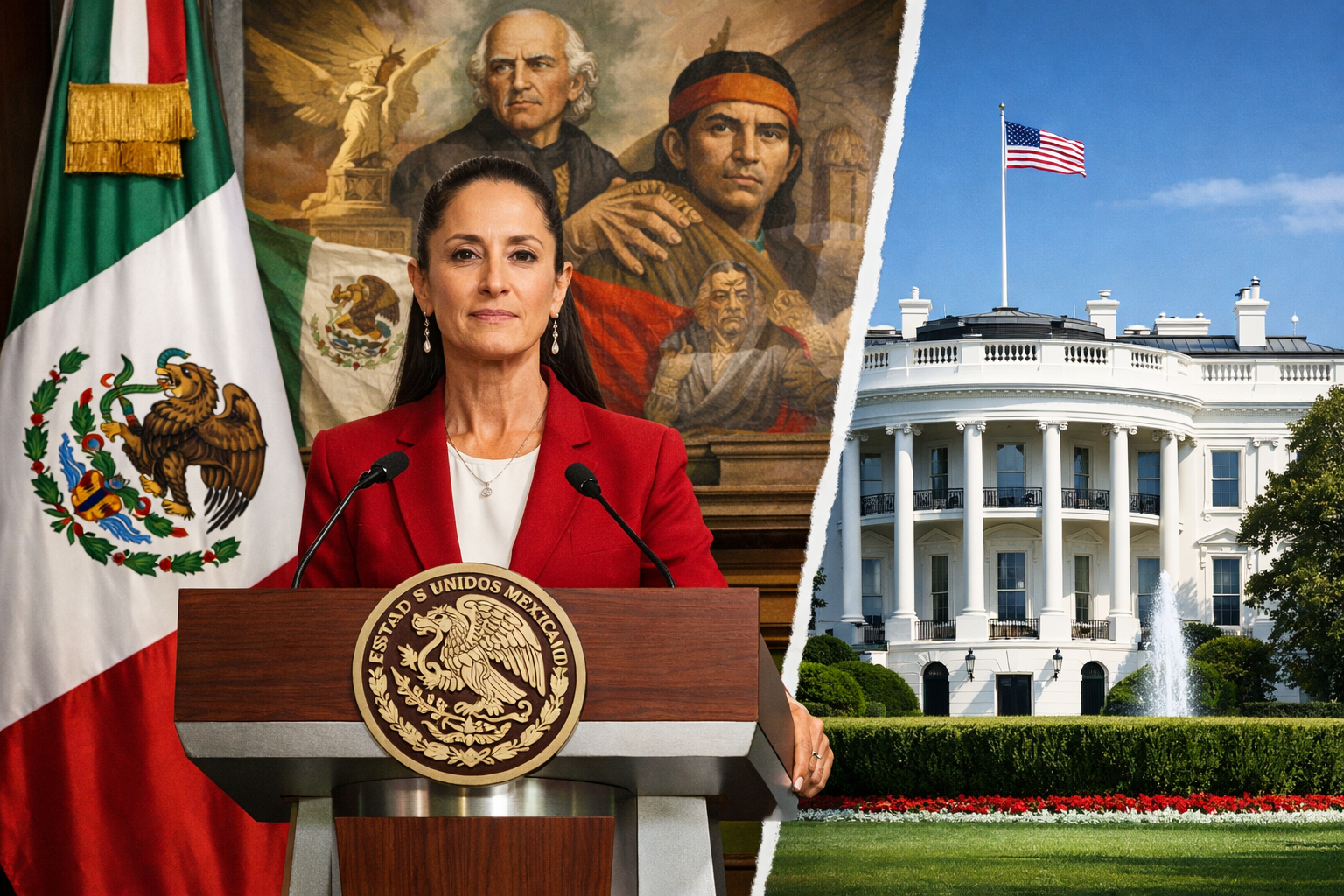
Mexican President Claudia Sheinbaum didn’t let the historical revisionism pass without response. In a direct challenge to the Trump administration’s framing, she emphasized Mexico’s sovereignty and reminded the U.S. president: “we have to defend sovereignty.”[1]
Sheinbaum’s response is significant for several reasons:
It connects past to present: By invoking sovereignty in response to historical revisionism, she’s highlighting how distorted history enables current aggression.
It asserts equal standing: Mexico won’t accept a narrative that frames its defeat as America’s “legendary victory” without acknowledging the imperialism involved.
It signals resistance: The statement warns that Mexico won’t passively accept either historical distortion or contemporary interventions justified by that distortion.
The Contemporary Context: Why This Matters Now
The White House statement didn’t emerge in a vacuum. It coincides with what observers describe as Trump administration interventions in Latin America “not seen in decades,” including:
- Deposing Venezuela’s president
- Meddling in Latin American elections
- Threatening military action in Mexico
- Aggressive economic pressure throughout the region[1]
By reframing the Mexican-American War as a “legendary victory” rather than imperial aggression, the administration creates rhetorical cover for these contemporary actions. If the 1846 conquest was heroic, why shouldn’t similar assertions of U.S. power be celebrated today?
This is precisely what makes historical accuracy so important. The past isn’t just about what happened—it’s about what we’re willing to do in the future.
A Broader Pattern: Rewriting Federal History Across Government
The Mexican-American War statement represents just one piece of a larger administration effort to reshape how the federal government presents American history. In 2026, the Trump administration has undertaken systematic revisions under the banner of “restoring truth and sanity to American history.”[1]
What’s Being Changed
Smithsonian Institution: The administration has ordered rewrites of historical exhibits and materials at the nation’s premier public history institution.[1]
Government websites: Federal agencies have scrubbed websites of history, legal records, and data deemed disagreeable to the administration’s narrative.[1]
Historical signage: References to slavery, destruction of Native American cultures, and climate change have been removed from federal sites and materials.[1]
The Information Control Playbook
This pattern should concern anyone who values government transparency and historical honesty:
- Identify inconvenient truths: Historical facts that complicate preferred narratives
- Remove or reframe: Delete information or present alternative versions
- Claim restoration: Frame censorship as correcting previous “bias”
- Justify current policy: Use revised history to support contemporary actions
For citizens in upstate New York and across the country, this raises urgent questions about government accountability. If federal agencies can simply erase historical facts they find politically inconvenient, what other information might they be hiding or distorting?
Why Historical Accuracy Matters for Democracy
Some might wonder: why does it matter how we describe a war from 178 years ago? The answer is fundamental to how democracy functions.
History Shapes Policy Debates
When policymakers and citizens debate foreign policy, they draw on historical precedents. If those precedents are distorted, the debate itself becomes corrupted. Accurate history provides:
- Honest assessment of past mistakes: Learning what didn’t work and why
- Understanding of consequences: Recognizing how actions affect other nations and peoples
- Moral grounding: Acknowledging when power was abused, not just celebrated
- Context for current challenges: Seeing how today’s problems connect to yesterday’s choices
Propaganda vs. Education
There’s a crucial difference between patriotic education and nationalist propaganda:
Patriotic education teaches the full story—achievements and failures, heroes and villains, progress and setbacks. It trusts citizens to love their country while understanding its flaws.
Nationalist propaganda presents a sanitized story designed to promote uncritical loyalty and justify current power structures. It treats citizens as subjects to be managed, not informed participants in democracy.
The White House statement on the Mexican-American War falls clearly into the second category.
What This Means for U.S.-Mexico Relations
The historical revisionism has real diplomatic consequences. Mexico is America’s largest trading partner, sharing a 2,000-mile border and deep cultural, economic, and family ties. Millions of Americans have Mexican heritage. Millions more depend on cross-border commerce for their livelihoods.
When the U.S. government glorifies a war that Mexicans remember as a traumatic loss of half their territory, it:
- Damages diplomatic trust: Making cooperation more difficult
- Inflames nationalist sentiment: Strengthening hardline voices in both countries
- Undermines regional stability: Creating tensions that affect immigration, trade, and security
- Disrespects shared history: Ignoring the complex, intertwined story of both nations
President Sheinbaum’s emphasis on defending sovereignty isn’t just rhetoric—it’s a necessary response to what Mexico perceives as historical and contemporary aggression.
The Role of Professional Historians in Democratic Society
The controversy highlights why professional historians matter in a democracy. Scholars like Aviña and Camarillo aren’t just academic experts—they’re guardians of factual accuracy against political manipulation.
What Historians Do
- Research primary sources: Original documents, letters, government records
- Challenge assumptions: Question inherited narratives and conventional wisdom
- Peer review: Subject findings to scrutiny by other experts
- Revise understanding: Update interpretations as new evidence emerges
- Educate the public: Share findings through teaching, writing, and public engagement
When government officials dismiss or ignore this scholarship, they’re not just disagreeing with individual professors—they’re rejecting the entire process of evidence-based historical inquiry.
Academic Freedom Under Pressure
The administration’s historical revisionism creates pressure on historians and educators:
- Will federal research funding be tied to producing “approved” narratives?
- Will museums and historical sites face pressure to change exhibits?
- Will teachers worry about presenting accurate history that contradicts official statements?
- Will students receive education or indoctrination?
These aren’t hypothetical concerns. The pattern of government website scrubbing and Smithsonian rewrites shows these pressures are already real in 2026.[1]
What Citizens Can Do: Defending Historical Truth
For readers in the Mohawk Valley and across upstate New York, this controversy might seem distant from daily concerns. But the principles at stake—government transparency, factual accuracy, democratic accountability—affect every community.
Immediate Actions
📚 Support local history education: Attend school board meetings to ensure accurate curriculum. Ask questions about what students are learning about American history, including difficult chapters.
🗣️ Demand transparency: Contact your congressional representatives (use house.gov and senate.gov to find contact information) and demand they oppose federal historical revisionism.
📰 Support fact-based journalism: Subscribe to outlets committed to factual reporting. Share accurate information on social media to counter propaganda.
🏛️ Visit historical sites: Museums, historic landmarks, and cultural institutions need public support to resist political pressure. Your attendance and donations matter.
🎓 Engage with historians: Read books and articles by professional historians. Attend public lectures at local colleges and universities.
Longer-Term Civic Engagement
Vote for transparency: Support candidates who commit to government accountability and honest historical education, regardless of party.
Build coalitions: Connect with organizations defending academic freedom, museum integrity, and educational standards.
Teach the next generation: Share accurate history with young people in your life. Encourage critical thinking about sources and claims.
Document the present: Today’s events are tomorrow’s history. Keep records, save documents, and preserve evidence of what’s happening in 2026.
The Stakes: Democracy Requires Honest History
At its core, this controversy about the Mexican-American War isn’t really about 1846. It’s about 2026—and beyond.
Can a democracy function when its government systematically distorts history? The answer is no. Democratic citizenship requires informed participation. If citizens can’t trust basic historical facts from their government, how can they make sound decisions about current policies?
Can international relations succeed when built on historical lies? Again, no. Mexico and other Latin American nations have their own histories and memories. American revisionism doesn’t erase their experiences—it just damages trust and cooperation.
Can we learn from past mistakes if we deny they happened? Never. The Mexican-American War offers important lessons about the costs of imperialism, the dangers of territorial expansion driven by slavery, and the long-term consequences of treating neighboring nations as inferior. Erasing those lessons doesn’t make them irrelevant—it just makes us more likely to repeat the mistakes.
Conclusion: Truth Matters
Historians and observers have accused the Trump administration of rewriting history regarding the Mexican-American War, calling it a “historically inaccurate” portrayal to justify foreign policy actions in Latin America. The White House referred to the Mexican-American War as a “legendary victory” without mentioning slavery’s role, which has drawn criticism from historians like Alexander Aviña. Aviña emphasized that the White House’s framing is an example of U.S. imperialism, contrasting it with how political leaders have viewed the war as a negative part of history. Mexican President Claudia Sheinbaum responded by emphasizing Mexico’s sovereignty, reminding Trump that, “we have to defend sovereignty.”[1]
This isn’t just an academic debate—it’s a test of whether factual accuracy still matters in American public life.
The good news is that truth has powerful defenders: professional historians committed to evidence-based research, journalists dedicated to factual reporting, educators teaching critical thinking, and citizens who refuse to accept propaganda as history.
The challenge for 2026 and beyond is clear: Will we demand honest history from our government, or will we accept convenient fictions? Will we learn from past mistakes, or will we erase them? Will we respect our neighbors’ sovereignty and experiences, or will we impose self-serving narratives?
These choices belong to all of us. Democracy isn’t a spectator sport—it requires active, informed participation. That starts with insisting on historical truth, even when it’s uncomfortable.
Your voice matters. Contact your representatives. Support honest education. Share factual information. Engage with your community. The history we preserve today shapes the democracy our children inherit tomorrow.
References
[1] Trump Accused Distorting History Mexican American War Justify 129832633 – https://abcnews.go.com/International/wireStory/trump-accused-distorting-history-mexican-american-war-justify-129832633
[2] B4mdfrzktu26npcwagz5aze3va – https://www.wpxi.com/news/world/trump-accused/B4MDFRZKTU26NPCWAGZ5AZE3VA/
[3] B4mdfrzktu26npcwagz5aze3va – https://www.kiro7.com/news/world/trump-accused/B4MDFRZKTU26NPCWAGZ5AZE3VA/
[4] B4mdfrzktu26npcwagz5aze3va – https://www.wdbo.com/news/world/trump-accused/B4MDFRZKTU26NPCWAGZ5AZE3VA/
[5] 2b48c697d4c93dfa8e8d3245f75e7110 – https://www.compuserve.com/news/world/story/0001/20260203/2b48c697d4c93dfa8e8d3245f75e7110
[6] B4mdfrzktu26npcwagz5aze3va – https://www.wgauradio.com/news/world/trump-accused/B4MDFRZKTU26NPCWAGZ5AZE3VA/


