


When a political figure who’s shaped American legislation for decades suddenly checks into a hospital, it raises questions that extend beyond partisan politics. Republican Kentucky Sen. Mitch McConnell was hospitalized Monday evening after experiencing flu-like symptoms, a spokesperson for the former Senate majority leader announced Tuesday. McConnell spokesman David Popp said the Kentucky Republican is receiving medical care in a local hospital and clarified that his “prognosis is positive.” McConnell, 83, missed votes Monday and Tuesday—a notable absence for someone who built a reputation on legislative discipline and attendance.
For those of us watching from upstate New York, this story matters beyond Washington insider baseball. It’s about accountability, transparency, and what happens when our elected officials face health challenges that could affect their ability to represent constituents. Whether you lean left, right, or somewhere in the middle, understanding the health of our nation’s lawmakers helps us make informed decisions about representation and governance.
Key Takeaways
- McConnell hospitalized Monday evening after experiencing flu-like symptoms over the weekend, with his office reporting a “positive prognosis”[1][2]
- The 83-year-old senator missed critical Senate votes on Monday and Tuesday, remaining in contact with staff from the hospital[1][2]
- Previous health scares raise concerns about age and fitness for office, including multiple falls and freezing episodes in recent years[2][3]
- McConnell has already announced retirement plans, having stepped down as Senate GOP leader last year after decades of leadership[1][2]
- Transparency about elected officials’ health remains crucial for constituent trust and government accountability
What Happened: The Timeline of McConnell’s Hospitalization
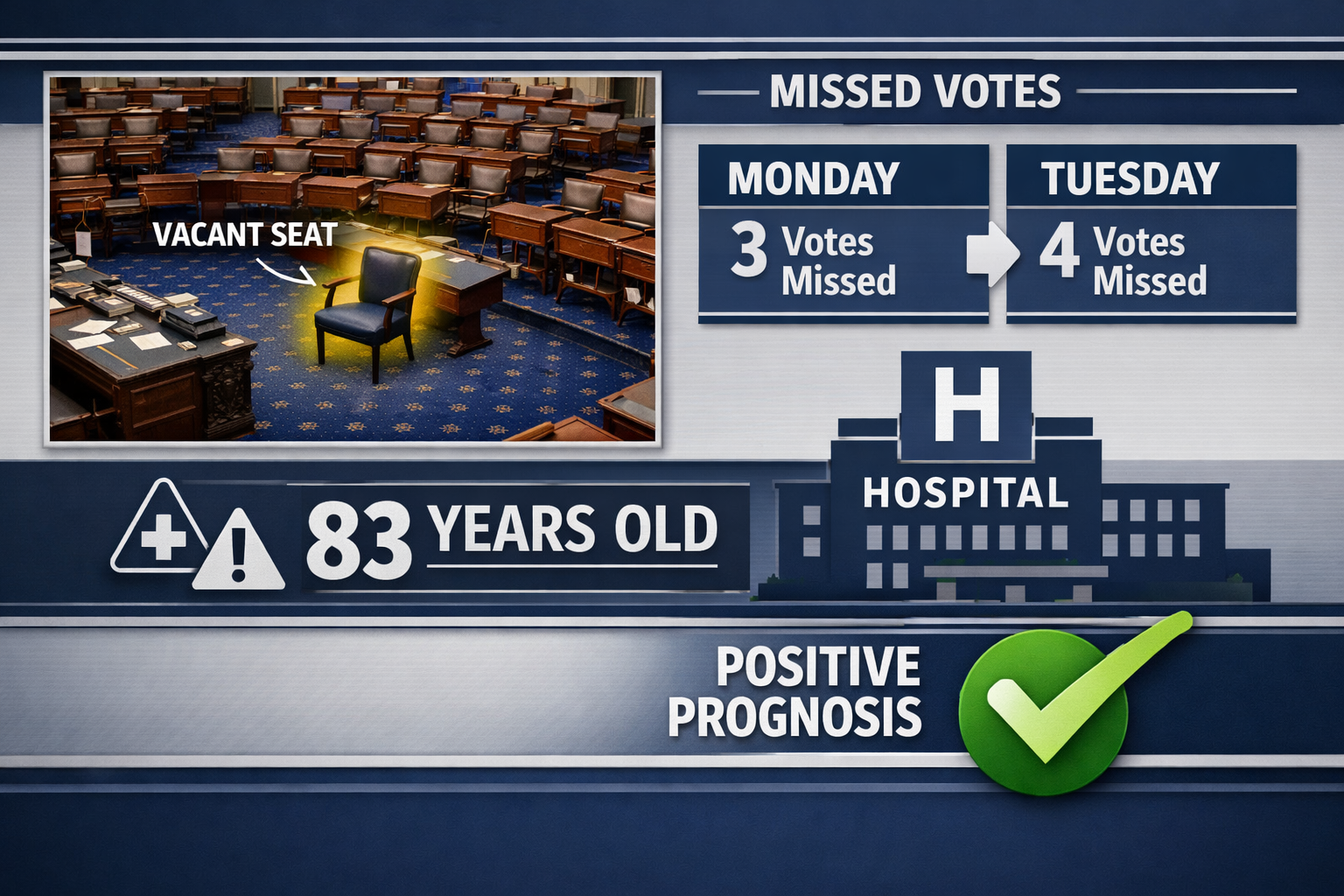
The sequence of events began over the weekend when McConnell started experiencing symptoms that resembled the flu. By Monday evening, the Kentucky senator made the decision to check himself into a local hospital for evaluation—a move his office described as taken “in an abundance of caution.”[1][2]
Here’s what we know about the hospitalization:
- McConnell experienced flu-like symptoms over the weekend
- He checked into a local hospital Monday evening for medical evaluation
- The senator missed Senate votes on both Monday, February 2 and Tuesday, February 3, 2026
- His spokesperson David Popp confirmed McConnell is “grateful for the excellent care he is receiving”[1][2]
- The office stated his prognosis is positive and he remains in regular contact with staff[1][2]
This isn’t the first time health concerns have sidelined the longtime senator. At 83 years old, McConnell represents a generation of political leaders whose age and health have become legitimate topics of public discourse—not as ageist attacks, but as practical considerations about fitness for the demanding responsibilities of national office.
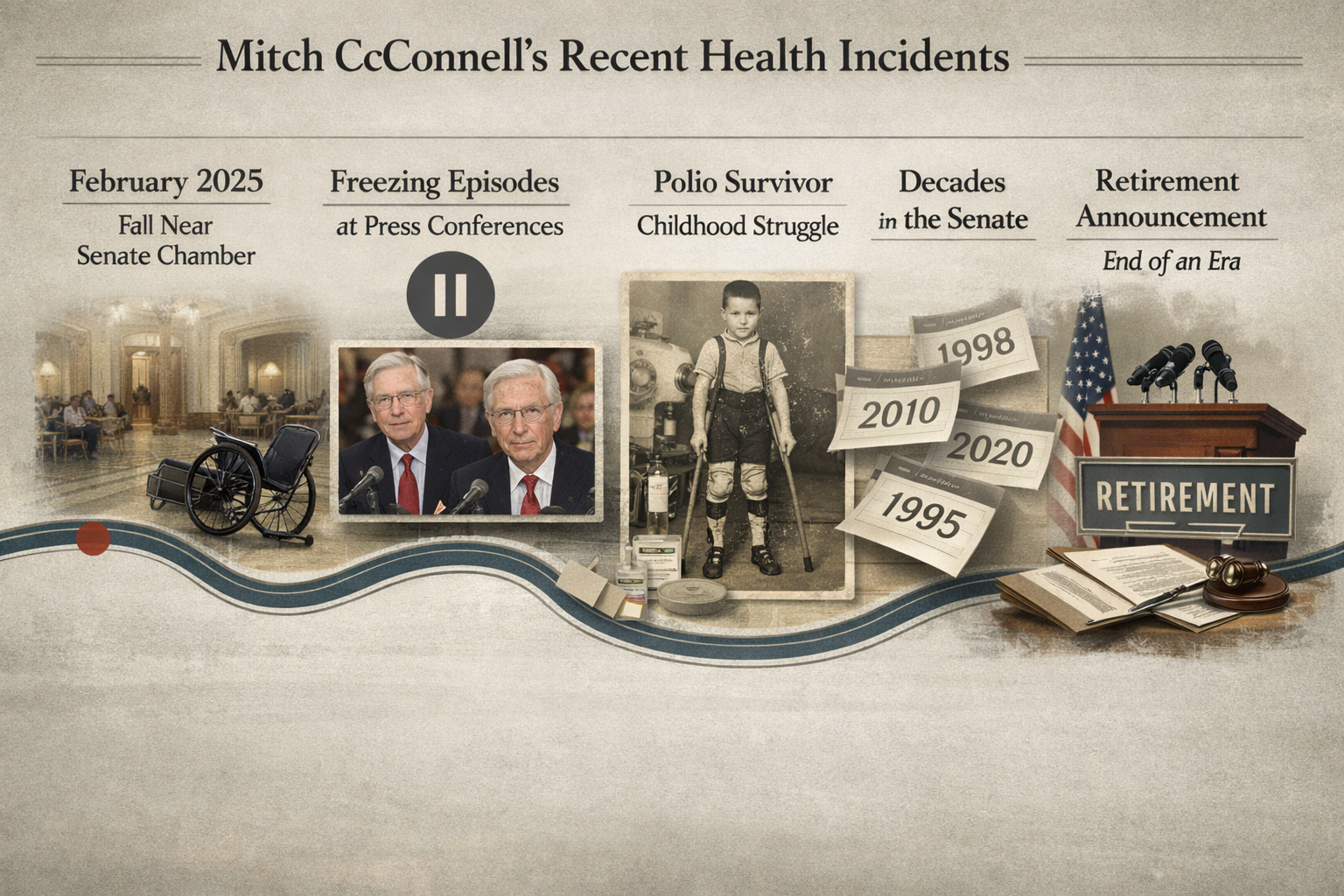
The senator is a childhood polio survivor, which left lasting effects on his left leg.[2] While he’s managed this condition throughout his entire political career, it provides important context for understanding his recent mobility challenges.
McConnell’s Recent Health Scares and Their Implications
The current hospitalization doesn’t exist in isolation. Over the past year, McConnell has experienced several concerning health incidents that have raised questions about his ability to continue serving effectively.
The 2025 Falls and Mobility Issues
In February 2025, McConnell suffered two separate falls that sent warning signals through the Capitol. He slipped and fell near the Senate chamber, and then fell again during a Republican conference lunch.[2] Following these incidents, he used a wheelchair as a precautionary measure—a wise decision that nonetheless highlighted his vulnerability.
These weren’t minor stumbles. For an 83-year-old with a history of polio affecting his mobility, falls represent serious risks for fractures, head injuries, and complications that could prove life-threatening.
The Freezing Episodes
Perhaps even more concerning were the episodes where McConnell appeared to freeze during press conferences.[2][3] These moments, captured on camera and widely circulated, showed the senator becoming suddenly silent and motionless mid-sentence before being assisted by colleagues.
Medical experts who observed the footage suggested various possible explanations, from transient ischemic attacks (mini-strokes) to seizure activity or medication side effects. McConnell’s office never provided detailed medical explanations for these episodes, citing privacy—a position that’s legally defensible but leaves constituents with legitimate unanswered questions.
Why This Matters for Government Transparency
Here’s where progressive values intersect with practical governance concerns: voters deserve to know if their elected representatives can physically and mentally perform the duties they were elected to fulfill.
This isn’t about discrimination against older Americans. Many people in their 80s maintain sharp minds and robust health. It’s about accountability and transparency. When someone holds significant power over legislation affecting healthcare access, workers’ rights, and economic policy, their capacity to execute those responsibilities becomes a matter of public interest.
The same standard should apply regardless of party affiliation. Progressive voters who rightfully questioned concerns about President Biden’s age should apply consistent principles when evaluating any elected official’s fitness for office.
Understanding the Political Context: McConnell’s Legacy and Transition
To fully grasp the significance of this hospitalization, we need to understand McConnell’s role in American politics and his current transition out of power.
From Majority Leader to Backbencher
McConnell stepped down as Senate GOP leader last year, ending one of the most consequential leadership tenures in modern Senate history.[1][3] Love him or hate him—and progressives have plenty of legitimate reasons for the latter—McConnell fundamentally reshaped how the Senate operates.
His legacy includes:
- Blocking Merrick Garland’s Supreme Court nomination in 2016, fundamentally altering the Court’s ideological balance
- Confirming three conservative Supreme Court justices during the Trump administration
- Orchestrating legislative strategies that advanced conservative priorities while obstructing progressive legislation
- Mastering Senate procedural rules to maximize minority party power
From a progressive perspective, McConnell represents much of what’s broken in American governance: prioritizing partisan advantage over democratic norms, blocking popular legislation on voting rights and climate action, and enabling corporate interests over working families.
The Retirement Announcement
McConnell announced last year that he would end his decades-long Senate career, though he hasn’t specified exactly when he’ll leave office.[2] This decision came amid mounting health concerns and changing political dynamics within the Republican Party, where MAGA-aligned members have increasingly challenged establishment figures like McConnell.
His retirement raises important questions:
- Who will fill the leadership vacuum in Kentucky’s Republican politics?
- Will his successor continue his obstructionist approach to progressive legislation?
- How will his departure affect the balance of power in an already closely divided Senate?
For progressives in places like the Mohawk Valley, these questions matter because they affect our ability to advance policies on affordable housing, healthcare access, climate action, and economic justice.
What “Positive Prognosis” Really Means
Medical terminology can be vague, especially in political communications designed to reassure without revealing too much. When McConnell’s office says his “prognosis is positive,” what does that actually tell us?[1][2]
Decoding Medical Speak
A “positive prognosis” generally means doctors expect recovery without serious complications. For flu-like symptoms in an otherwise stable patient, this typically indicates:
- Symptoms are likely viral and self-limiting
- No evidence of severe complications like pneumonia or sepsis
- Expected recovery within days to weeks
- Hospitalization is precautionary rather than emergency treatment
However, at 83 years old with a history of falls and neurological concerns, even “simple” flu can pose serious risks. Older adults face higher rates of flu-related complications, including pneumonia, dehydration, and exacerbation of underlying conditions.
The Transparency Question
McConnell’s office has provided minimal details about his condition, which is their right under medical privacy laws. But there’s a tension between personal privacy and public accountability that’s never fully resolved for elected officials.
Progressive advocates for government transparency argue:
- Voters deserve basic information about whether their representatives can perform their duties
- Vague reassurances without substantive details erode public trust
- A culture of secrecy around elected officials’ health enables situations where incapacitated leaders remain in power
- Clear, honest communication respects voters’ intelligence and right to make informed decisions
The Broader Conversation About Age and Leadership
McConnell’s hospitalization reignites an uncomfortable but necessary conversation about age, capacity, and political leadership in America.
The Gerontocracy Problem
The United States has the oldest political leadership in its history. The average age of senators is 64 years old, with many key committee chairs and party leaders well into their 70s and 80s. This creates several challenges:
Representation gaps: Older leaders may not fully grasp the urgent concerns of younger generations on climate change, student debt, and economic opportunity.
Health vulnerabilities: Age-related health issues can impair judgment, energy, and availability—affecting legislative effectiveness.
Succession planning failures: Political parties often lack clear mechanisms for gracefully transitioning power from aging leaders to the next generation.
Blocked advancement: When senior leaders cling to power, talented younger politicians can’t advance, creating bottlenecks in leadership development.
Finding the Balance
Progressives face a delicate challenge here. We rightfully oppose ageism and value the wisdom and experience that comes with age. Many of our most effective advocates—Bernie Sanders, Elizabeth Warren, and others—are older Americans who bring decades of expertise to their work.
But we can oppose ageist stereotypes while still acknowledging that age-related health decline is real and affects job performance. The solution isn’t arbitrary age limits, but rather:
✅ Robust transparency requirements for elected officials’ health status
✅ Regular, independent medical evaluations for officeholders above certain ages
✅ Cultural shifts that make retirement honorable rather than shameful
✅ Term limits or age-based transition plans that ensure fresh perspectives
✅ Stronger succession planning within political parties
What This Means for Kentucky Constituents and Beyond
For Kentuckians who elected McConnell to represent their interests, his hospitalization raises practical questions about constituent services and representation.
Immediate Impact on Senate Business
McConnell’s absence from Monday and Tuesday votes meant Kentucky had reduced representation during those legislative sessions.[2] While he remained in contact with staff, hospitalized senators can’t participate in floor debates, negotiate with colleagues, or cast votes on behalf of their constituents.
In a closely divided Senate where every vote matters, even brief absences can affect legislative outcomes on issues ranging from judicial confirmations to budget resolutions.
Long-Term Representation Questions
If McConnell’s health continues to decline, Kentucky voters deserve to know whether he can effectively serve out his term. This isn’t partisan point-scoring—it’s basic accountability.
Constituents should ask:
- Is the senator physically able to attend sessions and votes?
- Can he travel to Kentucky to meet with constituents?
- Is he mentally sharp enough to negotiate complex legislation?
- Are staff members effectively running the office without proper oversight?
These questions apply equally to politicians of any party affiliation. Progressive values demand transparency and accountability from all elected officials, not just those we disagree with politically.
Lessons for Upstate New York and the Mohawk Valley
You might wonder why a progressive news outlet serving Utica and the Mohawk Valley should care about a conservative Kentucky senator’s health. Here’s why it matters locally:
National Politics Affects Local Communities
McConnell’s legislative decisions have directly impacted working families in upstate New York:
- His opposition to infrastructure investment delayed funding for roads, bridges, and broadband access in rural communities
- His blocking of voting rights legislation affects election integrity nationwide, including in Oneida County
- His judicial confirmations shaped courts that rule on workers’ rights, environmental protections, and healthcare access
- His tax policies favored corporations over working families struggling with the cost of living
Understanding the health and capacity of national leaders helps us advocate more effectively for local priorities.
Building a Culture of Accountability
The standards we apply to national figures should mirror what we demand from local government in Utica, Rome, New Hartford, and throughout the Mohawk Valley:
🔍 Transparency about officials’ ability to serve
📊 Regular communication with constituents
⚖️ Accountability when performance falls short
🗳️ Informed voting based on complete information
When we normalize vague health updates and secretive medical situations at the national level, it becomes harder to demand transparency from our town councils, school boards, and county legislators.
Preparing for Generational Leadership Transitions
The Mohawk Valley, like much of America, needs to prepare for significant generational transitions in leadership. Many of our longtime local officials are approaching retirement age. McConnell’s situation reminds us to:
- Actively recruit and support younger candidates for local office
- Create mentorship programs connecting experienced leaders with emerging voices
- Establish clear succession plans in local government
- Make civic participation accessible to working families who can’t attend daytime meetings
What Happens Next: Monitoring McConnell’s Recovery and Return
As of this writing, McConnell remains hospitalized with a positive prognosis.[1][2] His office has indicated he looks forward to returning to Senate business, but hasn’t provided a specific timeline.
What to Watch For
Short-term indicators:
- Length of hospitalization (routine flu typically doesn’t require multi-day hospital stays)
- Whether he returns to voting and committee work
- Any additional health updates from his office
- His physical appearance and mobility upon return
Long-term considerations:
- Whether this becomes a pattern of recurring health issues
- His effectiveness in fulfilling Senate duties
- Any decisions about early retirement
- Kentucky’s preparation for succession
The Role of Media Coverage
Responsible journalism requires balancing respect for privacy with the public’s right to information. Media outlets should:
✓ Report confirmed facts from official sources
✓ Provide medical context without speculation
✓ Hold officials accountable for transparency
✓ Avoid sensationalism while taking health concerns seriously
✓ Connect individual health stories to broader systemic issues
Taking Action: What Citizens Can Do
Even if you’re not a Kentucky constituent, McConnell’s situation offers opportunities for civic engagement and advocacy.
For Kentucky Residents
📞 Contact McConnell’s office to ask for regular health updates and ensure constituent services continue
📧 Reach out to Kentucky’s other senator to ensure the state has full representation
🗳️ Research potential successors and their positions on issues affecting working families
📰 Support local Kentucky journalism that holds elected officials accountable
For Citizens Nationwide
✍️ Advocate for transparency requirements for elected officials’ health status
🗣️ Support candidates who commit to regular health disclosures
📊 Engage with legislation on age, term limits, and succession planning
🤝 Build coalitions across party lines on government accountability issues
For Mohawk Valley Residents
🏛️ Apply these standards locally by demanding transparency from Utica, Oneida County, and regional officials
👥 Attend town hall meetings and ask about succession planning
📢 Support local journalism like Mohawk Valley Voice that prioritizes accountability
🌱 Mentor younger community members interested in public service
🗳️ Vote in every election—local, state, and federal—with full information about candidates’ capacity to serve
Conclusion: Health, Transparency, and the Future of Representative Democracy
Republican Kentucky Sen. Mitch McConnell’s hospitalization Monday evening after experiencing flu-like symptoms reminds us that our elected officials are human beings subject to the same health vulnerabilities as anyone else. While his spokesperson’s announcement that his “prognosis is positive” offers reassurance, the incident raises larger questions about transparency, accountability, and the aging of American political leadership.[1][2]
McConnell, 83, who missed votes Monday and Tuesday, has already announced plans to end his decades-long Senate career.[2] His recent health scares—including multiple falls and freezing episodes—suggest those plans may be wise. Whether you view his legislative legacy as masterful strategy or destructive obstruction depends on your political perspective, but his impact on American governance is undeniable.
From a progressive standpoint, this situation demands we apply consistent principles: transparency about elected officials’ health, accountability for effective representation, and honest conversations about age and capacity in leadership roles. These standards should apply to politicians of all parties, from McConnell to any progressive leader facing similar challenges.
For those of us in the Mohawk Valley working to build stronger, more responsive local government, the lessons are clear. We need to cultivate the next generation of leaders, demand transparency from current officeholders, and create systems that allow for graceful transitions when health or age affects someone’s ability to serve.
The path forward requires:
- Honest assessment of leaders’ capacity to serve, regardless of party
- Robust transparency requirements balanced with personal dignity
- Investment in developing younger leaders at all levels of government
- Cultural shifts that honor retirement as a natural transition, not a failure
- Consistent application of accountability standards across the political spectrum
As McConnell recovers and we await updates on his condition, let’s use this moment to strengthen our commitment to transparent, accountable, and effective representative democracy—from Washington to Utica and everywhere in between.
The health of individual politicians matters, but the health of our democratic institutions matters more. By demanding transparency, supporting emerging leaders, and staying engaged in civic life, we can build a political system that serves working families, protects vulnerable communities, and creates opportunity for all—no matter who’s in the hospital or who’s in office.
References
[1] Mitch Mcconnell Hospitalized Flu Like Symptoms – https://www.ktvu.com/news/mitch-mcconnell-hospitalized-flu-like-symptoms
[2] Mitch Mcconnell Hospitalized After Experiencing Flu Like Symptoms Senate Votes Hospital Health Scares – https://abc7amarillo.com/news/nation-world/mitch-mcconnell-hospitalized-after-experiencing-flu-like-symptoms-senate-votes-hospital-health-scares
[3] Watch – https://www.youtube.com/watch?v=7Us3HL4J2-A


