


When a global food and beverage giant reports better-than-expected earnings while simultaneously cutting prices and eliminating one-fifth of its products, something significant is happening beneath the surface. On Feb. 3, PepsiCo, Inc. released fourth-quarter results reporting adjusted EPS of $2.26, surpassing the $2.24 per share analysts expected—yet the company’s stock fell in premarket trading as investors digested the complicated reality behind those numbers. The company cited volume declines in North America as global food volume fell 2%, while organic revenue rose 2.1% in the quarter, painting a picture of a corporation at a crossroads between profitability and consumer accessibility.
For working families in Utica and across the Mohawk Valley who’ve watched grocery prices climb relentlessly over the past few years, PepsiCo’s fourth-quarter performance reveals both the problem and a potential path forward. The company’s financial maneuvering—beating Wall Street expectations while acknowledging serious volume challenges—reflects broader economic tensions affecting Main Street economics nationwide.
Key Takeaways
- PepsiCo exceeded earnings expectations with adjusted EPS of $2.26 versus the $2.24 consensus, though shares fell over 1% as volume declines raised concerns about long-term growth
- Volume challenges persist with North American food volume dropping 2% and global food volume declining 2%, despite net sales rising 5.6% to $29.34 billion
- Major restructuring underway including elimination of nearly 20% of products, price reductions, and closure of three manufacturing plants following pressure from activist investor Elliott Investment Management
- Innovation and affordability initiatives aim to balance premium offerings with value-tier products to address consumer pushback against years of double-digit price increases
- 2026 outlook remains cautious with organic revenue projected at 2% to 4% growth and core constant-currency EPS growth of 4% to 6%, signaling modest expectations amid economic uncertainty
Breaking Down PepsiCo’s Fourth-Quarter Performance
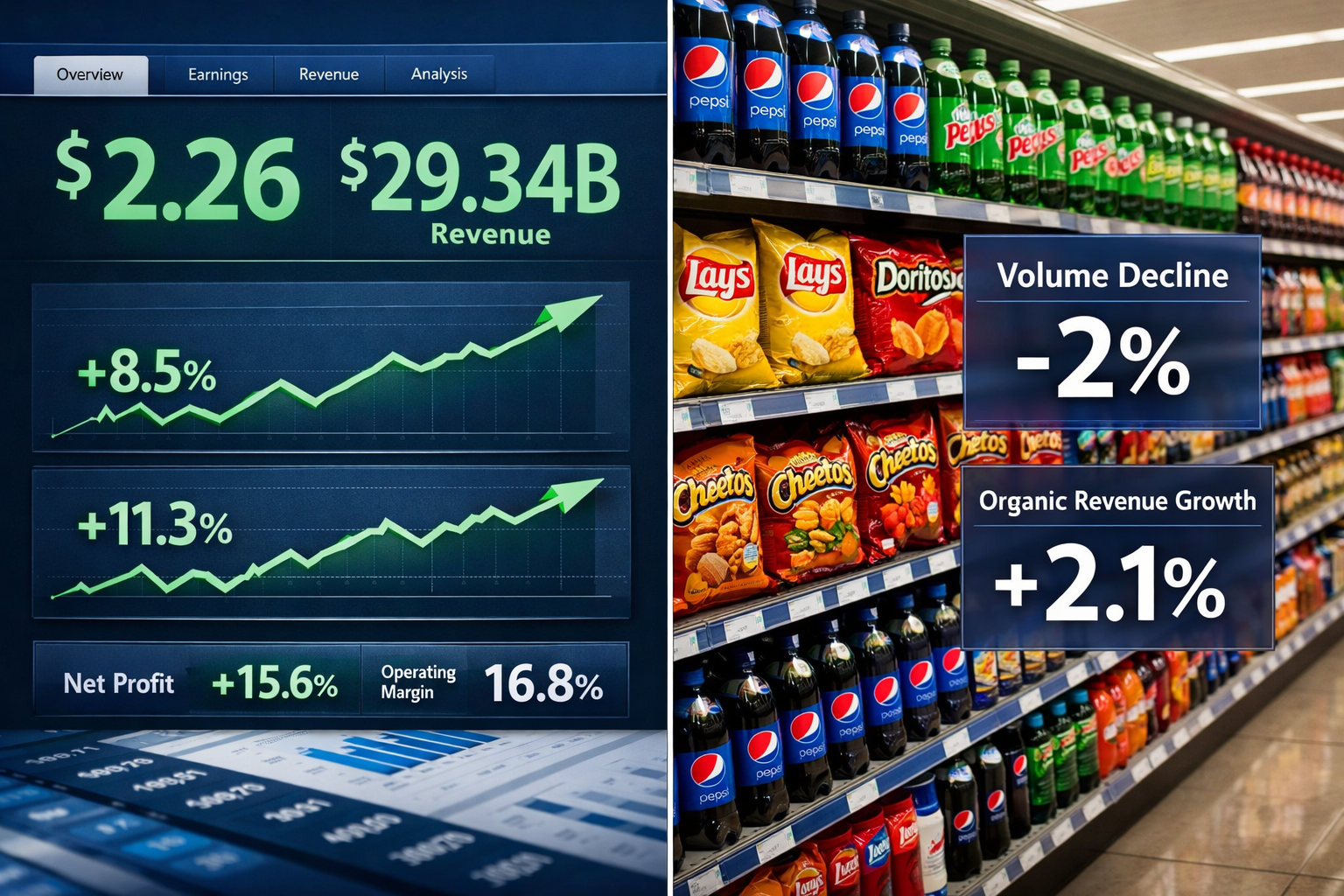
On the numbers front, net sales rose 5.6% to $29.34 billion, beating the $28.97 billion consensus, while net income reached $2.54 billion with earnings per share at $1.85. These figures tell a story that’s become increasingly common in corporate America: companies can still generate impressive revenue growth even as actual consumer demand softens.
The disconnect matters because it reveals how pricing power—not increased sales volume—has driven profitability. For the past several years, PepsiCo and other major food manufacturers have implemented double-digit price increases that outpaced inflation, boosting revenue while selling fewer actual products[1]. This strategy worked temporarily, but the fourth-quarter results show consumers reaching their breaking point.
Volume declines across key categories signal that price-conscious shoppers are trading down to cheaper alternatives or simply buying less. The 2% drop in global food volume represents real people making real decisions at checkout counters—decisions that disproportionately affect working families already stretched thin by housing costs, healthcare expenses, and stagnant wages.
Market Reaction and Investor Concerns
Market reaction showed shares fell more than 1% in premarket trading as PepsiCo reiterated its 2026 outlook with organic revenue projection of 2% to 4% and core constant-currency EPS projection of 4% to 6%. Wall Street’s tepid response reflects concern that the company’s growth engine is sputtering despite strong headline numbers.
Investors understand that sustainable growth requires volume growth, not just price increases. When a company reports rising revenue alongside falling volume, it’s essentially admitting it’s squeezing more money from fewer customers—a strategy with obvious limitations. Eventually, prices hit a ceiling where consumers refuse to pay more, forcing companies to either reduce prices or watch market share evaporate.
This dynamic has profound implications for economic inequality and workers’ rights. When corporations prioritize short-term profit maximization through aggressive pricing, they effectively transfer wealth from working-class consumers to wealthy shareholders. The families buying Doritos and Pepsi at convenience stores in Rome and New Hartford aren’t the same people benefiting from stock price appreciation.
The Elliott Investment Management Factor: Activist Pressure Drives Change
The fourth-quarter results can’t be understood without examining the pressure campaign that preceded them. Elliott Investment Management, a powerful activist investor, took a $4 billion stake in PepsiCo in September 2025 and immediately began pushing for dramatic changes[1].
Elliott’s critique was blunt: PepsiCo had been “hurt by a lack of strategic clarity, decelerating growth and eroding profitability in its North American food and beverage businesses”[1]. This wasn’t gentle shareholder feedback—it was a direct challenge to management’s competence and strategy.
The Restructuring Plan: Cost-Cutting and Product Elimination
In response to Elliott’s pressure, PepsiCo announced plans on December 8, 2025 to reduce prices and eliminate approximately 20% of its products by early 2026[1]. The company is reducing nearly 20% of SKUs (stock keeping units) in the U.S. by early 2026, a massive consolidation that will reshape grocery store shelves nationwide[1].
This product rationalization makes business sense from an efficiency standpoint—fewer SKUs mean simplified manufacturing, reduced inventory costs, and streamlined distribution. But it also represents job losses and community disruption. PepsiCo has already closed three manufacturing plants and shut several manufacturing lines in 2025 to drive operational efficiency[1].
For communities dependent on manufacturing jobs—including many in upstate New York and the broader Rust Belt—these closures represent real economic pain. When a PepsiCo plant closes, it doesn’t just eliminate direct employment; it ripples through the local economy, affecting suppliers, service providers, and retail businesses that depend on workers’ paychecks.
“The company committed to implementing ‘sharper everyday value through a targeted approach on affordable price tiers by brand and channel’ to stimulate growth”[1]
This commitment to affordability and value represents a significant strategic shift. After years of prioritizing premium pricing and profit margins, PepsiCo is acknowledging that it pushed too hard and alienated price-sensitive consumers.
Price Reductions and Value Strategies: Too Little, Too Late?
PepsiCo had previously tried to combat perceptions that its products are “too expensive” by expanding distribution of value brands like Chester’s and Santitas as of July 2025[1]. These budget-friendly options were designed to retain customers trading down from premium brands like Lay’s and Doritos.
The strategy reflects a fundamental tension in modern capitalism: companies want to serve both affluent consumers willing to pay premium prices and working-class families seeking basic affordability. Threading that needle requires maintaining distinct product tiers—a challenge when your brand identity has been built on premium positioning.
The company acknowledged that “years of double-digit price increases and changing customer preferences have weakened demand for its drinks and snacks” (referenced from February 2025)[1]. This admission is significant because it acknowledges corporate responsibility for declining volumes rather than blaming external factors like inflation or supply chain disruptions.
Innovation Meets Accessibility
PepsiCo is attempting to balance affordability with innovation by elevating “permissible and functional offerings” that remove artificial colors and flavors, provide simpler ingredients, and include more protein, fiber, and whole grains[1]. Recent introductions include Simply NKD Cheetos and Doritos with restaging of Lay’s and Tostitos, plus a planned 2026 launch of Doritos Protein[1].
These healthier, cleaner-label products respond to genuine consumer demand for better nutrition and transparency. But they also typically command higher prices, potentially creating a two-tier food system where wealthy consumers access healthier options while working families are steered toward cheaper, less nutritious alternatives.
This dynamic raises important questions about food justice and economic equity. Should access to minimally processed, nutritious snacks be a luxury good, or should it be universally accessible? When companies like PepsiCo develop healthier products primarily for premium market segments, they reinforce existing health disparities rooted in income inequality.
The Technology Partnership: Siemens and NVIDIA Collaboration
In retail contexts, PepsiCo’s visibility on shelves in San Anselmo, California, remains evident despite recent sales growth, supported by its Jan. 6 collaboration with Siemens and NVIDIA. This partnership represents PepsiCo’s bet on digital transformation and artificial intelligence to optimize manufacturing and distribution.
The Siemens and NVIDIA collaboration focuses on using advanced AI and industrial automation to improve operational efficiency, reduce waste, and better match production with real-time demand. In theory, these technologies could help PepsiCo reduce costs without eliminating as many jobs—automating repetitive tasks while retraining workers for higher-skilled positions.
However, the reality of workforce development in corporate restructurings rarely matches the optimistic rhetoric. When companies invest in automation, displaced workers often lack access to meaningful retraining programs or comparable employment opportunities. The promised transition from assembly line work to high-tech jobs frequently fails to materialize, leaving communities struggling with unemployment and economic decline.
For progressive advocates concerned about workers’ rights and economic justice, the PepsiCo-Siemens-NVIDIA partnership highlights the urgent need for policies that ensure technology serves workers rather than replacing them. This includes:
- Strong labor protections guaranteeing severance, retraining, and job placement assistance for displaced workers
- Community investment requirements ensuring companies contribute to local economic development when closing facilities
- Worker voice in automation decisions through union representation and stakeholder consultation
- Tax policies that capture productivity gains from automation and redistribute them through public investment
What PepsiCo’s Strategy Means for the Mohawk Valley
While PepsiCo doesn’t have major manufacturing facilities in the immediate Mohawk Valley region, the company’s strategic direction has direct implications for local consumers, workers, and small businesses throughout Utica, Rome, and Oneida County.
Impact on Local Grocery Prices and Consumer Choice
The commitment to price reductions and value-tier products could provide genuine relief for working families facing persistent food insecurity and budget constraints. If PepsiCo follows through on making Chester’s, Santitas, and other affordable brands more widely available, local grocery stores and convenience stores could offer better options for price-conscious shoppers.
However, the elimination of 20% of products also means reduced choice and potential disruption for consumers who prefer discontinued items. Small independent retailers may face challenges as product availability shifts and promotional programs change.
Lessons for Local Economic Development
PepsiCo’s experience offers important lessons for economic development strategies in upstate New York and similar regions:
- Over-reliance on corporate decision-making leaves communities vulnerable to sudden plant closures and restructurings driven by distant shareholders
- Diversified local economies with strong small business sectors and worker cooperatives provide more resilience than dependence on large corporate employers
- Investment in workforce skills must anticipate technological change rather than react to it after jobs have already disappeared
- Community ownership models like community land trusts and municipal enterprises can provide economic stability that purely private corporations cannot
The Mohawk Valley has experienced these dynamics repeatedly as manufacturing jobs have declined over recent decades. PepsiCo’s current restructuring is part of a broader pattern affecting the entire Erie Canal corridor and Rust Belt region.
Looking Ahead: PepsiCo’s 2026 Outlook and Economic Implications
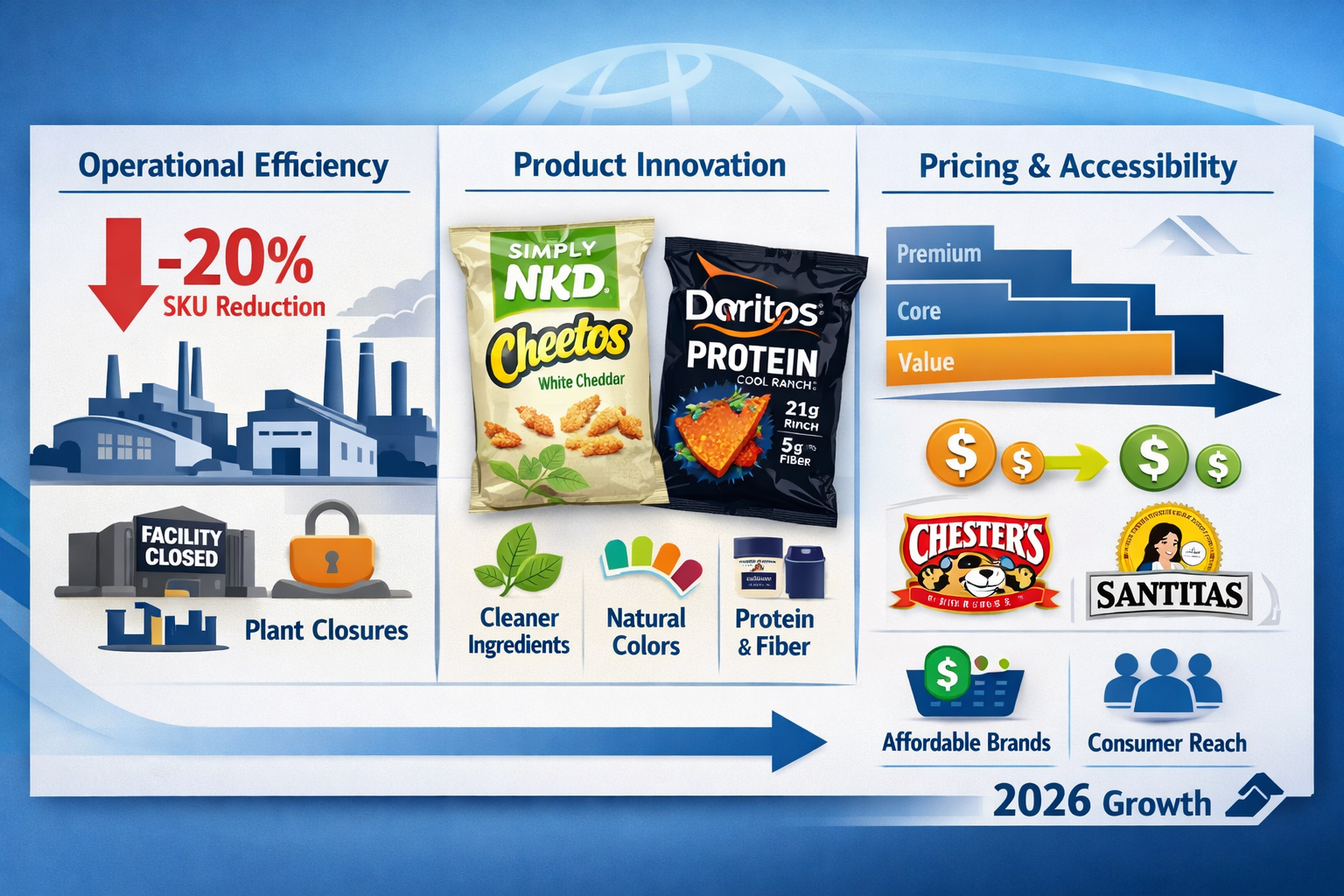
PepsiCo’s reiterated 2026 outlook projects organic revenue growth of 2% to 4% and core constant-currency EPS growth of 4% to 6%—modest targets that reflect economic uncertainty and competitive pressures. The company aims to “accelerate organic revenue growth, deliver record productivity savings and improve core operating margin—starting in 2026″[1].
Elliott and PepsiCo management have committed to a comprehensive review of PepsiCo’s North America supply chain and go-to-market systems[1], suggesting further changes ahead. This ongoing evaluation could lead to additional plant closures, distribution consolidation, or strategic divestitures.
The Productivity Paradox
The initiative aims to aggressively reduce operating costs, with savings directed toward meaningful investments in advertising and marketing and consumer value[1]. This approach embodies what economists call the productivity paradox: companies become more efficient and profitable while providing fewer jobs and less economic security for workers.
From a progressive perspective, this paradox demands policy responses that ensure productivity gains benefit society broadly rather than concentrating wealth among executives and shareholders. Potential solutions include:
- Strengthening antitrust enforcement to prevent excessive corporate consolidation and market power
- Progressive taxation on corporate profits and executive compensation
- Worker profit-sharing requirements ensuring employees benefit from productivity improvements
- Public investment in job creation, education, and infrastructure funded by corporate tax revenue
- Support for union organizing and collective bargaining to give workers negotiating power
The Bigger Picture: Corporate Accountability and Economic Justice
PepsiCo’s fourth-quarter results and strategic pivot illustrate fundamental tensions in American capitalism. The company succeeded financially—beating earnings expectations and generating billions in profit—while simultaneously acknowledging it had alienated consumers through excessive pricing and needed to eliminate jobs and products to remain competitive.
This outcome raises critical questions about corporate accountability and stakeholder capitalism. Should companies be evaluated solely on shareholder returns, or should they be held responsible for their impacts on workers, communities, consumers, and the environment?
Consumer Power and Market Accountability
The volume declines PepsiCo experienced demonstrate that consumer power remains a meaningful check on corporate behavior. When enough people decide products are too expensive and choose alternatives, even dominant corporations must respond. This market accountability works imperfectly and slowly, but it works.
However, relying solely on consumer choice to discipline corporate excess has serious limitations:
- Information asymmetry means consumers often lack full knowledge of pricing, ingredients, and alternatives
- Market power allows dominant firms to maintain high prices even as volume declines
- Economic inequality means wealthy consumers can absorb price increases while working families suffer
- Collective action problems prevent consumers from coordinating effective boycotts or pressure campaigns
These limitations argue for stronger government regulation and public policy interventions to protect consumers and workers. Potential approaches include:
- Price gouging prohibitions during periods of supply disruption or economic crisis
- Merger review standards that consider impacts on workers and communities, not just consumer prices
- Disclosure requirements for pricing decisions and profit margins
- Worker representation on corporate boards to ensure stakeholder voices in strategic decisions
Taking Action: What Mohawk Valley Residents Can Do
Understanding PepsiCo’s financial performance and strategic direction is valuable, but knowledge without action doesn’t create change. Here are concrete steps Mohawk Valley residents can take to promote economic justice and corporate accountability:
Support Local Alternatives
- Buy from local producers and food cooperatives when possible, keeping money circulating in the regional economy
- Join or start a food co-op to create community-controlled alternatives to corporate food systems
- Participate in farmers markets and community-supported agriculture programs
- Advocate for local procurement policies requiring schools and government agencies to purchase from regional suppliers
Engage in Civic Action
- Contact congressional representatives to support stronger antitrust enforcement and worker protections
- Attend town hall meetings and school board sessions to advocate for fair wages and benefits for public employees
- Support union organizing efforts in local workplaces, including retail and food service
- Vote in local elections for candidates committed to economic justice and workers’ rights
- Join grassroots organizations focused on economic inequality and corporate accountability
Make Informed Consumer Choices
- Compare prices and choose value options when budget constraints require it—without shame or stigma
- Read labels and understand what you’re buying, including nutritional content and ingredient sourcing
- Support companies with strong labor practices and community investment records
- Share information with neighbors and community members about pricing, quality, and alternatives
Demand Transparency and Accountability
- Ask questions at shareholder meetings if you own stock in major corporations
- Support investigative journalism and local news outlets that hold corporations accountable
- Participate in public comment processes when companies seek tax breaks or regulatory approvals
- Build coalitions with labor unions, environmental groups, and community organizations for coordinated advocacy
Conclusion: Navigating Corporate Power in the Public Interest
PepsiCo’s fourth-quarter earnings report tells a complex story about corporate power, consumer resistance, and economic restructuring in 2026. The company beat Wall Street expectations while acknowledging fundamental challenges in its core North American business. It’s cutting prices and products while investing in innovation and technology. It’s responding to activist investor pressure while claiming to prioritize consumer value.
These contradictions reflect the broader tensions shaping American economic life. Corporations pursue profit maximization while facing pushback from consumers, workers, and communities bearing the costs of that pursuit. Market forces provide some accountability, but not enough to ensure equitable outcomes or sustainable prosperity.
For Mohawk Valley residents and progressive citizens nationwide, the path forward requires both understanding these dynamics and acting to change them. PepsiCo’s experience demonstrates that consumer resistance to excessive pricing can force corporate responses—but also shows that those responses often include job cuts and community disruption rather than fundamental business model changes.
Building an economy that works for working families requires more than hoping corporations will voluntarily prioritize stakeholders over shareholders. It requires organized advocacy, policy reform, community ownership, and democratic participation in economic decision-making.
The good news is that change is possible. Elliott Investment Management’s $4 billion stake forced PepsiCo to reconsider its strategy—imagine what organized workers, consumers, and communities could accomplish with comparable resources and coordination. The challenge is building that power and wielding it effectively in the public interest.
As PepsiCo navigates its restructuring throughout 2026, the impacts will ripple through communities nationwide, including here in upstate New York. Whether those impacts strengthen or weaken working families depends on the choices we make collectively—as consumers, workers, citizens, and community members committed to economic justice and shared prosperity.
References
[1] Pepsico To Eliminate Nearly 20 Of Products Reduce Prices – https://www.supermarketnews.com/beverages/pepsico-to-eliminate-nearly-20-of-products-reduce-prices
[2] Pepsico Cutting Prices Removing Products 180426368 – https://www.aol.com/news/pepsico-cutting-prices-removing-products-180426368.html


