


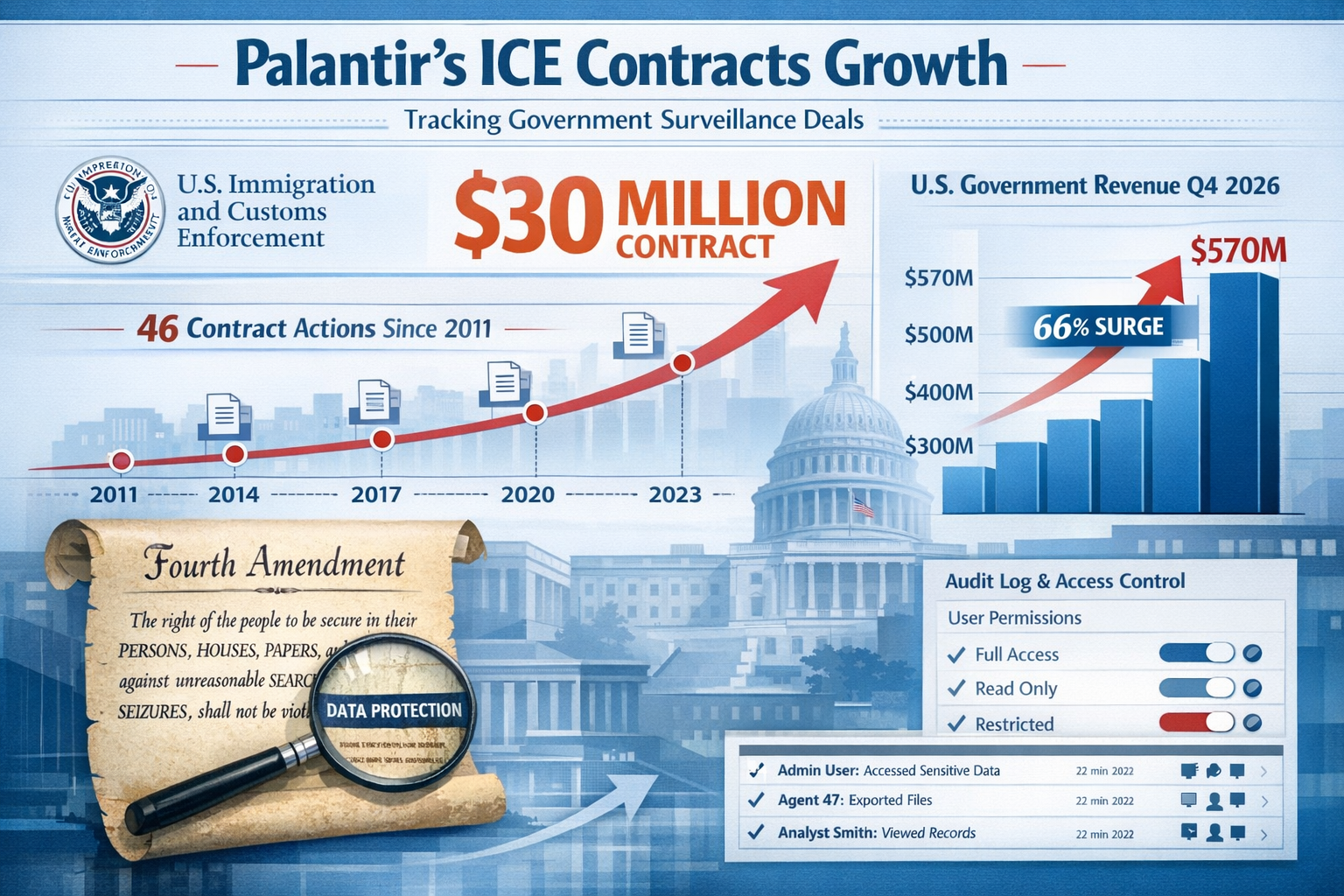
When a tech company’s stock jumps 5% after announcing it’s helping Immigration and Customs Enforcement track undocumented immigrants, we need to talk about what that means for the rest of us. On Monday, Alex Karp, CEO of Palantir Technologies, defended the firm’s surveillance and AI tools as total sales of $1.41 billion exceeded analysts’ estimates. U.S. government contracts lifted revenue, as Palantir won a $30 million contract with U.S. Immigration and Customs Enforcement in April for real-time visibility systems. The CEO emphasized legal and technical safeguards, noting the system requires Fourth Amendment data protections and that audit logs and permissioning controls ensure only authorized access. Market reactions were mixed as Palantir expects revenue between $7.18 billion and $7.20 billion in 2026, with shares jumping around 5% and nearly 12% early on Tuesday. Amid growing scrutiny after January’s deadly protests, Palantir’s military-grade AI marketing and the sale of a U.S. unit by CapGemini reflect broader reputational risks, critics said.[1]
This isn’t just another tech earnings report. This is about a company that’s become the invisible backbone of government surveillance—and what that means for your privacy, your rights, and your future in an increasingly monitored America.
Key Takeaways
- Palantir’s government contracts surged 66% in Q4 2026, reaching $570 million, with a controversial $30 million ICE contract for surveillance systems among 46 federal contract actions since 2011
- CEO Alex Karp defended surveillance safeguards by emphasizing Fourth Amendment protections, audit logs, and permissioning controls, though critics question the effectiveness of these measures
- Stock market sent mixed signals: shares jumped 5% initially but face valuation concerns with a price-to-earnings ratio of 140.5, requiring “perfect execution” to justify investor confidence
- Privacy advocates warn that military-grade AI tools sold to government agencies create unprecedented risks for civil liberties, especially for immigrant communities and marginalized groups
- Corporate accountability pressure is mounting, as evidenced by France’s CapGemini divesting a U.S. unit with ICE contracts following criticism from lawmakers
Who Is Palantir and What Do They Actually Do?
If you haven’t heard of Palantir Technologies, that’s partly by design. The company doesn’t advertise on TV or sponsor your favorite podcast. Instead, it operates in the shadows of government agencies and corporate boardrooms, building some of the most powerful surveillance and data analysis tools in existence.
Founded in 2003 by billionaire Peter Thiel (yes, the same Thiel who co-founded PayPal and maintains close ties with Vice President J.D. Vance), Palantir started with backing from the CIA’s venture capital arm.[1] The company’s name comes from the all-seeing orbs in The Lord of the Rings—which should tell you something about their ambitions.
Palantir provides two main platforms:
- Gotham: Used primarily by government agencies for counterterrorism, law enforcement, and military operations
- Foundry: Marketed to commercial clients for data integration and analysis
- Apollo: Infrastructure for deploying and managing software across different environments
- Artificial Intelligence Platform (AIP): The newest offering, bringing military-grade AI capabilities to businesses and government agencies
These aren’t simple database programs. Palantir’s technology can integrate massive amounts of data from disparate sources—social media, financial records, location data, communications, you name it—and use AI to find patterns, predict behavior, and identify targets. Think of it as giving government agencies superhuman abilities to surveil, track, and analyze anyone they choose.
For the average American citizen in places like Utica, NY, or anywhere in the Mohawk Valley, this technology might seem distant. But here’s the reality: if you’ve ever crossed a border, applied for government benefits, been arrested, or even just used social media, your data could be sitting in a Palantir system right now.
The company’s work with Immigration and Customs Enforcement is particularly revealing. That $30 million contract awarded in April 2025 isn’t just about tracking undocumented immigrants—it’s about building “real-time visibility systems” that can identify individuals, track their movements, and monitor self-deportations.[1] This represents Palantir’s largest single award from ICE among 46 federal contract actions since 2011.
Palantir’s Explosive Growth: Following the Money
The numbers from Palantir’s recent earnings announcement are staggering, and they tell a story about where our government is placing its bets—and our tax dollars.
Fourth Quarter 2026 Performance:
- Total revenue: $1.41 billion (exceeding analyst estimates)
- U.S. government revenue: $570 million (up 66% from previous year)
- Overall revenue guidance for 2026: $7.18-$7.20 billion (representing 60% growth from 2025)[1]
To put this in perspective, Palantir expects its U.S. business sales to grow by at least 115% to over $3.14 billion in 2026.[1] That’s not incremental growth—that’s explosive expansion fueled almost entirely by government contracts.
The company’s first-quarter 2026 sales forecast of $1.53-$1.54 billion substantially exceeds analyst estimates of $1.32 billion, signaling that government demand isn’t slowing down anytime soon.[1]
What’s Driving This Growth?
Several factors are converging to make Palantir one of the hottest government contractors:
Immigration enforcement expansion: The current administration’s immigration policies have created massive demand for surveillance and tracking technology. Palantir’s systems help ICE identify, locate, and apprehend undocumented immigrants with unprecedented efficiency.
Military AI modernization: The Pentagon and intelligence agencies are racing to integrate artificial intelligence into everything from drone operations to cyber warfare. Palantir positions itself as the bridge between traditional military systems and cutting-edge AI.
Political connections: Founder Peter Thiel’s close relationship with Vice President J.D. Vance (whom he supported in the 2022 Senate race) doesn’t hurt when it comes to winning federal contracts.[1]
First-mover advantage: Palantir has been building these systems for over two decades, giving them institutional knowledge and integration that competitors can’t easily replicate.
For working families in upstate New York worried about how their tax dollars are spent, these contracts represent a significant investment in surveillance infrastructure rather than, say, affordable housing, healthcare access, or infrastructure investment in communities like the Erie Canal corridor.
The CEO’s Defense: Fourth Amendment Protections and Audit Logs
When CEO Alex Karp took the stage on Monday to discuss earnings, he knew he’d face questions about privacy and civil liberties. His defense was carefully crafted, emphasizing technical safeguards and constitutional protections.
Karp stated that Palantir’s technology includes “granular permissioning capabilities” and “functional audit logs” to ensure “the state and its agents can see only what ought to be seen.”[1] He emphasized that the systems require Fourth Amendment data protections, which guard against unreasonable searches and seizures.
Sounds reassuring, right? Let’s unpack what this actually means—and what it doesn’t.
What Are Audit Logs and Permissioning Controls?
In simple terms:
Audit logs are detailed records of who accessed what data, when they accessed it, and what they did with it. Think of it like a security camera for data—every action leaves a digital footprint.
Permissioning controls determine who has access to specific information. An ICE agent in Buffalo might have access to data about individuals in New York, but not California, for example.
These are legitimate security measures, and they’re better than nothing. But here’s the problem: they only work if someone is actually monitoring them and holding people accountable when violations occur.
The Fourth Amendment Question
Karp’s invocation of Fourth Amendment protections sounds great, but there’s a massive caveat: he didn’t specify which government programs use this technology or how these protections are enforced in practice.[1]
The Fourth Amendment protects against unreasonable searches and seizures, but courts have carved out numerous exceptions for immigration enforcement, border security, and national security operations. In many cases, ICE agents don’t need warrants to access databases or conduct surveillance on individuals they suspect of immigration violations.
Critical questions Karp didn’t answer:
- Who reviews the audit logs, and how often?
- What happens when agents violate permissioning rules?
- How are Fourth Amendment protections enforced for non-citizens?
- Can data collected for one purpose be shared with other agencies?
- What oversight exists to prevent mission creep?
In November 2025, Karp took a more aggressive stance, characterizing critics of Palantir’s surveillance tools as “parasitic” and arguing the company builds technology to prevent government abuses rather than enable surveillance.[2] He positioned Palantir as a national security asset supporting military strength.
This framing—that surveillance technology actually protects civil liberties—is a tough sell for privacy advocates and civil rights organizations who’ve documented numerous cases of government surveillance abuse.
Market Reactions: Investors Love Surveillance, But Valuation Concerns Loom
Wall Street’s response to Palantir’s earnings announcement reveals the complicated relationship between profit and principle in modern capitalism.
Immediate reaction (February 2, 2026):
- Shares jumped 5% after earnings announcement
- Early Tuesday trading saw gains of nearly 12%[1]
Longer-term concerns (February 3, 2026):
- Shares declined more than 15% as valuation questions emerged
- Current 12-month-forward price-to-earnings ratio: 140.5[1]
To understand why investors are nervous despite stellar earnings, consider this: a P/E ratio of 140.5 means investors are paying $140.50 for every dollar of earnings Palantir generates. For comparison, the S&P 500 average is around 20-25.
Analyst Zavier Wong captured the dilemma perfectly: “Valuation question marks won’t disappear. Palantir remains priced for perfection, which means it will need to continue executing in future quarters.”[1]
What “Priced for Perfection” Means for Average Investors
If you’re a working family in Oneida County with a 401(k) or retirement account, you might own Palantir stock without even knowing it (through index funds or tech-heavy portfolios). Here’s what you need to understand:
The stock has gained an astounding 1,700% over the past three years,[1] making it one of the best-performing AI stocks in the market. But that kind of growth creates enormous expectations. If Palantir misses earnings targets, loses a major contract, or faces regulatory restrictions, the stock could plummet quickly.
This volatility matters because it reflects deeper uncertainty about the company’s business model. How sustainable is growth built primarily on government surveillance contracts? What happens if political winds shift and privacy protections become a priority? What if public backlash forces companies to distance themselves from controversial government programs?
These aren’t hypothetical concerns. We’re already seeing it happen.
Reputational Risks: When Surveillance Contracts Become Toxic
The same week Palantir announced its blockbuster earnings, France’s CapGemini made a very different announcement: it would divest a U.S. unit that holds contracts with ICE, following criticism from French lawmakers.[1]
This decision reflects growing pressure on companies involved in immigration enforcement, especially after January 2026’s deadly protests that resulted in the fatal shootings of two U.S. citizens.[1] While details of these incidents remain under investigation, they’ve intensified scrutiny of ICE operations and the technology companies that enable them.
The Corporate Accountability Movement
For years, tech workers and activists have organized campaigns targeting companies with government surveillance contracts:
2018-2019: Microsoft employees protested a $480 million contract with the U.S. Army for augmented reality headsets, arguing the technology could be weaponized.
2020: Amazon faced pressure over facial recognition technology sold to law enforcement, eventually implementing a moratorium on police use.
2021-2022: Google employees successfully pressured the company to limit AI technology sales to certain government agencies.
2026: CapGemini’s divestment signals that even companies outside the U.S. are feeling pressure from stakeholders who view immigration enforcement technology as reputationally toxic.
Palantir, however, has taken the opposite approach. Rather than backing away from controversial government work, CEO Karp has leaned into it, positioning the company as unapologetically patriotic and essential to national security.
At the World Economic Forum in January 2026, Karp discussed how artificial intelligence is reshaping warfare, national security, and the broader economy, arguing AI will expose which societies can truly “bear” technological transformation.[3] This framing suggests Palantir sees itself not just as a vendor, but as a crucial player in determining which nations succeed in the AI age.
What This Means for Your Privacy and Civil Liberties

Let’s bring this home to what matters for everyday people in the Mohawk Valley and across America.
When a company like Palantir builds surveillance systems for government agencies, the technology doesn’t discriminate between undocumented immigrants and U.S. citizens. The same tools used to track someone who overstayed a visa can be used to monitor activists, journalists, political opponents, or anyone else the government deems interesting.
Real-World Privacy Implications
Data integration across agencies: Palantir’s strength is connecting information from multiple sources. That means data you provided to one government agency for one purpose could be accessed by another agency for a completely different purpose.
Persistent surveillance: Unlike traditional investigations that require warrants and have defined endpoints, algorithmic surveillance is continuous. Once you’re in the system, you’re always in the system.
Predictive policing concerns: AI-powered tools don’t just track what you’ve done—they predict what you might do. These predictions can be based on factors like your neighborhood, social connections, or online activity, raising serious questions about presumption of innocence.
Mission creep: Technology built for counterterrorism gets used for immigration enforcement. Technology built for immigration enforcement gets used for local policing. Technology built for law enforcement gets used for… what’s next?
Chilling effects on free speech: When people know they’re being surveilled, they self-censor. They don’t attend protests, join advocacy groups, or speak out on controversial issues. This undermines the very foundation of democratic participation and civic engagement.
Who’s Most at Risk?
While Palantir’s surveillance tools theoretically affect everyone, certain communities face disproportionate risks:
- Immigrant communities (documented and undocumented)
- Muslim Americans and other groups associated with counterterrorism efforts
- Political activists and organizers, particularly those involved in racial justice, environmental justice, or workers’ rights movements
- Journalists investigating government activities
- Marginalized communities already experiencing over-policing
For a progressive community like the Mohawk Valley, these concerns aren’t abstract. When local activists organize for affordable housing, education reform, or climate action, they could find themselves in databases designed for entirely different purposes.
The Bigger Picture: Democracy in the Age of AI Surveillance
Palantir’s success represents a fundamental shift in the relationship between citizens and government. We’re moving from a system where surveillance required individual warrants and specific justifications to one where mass data collection is the default and AI algorithms decide who deserves scrutiny.
This transformation is happening with minimal public debate, limited congressional oversight, and virtually no input from the communities most affected.
Questions We Should Be Asking
As citizens committed to government transparency and democratic accountability, we need to demand answers:
Oversight and accountability:
- Who oversees Palantir’s government contracts?
- What independent audits exist to ensure Fourth Amendment compliance?
- How can citizens access information about whether they’re in these systems?
- What recourse exists when surveillance tools are misused?
Scope and limits:
- What are the legal limits on data integration across agencies?
- How long is surveillance data retained?
- Can data collected for immigration enforcement be used for other purposes?
- What protections exist for U.S. citizens caught in systems designed for non-citizens?
Democratic input:
- Why are these contracts awarded with minimal public notice?
- How can communities provide input on surveillance technology deployed in their neighborhoods?
- What role should Congress play in authorizing new surveillance capabilities?
- Should local governments have the power to restrict federal surveillance operations?
The Path Forward: Balancing Security and Liberty
This isn’t about being anti-technology or anti-security. Legitimate threats exist, and government agencies need tools to address them. But there’s a massive difference between targeted, warranted surveillance of specific threats and mass surveillance infrastructure that treats everyone as a potential suspect.
What meaningful oversight looks like:
✅ Independent review boards with civil liberties experts, not just law enforcement representatives
✅ Regular public reporting on how surveillance tools are used, with statistics on searches, targets, and outcomes
✅ Strict data minimization rules that limit collection to what’s genuinely necessary
✅ Sunset provisions that require regular reauthorization rather than permanent surveillance authorities
✅ Whistleblower protections for employees who report abuses
✅ Community input before deploying surveillance technology, especially in marginalized neighborhoods
✅ Algorithmic transparency so we understand how AI systems make decisions about who to target
Taking Action: What You Can Do
Feeling overwhelmed? That’s understandable. Surveillance technology moves faster than democratic accountability. But that doesn’t mean we’re powerless.
Individual Actions
Protect your digital privacy:
- Use encrypted messaging apps (Signal, WhatsApp)
- Enable two-factor authentication on important accounts
- Use a VPN when browsing sensitive content
- Limit what you share on social media
- Review privacy settings regularly
Exercise your rights:
- File Freedom of Information Act (FOIA) requests to learn what data government agencies have about you
- Support organizations like the ACLU and Electronic Frontier Foundation that litigate surveillance overreach
- Document interactions with law enforcement
Community Actions
Organize locally:
- Attend town hall meetings and ask elected officials about surveillance technology
- Join or support local immigrant rights organizations
- Participate in community organizing around police reform and government accountability
- Build coalitions between civil liberties groups, immigrant advocates, and racial justice organizations
Demand transparency:
- Push your city council to require transparency reports before adopting surveillance technology
- Support local journalism that investigates government contracts and spending
- Attend school board meetings and county planning sessions where these issues might arise
Political Actions
Contact your representatives:
- Call Senators and House members to demand oversight of government surveillance contracts
- Support legislation requiring warrants for data access
- Advocate for stronger Fourth Amendment protections for non-citizens
- Push for algorithmic accountability laws
Vote strategically:
- Support candidates committed to privacy rights and criminal justice reform
- Ask local election candidates about their positions on surveillance technology
- Make civil liberties a priority issue in primary elections and general elections
Support advocacy organizations:
- Electronic Frontier Foundation (digital rights)
- American Civil Liberties Union (civil liberties)
- National Immigration Law Center (immigrant rights)
- Brennan Center for Justice (democracy and justice)
For Investors
If you own Palantir stock (directly or through funds):
- Engage in shareholder advocacy by supporting resolutions demanding transparency and human rights assessments
- Divest if the company’s practices conflict with your values
- Support ESG investing that screens for companies with problematic government contracts
- Ask questions at shareholder meetings about reputational risks and ethical guidelines
Conclusion: The Surveillance State We’re Building
Palantir’s record-breaking revenue and government contract growth aren’t just business stories—they’re a window into the future we’re building, one database and algorithm at a time.
On Monday, Alex Karp, CEO of Palantir Technologies, defended the firm’s surveillance and AI tools as total sales of $1.41 billion exceeded analysts’ estimates. U.S. government contracts lifted revenue, as Palantir won a $30 million contract with U.S. Immigration and Customs Enforcement in April for real-time visibility systems. The CEO emphasized legal and technical safeguards, noting the system requires Fourth Amendment data protections and that audit logs and permissioning controls ensure only authorized access. Market reactions were mixed as Palantir expects revenue between $7.18 billion and $7.20 billion in 2026, with shares jumping around 5% and nearly 12% early on Tuesday. Amid growing scrutiny after January’s deadly protests, Palantir’s military-grade AI marketing and the sale of a U.S. unit by CapGemini reflect broader reputational risks, critics said.[1]
The question isn’t whether surveillance technology will exist—it already does, and it’s growing exponentially. The question is whether we’ll build democratic guardrails around it or allow it to operate in the shadows, accountable to no one except shareholders and government agencies with their own agendas.
For communities in the Mohawk Valley and across upstate New York, these issues might seem distant from daily concerns about affordable housing, healthcare access, and economic opportunity. But they’re deeply connected. The same government that spends billions on surveillance technology is the government that claims it can’t afford universal healthcare, student debt relief, or infrastructure investment in places like Utica and Rome.
This is about priorities. This is about values. And this is about what kind of country we want to be.
A society that treats surveillance as the solution to every problem becomes a society where fear replaces trust, where compliance replaces freedom, and where the powerful can monitor the powerless with impunity.
We can do better. We must do better. And it starts with paying attention, asking questions, and demanding that our government serves the people—not the other way around.
The surveillance state isn’t inevitable. It’s a choice. And we still have time to choose differently.
References
[1] Palantir CEO defends surveillance tech as contracts with US government including ICE boost sales – https://www.straitstimes.com/world/united-states/palantir-ceo-defends-surveillance-tech-as-contracts-with-us-government-including-ice-boost-sales
[2] Palantir CEO Alex Karp slams critics of surveillance state and military tech as ‘parasitic’ – https://fortune.com/2025/11/13/palantir-ceo-alex-karp-slams-critics-surveillence-state-military-tech-patriotism-mind-virus/
[3] Palantir’s CEO Alex Karp warns AI will redefine power, war, and economies – https://futurist.com/2026/01/24/palantirs-ceo-alex-karp-warns-ai-will-redefine-power-war-and-economies/


