


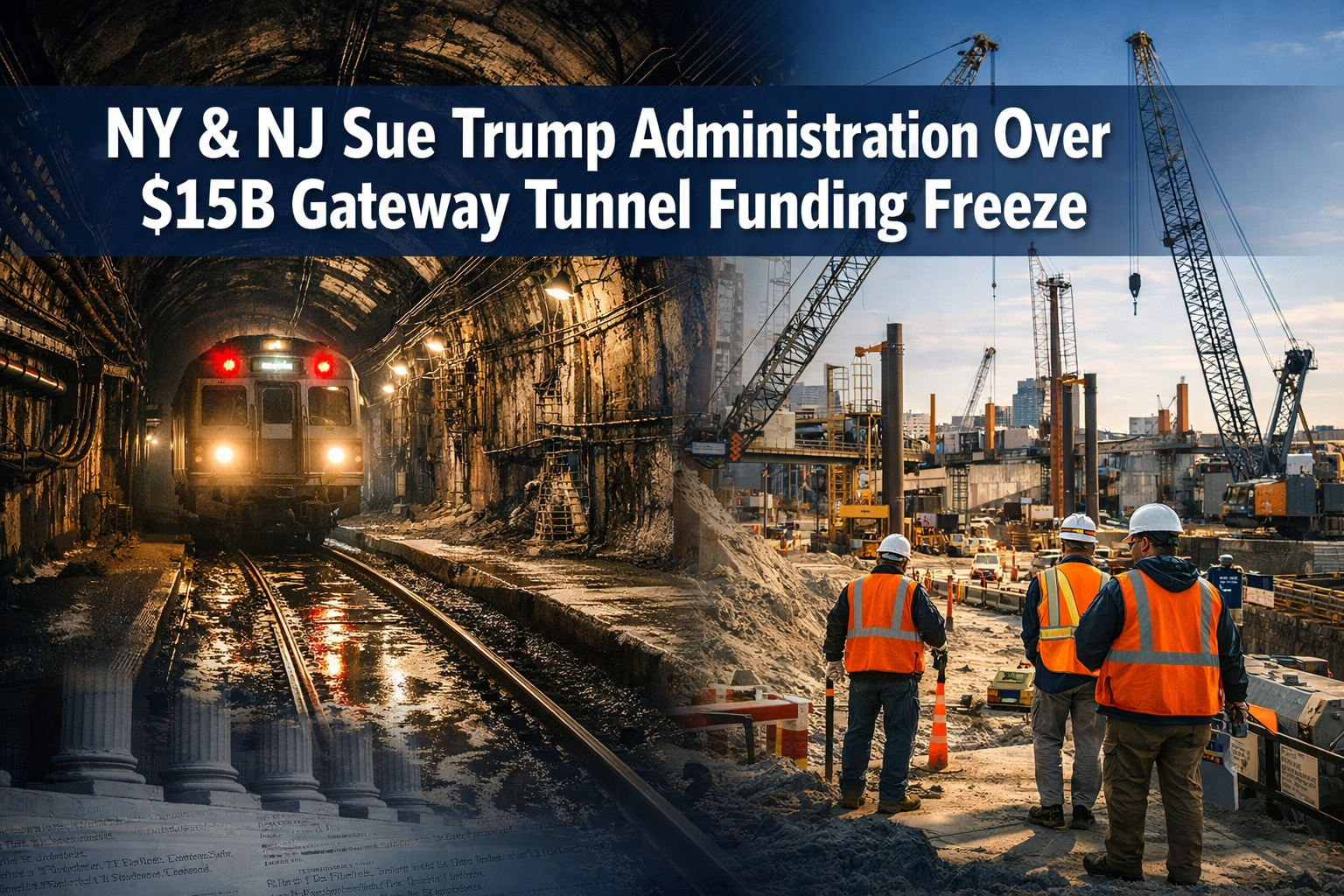
The economic lifeline connecting New York and New Jersey just got caught in a political stranglehold. New York and New Jersey announced this evening that both states are suing the Trump Administration for illegally withholding $15 billion in federally committed funding for the Gateway project to provide new tunnels and rehabilitate the existing vital Hudson River rail crossing between northern New Jersey and New York City, jeopardizing the economic future of the Northeast region. The lawsuit, filed in federal court in the Southern District of New York, seeks emergency relief to stop the U.S. Department of Transportation (DOT) from continuing to implement its indefinite funding freeze—funds needed to ensure that active construction on the project can continue, that workers do not lose their jobs, and that the States and their residents are not harmed.[1][3]
This isn’t just about infrastructure. It’s about whether 200,000 daily commuters will have a functioning rail system, whether nearly 1,000 construction workers will keep their jobs, and whether the federal government can arbitrarily break its funding commitments to score political points.
Key Takeaways
- Dual Legal Action: New York and New Jersey filed a lawsuit on February 3, 2026, with the Gateway Development Commission filing a separate suit the same day seeking release of contractually-obligated funds.[1][4]
- Urgent Timeline: Construction sites face potential shutdown by February 6, 2026, creating a critical three-day window for emergency court intervention.[2][4]
- Massive Economic Impact: The funding freeze threatens 1,000 immediate job losses and billions of dollars in lost productivity across the Northeast region.[3][4]
- Aging Infrastructure Crisis: The existing 116-year-old North River Tunnel is the most heavily used passenger rail line in the country and a leading cause of delays affecting hundreds of thousands of daily riders.[4]
- Political Motivation: The Trump administration froze the funding in late September 2025, citing concerns about diversity, equity, and inclusion principles rather than project merit.[1][2]
The Gateway Project: A Critical Infrastructure Lifeline Under Threat
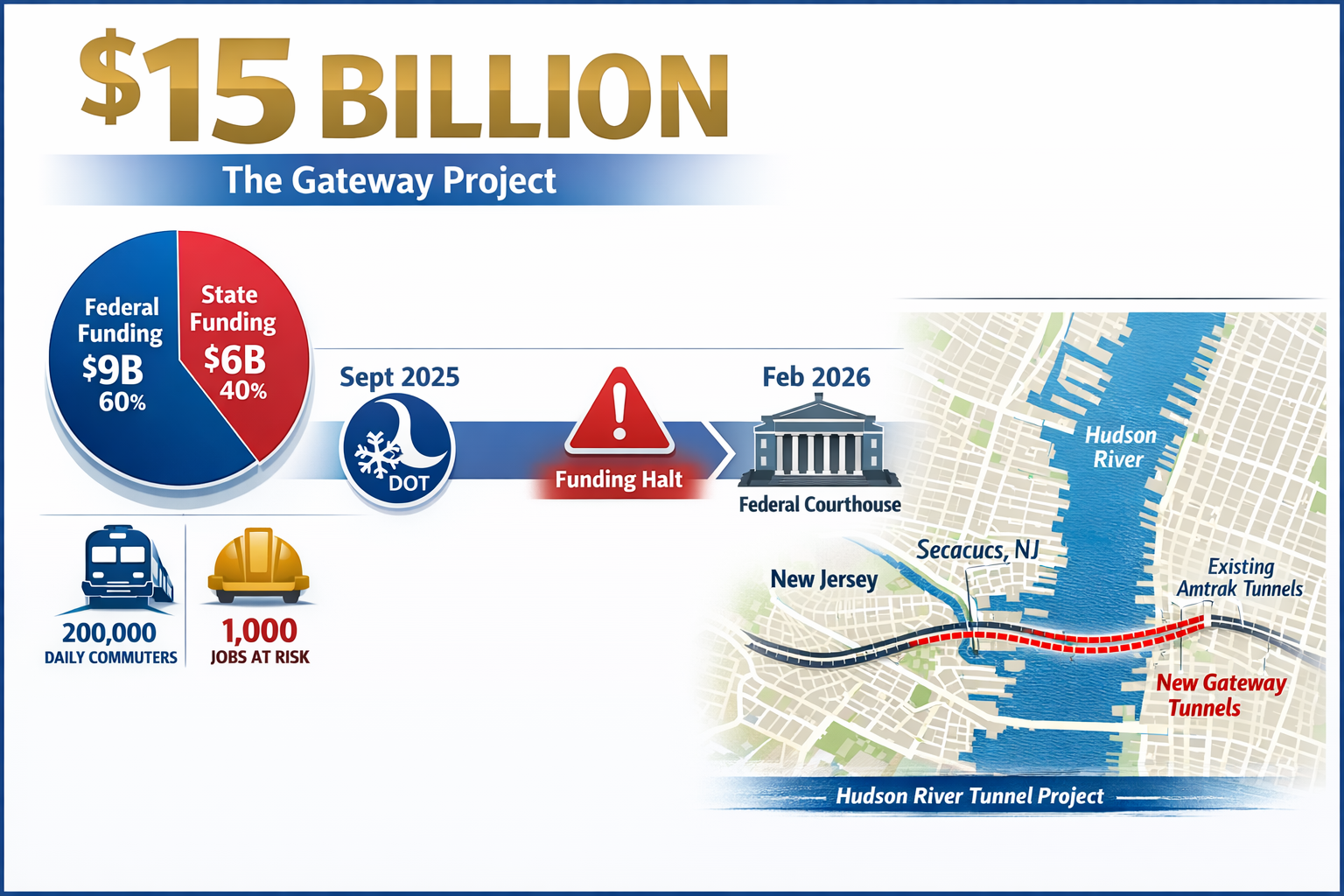
The Gateway project represents more than just another infrastructure initiative. It’s the vital connection that keeps the Northeast economy functioning. Every day, 200,000 commuters depend on the Hudson River rail crossing to get to work, support their families, and contribute to the region’s economic engine.[3]
The project has two essential components: building a new rail tunnel under the Hudson River and rehabilitating the existing North River Tunnel, which has been in service for 116 years. That’s not a typo—the tunnel currently carrying hundreds of thousands of passengers daily was built before World War I.[3][4]
Why does this matter to upstate New York residents? The Gateway project isn’t just a New York City issue. The Northeast Corridor connects communities throughout New York State, including the Mohawk Valley region. When the region’s economic hub struggles with infrastructure failures, the ripple effects reach every corner of the state—from reduced economic opportunity to diminished state tax revenues that fund essential services in communities like Utica, Rome, and New Hartford.
The existing tunnel is described by officials as “the most heavily used passenger rail line in the country” and a “leading cause of delays that impact hundreds of thousands of daily riders.”[4] When this tunnel fails—and experts warn it’s a matter of when, not if—the economic consequences will be catastrophic.
Understanding the Federal Funding Freeze and Legal Challenge
The Trump administration’s decision to freeze $15-16 billion in federally committed funding didn’t happen overnight. In late September 2025, the Department of Transportation implemented an indefinite funding freeze, citing concerns about unconstitutional diversity, equity, and inclusion (DEI) principles.[1][2]
Let’s be clear about what’s happening here: The federal government made contractual commitments to fund this critical infrastructure project. States planned accordingly. Construction began. Workers were hired. And then, months into active construction, the administration pulled the plug based on ideological objections that have nothing to do with the project’s merit or necessity.
New York Attorney General Letitia James and New Jersey Acting Attorney General Jennifer Davenport are leading the legal action filed on February 3, 2026, in federal court in the Southern District of New York.[1][3] The same day, the Gateway Development Commission filed a separate lawsuit in the U.S. Court of Federal Claims, seeking release of contractually-obligated grant and loan funds.[4]
The states are seeking emergency relief, including a preliminary injunction, to block the Department of Transportation from continuing the funding freeze.[3] This isn’t just a routine legal filing—it’s an emergency action because construction sites face potential shutdown by February 6, 2026, just three days after the lawsuit was filed.[2][4]
The Human Cost of Political Gamesmanship
New Jersey Governor Mikie Sherrill stated bluntly that “1,000 workers will immediately lose their jobs” if the project stops.[3] These aren’t abstract statistics—they’re construction workers, engineers, project managers, and support staff who depend on steady employment to support their families.
Nearly 1,000 jobs will be lost if construction pauses due to insufficient funding.[4] In 2026, with working families already struggling with the cost of living, putting a thousand people out of work to make a political point about DEI policies is unconscionable.
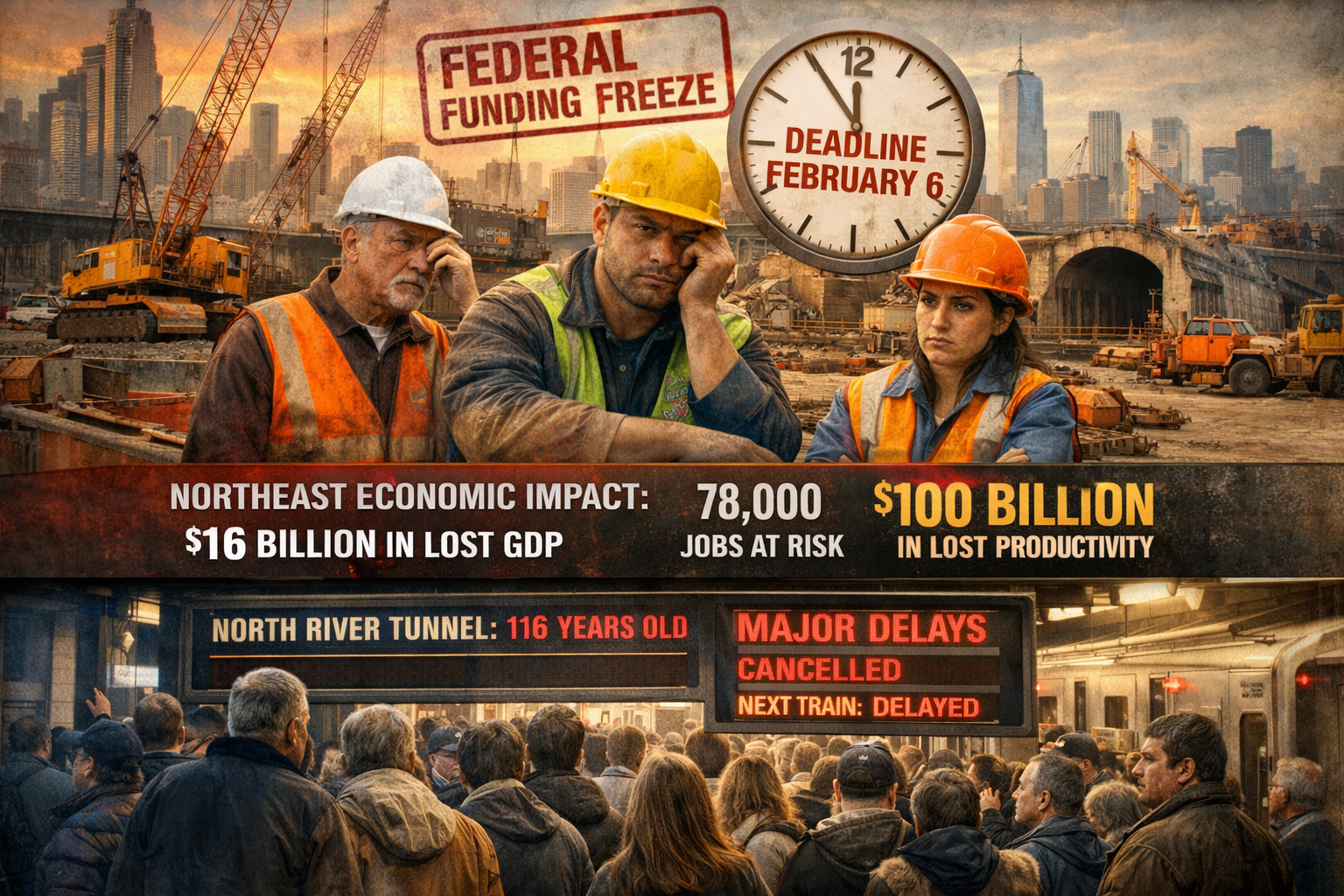
The economic damage extends far beyond immediate job losses. States cite “billions of dollars in lost time and productivity” from a potential tunnel shutdown.[4] When hundreds of thousands of commuters can’t get to work reliably, when businesses can’t count on their employees arriving on time, when the entire Northeast transportation network grinds to a halt—the economic consequences compound rapidly.
Why the Gateway Funding Freeze Matters to Upstate New York
Readers in the Mohawk Valley might wonder why they should care about a tunnel project connecting New Jersey and New York City. The answer is simple: We’re all connected in the same economic ecosystem.
The Northeast Corridor isn’t just about Manhattan commuters. It’s the economic spine of the entire region. When that spine breaks, everyone feels the pain:
- State Budget Impact: New York State depends on tax revenues generated by the downstate economy. When that economy suffers from infrastructure failures, the entire state budget takes a hit—including funding for upstate schools, healthcare, and infrastructure investment.
- Economic Opportunity: Young people from Utica and surrounding communities often seek opportunities in the broader New York metro area. Reliable transportation infrastructure makes those opportunities accessible.
- Supply Chain Connections: The goods and services that flow through the Northeast Corridor affect prices and availability in communities throughout upstate New York.
- Federal Accountability: If the federal government can arbitrarily break funding commitments to New York on one project, what prevents them from doing the same to infrastructure investment in the Mohawk Valley or other upstate regions?
This is about government transparency and accountability. It’s about whether states can trust federal funding commitments when planning critical infrastructure projects. It’s about whether political ideology should override economic necessity and contractual obligations.
The Broader Pattern of Infrastructure Neglect
The Gateway funding freeze fits into a troubling pattern of infrastructure investment being treated as a political football rather than a national priority. The United States has been falling behind on infrastructure investment for decades, and projects like Gateway represent attempts to finally address that deficit.
The existing 116-year-old tunnel wasn’t designed for current passenger loads. It wasn’t built with modern safety standards. It sustained significant damage during Hurricane Sandy in 2012. Every day it remains in service without proper rehabilitation increases the risk of catastrophic failure.
Infrastructure investment shouldn’t be a partisan issue. Whether you lean left or right, whether you live in a city or a small town, everyone benefits from safe, reliable transportation networks. Everyone suffers when critical infrastructure fails.
The Trump administration’s decision to freeze funding based on DEI concerns rather than engineering necessity or project merit represents a dangerous precedent. It suggests that ideological purity tests matter more than keeping trains running, workers employed, and the economy functioning.
What Happens Next: Legal Timeline and Potential Outcomes
The legal battle will unfold on multiple fronts. The states’ lawsuit in the Southern District of New York seeks emergency relief to immediately unfreeze the funding.[1][3] The Gateway Development Commission’s separate lawsuit in the U.S. Court of Federal Claims focuses on the contractual obligations the federal government made.[4]
The urgent timeline cannot be overstated. With construction sites facing potential shutdown by February 6, 2026, the courts will need to act quickly if they’re going to prevent immediate harm.[2][4] Emergency injunctions exist for precisely these situations—when irreparable harm will occur without immediate judicial intervention.
If the courts grant the emergency relief, construction can continue while the underlying legal issues are resolved. If they don’t, workers lose their jobs, construction stops, and the economic damage begins accumulating immediately.
The legal arguments are straightforward: The federal government made contractual commitments. States relied on those commitments in good faith. The administration cannot unilaterally break those commitments without legal justification. Concerns about DEI policies don’t constitute valid grounds for breaching contractual obligations.
Potential Legal Outcomes
Several scenarios could unfold:
- Emergency Injunction Granted: The court orders the DOT to release the frozen funds immediately, allowing construction to continue while the case proceeds.
- Partial Relief: The court orders release of some funds to prevent immediate job losses while considering the broader legal questions.
- Delayed Decision: The court takes time to consider the arguments, potentially resulting in construction stoppage and job losses.
- Settlement: The administration and states reach a negotiated agreement to release funding with modified terms.
The most likely outcome, given the strength of the states’ contractual arguments and the urgent timeline, is some form of emergency relief. Federal courts generally don’t look favorably on government agencies breaking contractual commitments without compelling justification.
The Economic Stakes for the Northeast Region
Let’s talk numbers. The Gateway project involves $15-16 billion in federally committed funding.[1][3] That’s not just government spending—it’s economic investment that generates jobs, improves productivity, and prevents future economic losses.
Consider what happens if the existing tunnel fails without a replacement ready:
- Daily Commuter Impact: 200,000 people unable to get to work reliably.[3]
- Business Disruption: Companies throughout the region unable to count on their workforce arriving on time.
- Tourism Impact: Visitors unable to travel easily between New Jersey and New York.
- Supply Chain Disruption: Goods and services delayed or rerouted at significant cost.
- Property Values: Real estate values declining in communities that depend on reliable transit access.
The states cite “billions of dollars in lost time and productivity” from a potential tunnel shutdown.[4] That’s not hyperbole—it’s a conservative estimate based on the economic value generated by hundreds of thousands of daily commuters and the businesses they support.
For working families throughout the Northeast, including upstate New York, this translates to real consequences: longer commutes, less time with family, reduced economic opportunity, and higher costs for goods and services affected by supply chain disruptions.
What Citizens Can Do: Civic Engagement and Political Accountability
This situation demands civic engagement. The federal government’s decision to freeze funding for a critical infrastructure project based on ideological concerns rather than merit should concern every citizen who values government accountability and economic stability.
Immediate Actions
Contact Your Representatives: Call or email your congressional representatives and senators. Tell them you support the Gateway project and oppose the funding freeze. Make it clear that infrastructure investment shouldn’t be held hostage to political ideology.
- Senator Chuck Schumer: (202) 224-6542
- Senator Kirsten Gillibrand: (202) 224-4451
- Find Your House Representative: house.gov/representatives/find-your-representative
Support the Legal Action: New York and New Jersey are fighting this battle on behalf of all residents who depend on reliable infrastructure. Let state officials know you support their legal challenge.
Educate Your Community: Share information about the Gateway project and why it matters. Many people don’t understand how interconnected our regional economy is or how infrastructure failures in one area affect everyone.
Vote: Remember this issue when election time comes. Support candidates who prioritize infrastructure investment and government accountability over ideological purity tests.
Long-Term Engagement
Attend Town Hall Meetings: When representatives hold constituent services events, show up and ask about infrastructure investment and federal funding accountability.
Join Advocacy Organizations: Groups focused on infrastructure investment, workers’ rights, and government transparency need members and volunteers.
Stay Informed: Follow the legal proceedings and stay updated on infrastructure issues affecting the region. Local journalism outlets like the Mohawk Valley Voice provide the factual reporting needed to make informed decisions.
Build Coalitions: Infrastructure investment benefits everyone. Work across political lines to build support for critical projects.
The Intersection of Infrastructure and Social Justice
The Gateway funding freeze also raises important questions about environmental justice and economic equity. When infrastructure fails, it’s not wealthy executives who suffer most—it’s working families who depend on public transit to get to work.
The existing tunnel’s unreliability disproportionately affects:
- Lower-income commuters who can’t afford alternative transportation options
- Service workers whose jobs don’t offer flexible scheduling to accommodate delays
- Communities of color that rely more heavily on public transportation
- Small businesses that can’t absorb the costs of supply chain disruptions
The Trump administration’s stated concern about DEI principles is particularly ironic given that freezing infrastructure funding actually harms the diverse communities that depend most on reliable public transit.
Environmental justice also factors into this equation. Reliable rail transit reduces car traffic, lowering emissions and improving air quality. When rail infrastructure fails, more people drive, increasing pollution in communities already burdened by poor air quality.
The Gateway project represents the kind of infrastructure investment that supports climate action, reduces inequality, and promotes economic opportunity. Freezing that funding undermines all those goals.
Lessons for Future Infrastructure Investment
The Gateway funding freeze offers important lessons for how we approach infrastructure investment going forward:
Federal Commitments Must Be Reliable: States can’t plan major infrastructure projects if federal funding commitments can be arbitrarily withdrawn based on political whims.
Contractual Obligations Matter: When the government makes contractual commitments, it should honor them. Breaking contracts undermines trust and makes future cooperation difficult.
Infrastructure Shouldn’t Be Partisan: Safe bridges, reliable tunnels, and functioning transit systems benefit everyone regardless of political affiliation.
Urgent Needs Require Urgent Action: The 116-year-old tunnel won’t wait for political disputes to be resolved. Critical infrastructure needs must be addressed before catastrophic failures occur.
Transparency and Accountability: Government decisions about infrastructure funding should be based on engineering necessity and economic merit, not ideological considerations or political revenge.
These lessons matter for communities throughout New York State, including the Mohawk Valley region. When we advocate for infrastructure investment in upstate New York—whether it’s broadband access, water quality improvements, or transportation upgrades—we need federal partners we can trust to honor their commitments.
Conclusion: The Fight for Infrastructure and Accountability
New York and New Jersey’s lawsuit against the Trump administration represents more than a legal dispute over $15 billion. It’s a fight for the principle that government commitments should mean something, that critical infrastructure shouldn’t be held hostage to political ideology, and that working families deserve reliable transportation to get to their jobs.
The urgent timeline—with construction sites facing shutdown by February 6, 2026—means this fight is happening right now.[2][4] The courts will decide quickly whether emergency relief is warranted. The economic future of the Northeast region hangs in the balance.
For residents of upstate New York and the Mohawk Valley region, this battle matters because we’re all part of the same economic ecosystem. When the federal government breaks funding commitments to New York, it affects all of us. When infrastructure investment is treated as a political football rather than a national priority, every community suffers.
The path forward requires civic engagement. Contact your representatives. Support the legal action. Stay informed. Vote for candidates who prioritize infrastructure investment and government accountability. Build coalitions across political lines to demand better.
The Gateway project will eventually be completed—the economic necessity is too great to ignore indefinitely. The question is whether it happens before catastrophic infrastructure failure forces emergency action at far greater cost, both economically and in human suffering.
This is our moment to demand better. To insist that government commitments mean something. To fight for the infrastructure investment that supports economic opportunity, environmental justice, and regional prosperity.
The lawsuit filed by New York and New Jersey is fighting that battle in court. Citizens throughout the region need to fight it in the political arena, demanding accountability from elected officials and refusing to accept infrastructure neglect as the status quo.
Our communities deserve better. Our workers deserve better. Our future deserves better. The time to act is now.
References
[1] New York New Jersey Sue Trump Administration 16b 129834338 – https://abcnews.go.com/Politics/wireStory/new-york-new-jersey-sue-trump-administration-16b-129834338
[2] aa.com.tr – https://www.aa.com.tr/en/americas/new-york-new-jersey-sue-trump-administration-to-unfreeze-16b-gateway-hudson-tunnel-funding/3820024
[3] New York New Jersey Sue Trump Administration Illegally Withholding Gateway Tunnel Funding – https://www.governor.ny.gov/news/new-york-new-jersey-sue-trump-administration-illegally-withholding-gateway-tunnel-funding
[4] 20260203a – https://nj.gov/governor/news/2026/approved/20260203a.shtml
[5] Nj Ny Sue Trump Administration Gateway Tunnel Funding – https://njbiz.com/nj-ny-sue-trump-administration-gateway-tunnel-funding/
[6] New Jersey New York Sue Trump Administration For Illegally Withholding Gateway Tunnel Funding – https://www.njoag.gov/new-jersey-new-york-sue-trump-administration-for-illegally-withholding-gateway-tunnel-funding/


