


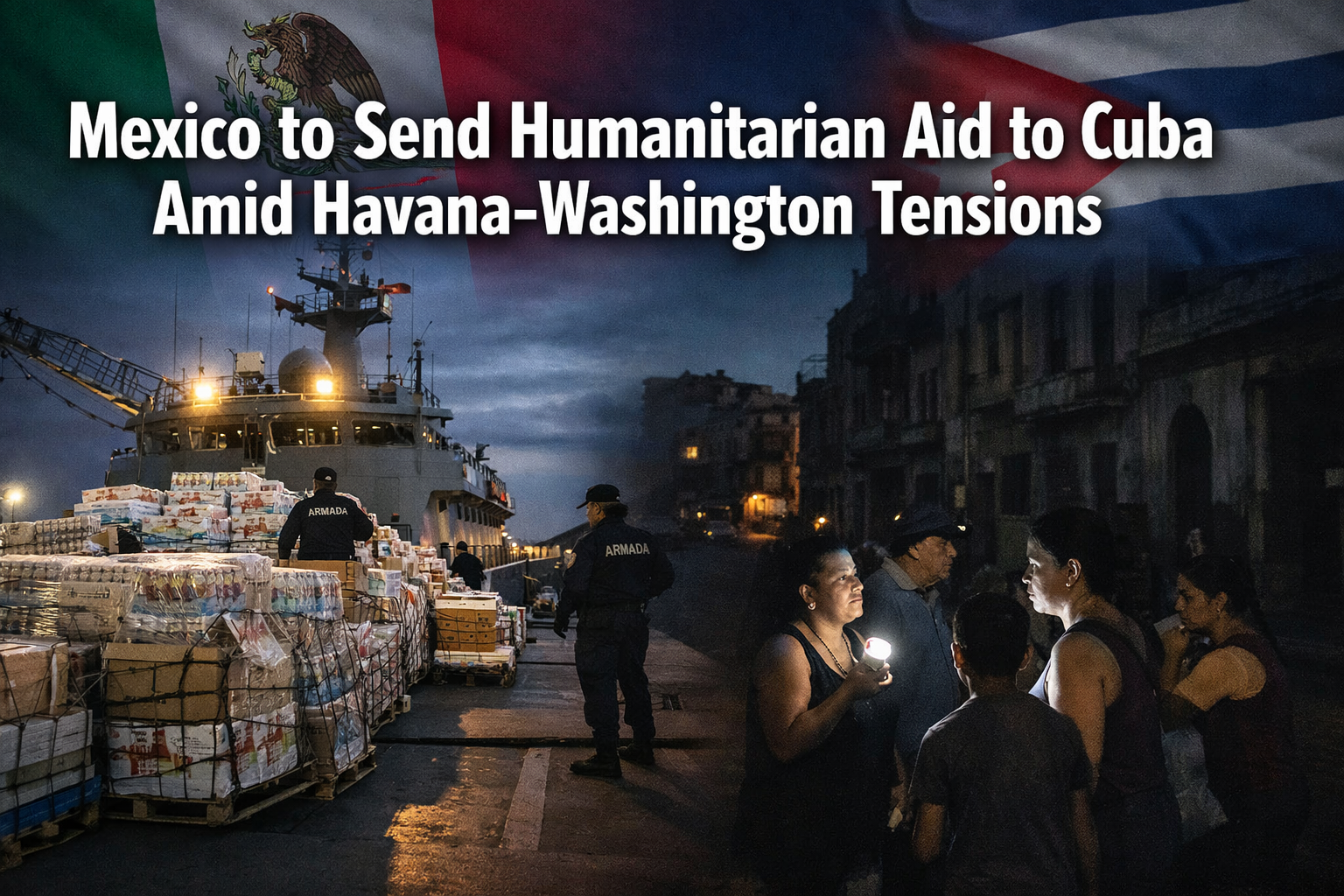
When Mexican President Claudia Sheinbaum stood before cameras in Guaymas, Sonora on Sunday, her announcement carried weight far beyond the port city’s shores. Mexico plans to send humanitarian aid to Cuba this week—food, household goods, and essential supplies—despite mounting pressure from Washington and threats of economic retaliation. It’s a bold diplomatic move that places Mexico squarely between a collapsing Caribbean nation and an American administration determined to tighten the screws on Havana.
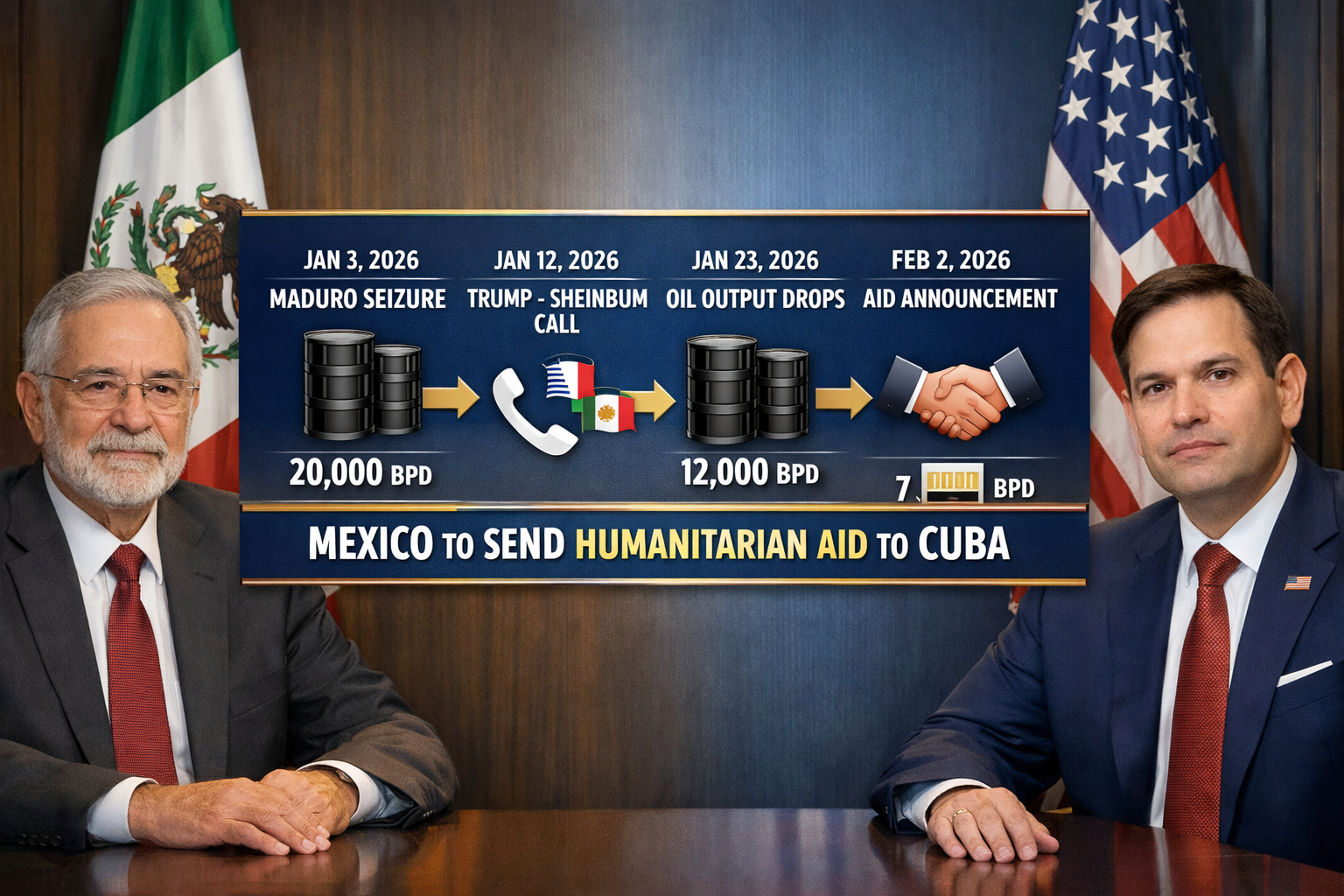
The decision to send aid comes at a moment of extraordinary tension. President Donald Trump declared a national emergency concerning Cuba just days earlier, threatening sanctions against any country delivering oil to the island. Venezuela, once Cuba’s lifeline, stopped shipments after Trump oversaw the dramatic seizure of Venezuelan leader Nicolás Maduro on January 3, 2026. Now Cuba faces power outages lasting up to 12 hours daily, and Mexico—despite pausing its own oil deliveries last week—refuses to abandon the island entirely.[1][2][3]
For those of us watching from upstate New York, this story might seem distant. But it speaks to fundamental questions about sovereignty, humanitarian responsibility, and what nations owe each other when politics and human suffering collide. It’s also a reminder that progressive values—compassion, international cooperation, resistance to bullying—still matter on the world stage, even when they come with a price tag.
Key Takeaways
- President Sheinbaum announced Sunday that Mexico will send humanitarian aid to Cuba this week, including food, household goods, and essential supplies via naval vessels, despite U.S. pressure and threats of sanctions.[1][2]
- Mexico temporarily suspended oil shipments to Cuba last week as “a sovereign decision” while pursuing diplomatic channels with the U.S. to resume fuel deliveries for humanitarian purposes.[1][2]
- Trump declared a national emergency on Cuba and threatened tariffs against countries supplying oil, warning the island is “on the verge of collapse” after Venezuela stopped shipments following Maduro’s seizure.[1][3]
- Cuba faces a severe energy crisis with 12-hour daily power outages due to oil shortages, creating urgent humanitarian needs that Mexico refuses to ignore despite secondary sanctions risks.[3]
- Mexican Foreign Affairs Secretary Juan Ramón de la Fuente stated Mexico “will not stop sending humanitarian aid to Cuba” and rejects external prohibitions on humanitarian assistance as a matter of principle.[4]
Understanding Mexico’s Humanitarian Commitment to Cuba
Mexico’s relationship with Cuba has always been unique in Latin America. While most nations in the hemisphere bowed to U.S. pressure and severed ties with Havana after the 1959 revolution, Mexico maintained diplomatic relations throughout the Cold War. That tradition of independence continues today, even as the stakes grow higher.
Foreign Affairs Secretary Juan Ramón de la Fuente made Mexico’s position crystal clear: the government “will not stop sending humanitarian aid to Cuba.”[4] This isn’t just diplomatic posturing. It’s a statement rooted in Mexico’s constitutional commitment to non-intervention and international solidarity—principles that resonate with progressive values of mutual aid and rejecting economic warfare against civilian populations.
The humanitarian supplies heading to Cuba this week include:
- 🍚 Food staples for families facing shortages
- 🏠 Household goods to support daily living
- 💊 Essential supplies addressing urgent needs
- 📦 Other critical items determined by Cuban requirements
These shipments will travel via the Secretariat of the Navy, ensuring direct government-to-government delivery that bypasses commercial channels vulnerable to U.S. sanctions.[1][2] It’s a logistical approach that protects Mexican companies from secondary sanctions while ensuring aid reaches those who need it most.
The Principle Behind the Policy
De la Fuente emphasized that Mexico “does not accept the prohibition of humanitarian aid to any country” and will continue exercising this principle independently without submitting to external pressures.[4] This stance deserves recognition, especially in an era when many nations cave to economic threats.
Think about it this way: if your neighbor’s house caught fire, would you refuse to help because someone else told you not to? That’s essentially what the U.S. is asking Mexico to do—watch Cuba collapse while doing nothing. Mexico’s response reflects a different moral calculus, one that prioritizes human welfare over geopolitical gamesmanship.
The Complex Diplomatic Dance: Mexico to Send Humanitarian Aid to Cuba While Navigating U.S. Relations
The diplomatic tightrope Mexico walks right now would challenge even the most experienced statesperson. On one side sits Cuba, desperate for support as its energy infrastructure crumbles. On the other stands the United States, Mexico’s largest trading partner and a neighbor with enormous economic leverage.
Last week, Sheinbaum made the difficult decision to temporarily suspend oil deliveries to Cuba, describing it as “a sovereign decision.”[1][2] The pause came amid intense diplomatic pressure and Trump’s national emergency declaration, which introduced a framework to sanction any nation delivering oil to the island.[1]
But here’s what makes this situation fascinating from a progressive policy perspective: Mexico didn’t capitulate entirely. Instead, Sheinbaum’s administration is pursuing diplomatic channels to resume fuel shipments specifically for humanitarian purposes while simultaneously sending non-oil aid this week.[1]
The Trump-Sheinbaum Conversation
On Thursday, January 30, 2026, Sheinbaum and Trump held a 40-minute telephone conversation. Trump characterized the call as “very productive,” focusing on border issues, drug trafficking, and trade.[1] According to Trump, he asked the Mexican leader to suspend oil shipments during their conversation.[2]
Sheinbaum’s account differs slightly but significantly. She stated they did not discuss Cuba during this call.[1][2] This discrepancy matters because it shows Mexico maintaining narrative control over its sovereign decisions rather than framing the oil pause as submission to U.S. demands.
The diplomatic discussions involve high-level contacts between Mexico’s Foreign Secretary Juan Ramón de la Fuente and U.S. Secretary of State Marco Rubio, with Sheinbaum emphasizing Mexico is investigating “all diplomatic options” to deliver fuel for humanitarian support.[1]
The Numbers Behind the Oil Relationship
Understanding the oil situation requires looking at the data:
| Time Period | Daily Oil Shipments to Cuba |
|---|---|
| January-September 2025 | ~20,000 barrels per day |
| September 2025 | ~7,000 barrels per day |
| February 2026 | Temporarily suspended |
Mexico became Cuba’s primary oil supplier after the U.S. military operation on January 3, 2026, removed Venezuelan President Nicolás Maduro, which caused Venezuela to suspend oil shipments to the island.[1][2][3] Pemex, Mexico’s state oil company, had shipped nearly 20,000 barrels of oil per day to Cuba from January through September 30, 2025, but this figure had declined to approximately 7,000 barrels per day by September 2025 following U.S. diplomatic pressure.[2]
That 65% decline—from 20,000 to 7,000 barrels—shows U.S. pressure was already working before Trump’s emergency declaration. The complete suspension represents an escalation, but Mexico’s simultaneous pursuit of humanitarian fuel channels suggests this isn’t the final word.
Cuba’s Crisis and the Long Shadow of the U.S. Embargo
To understand why Mexico’s humanitarian aid matters so much, we need to grasp the depth of Cuba’s current crisis. Trump warned that Cuba is “on the verge of collapse”—and for once, his hyperbole might actually understate the situation.[1]
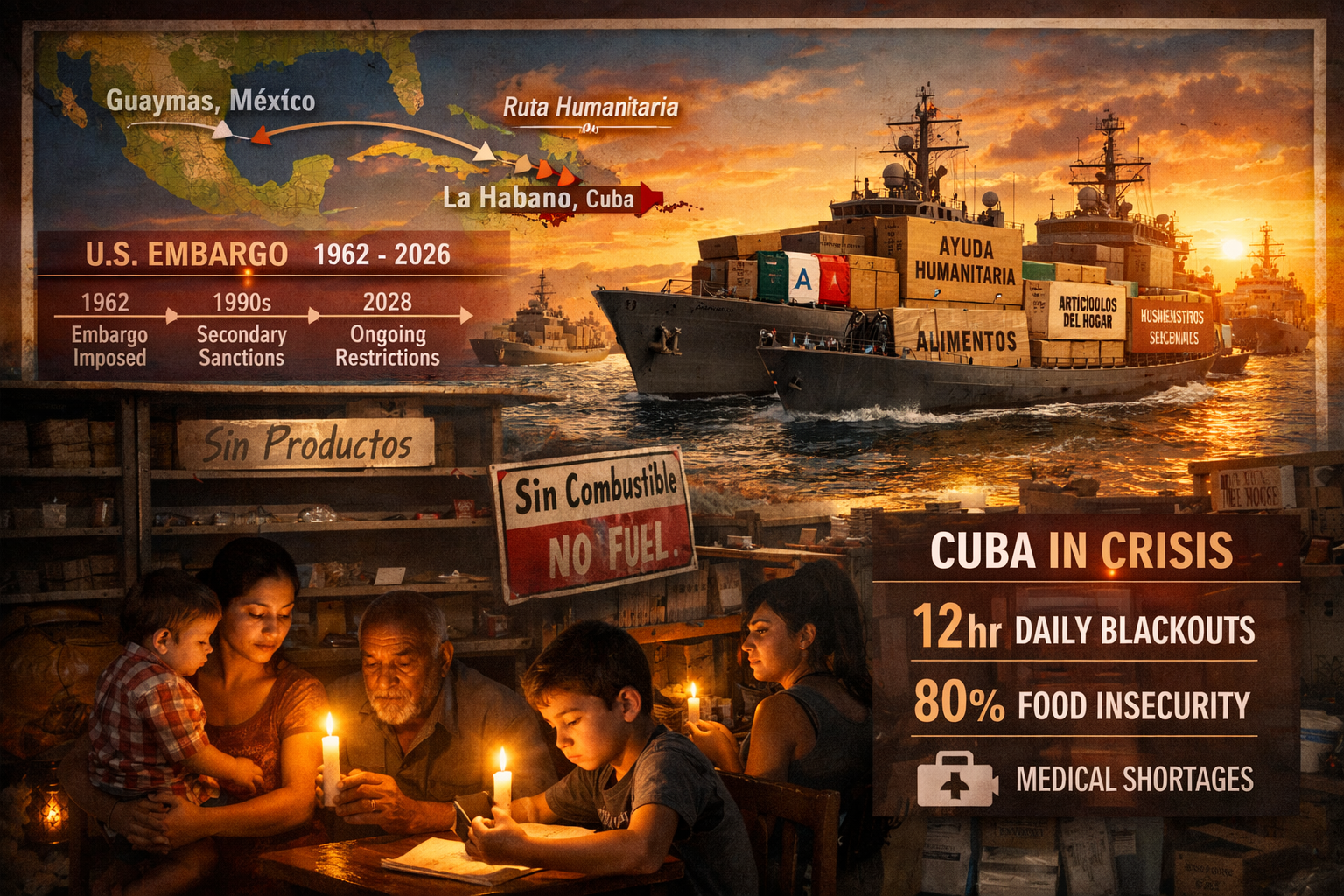
Cuba faces a severe economic and energy crisis with power outages reaching up to 12 hours daily due to oil shortages, with the situation significantly worsened following Venezuela’s supply suspension.[3] Imagine living in a place where electricity is only available half the day. Refrigerators don’t work. Medical equipment shuts down. Water pumps stop. Food spoils. It’s not just inconvenient—it’s life-threatening.
The energy crisis compounds Cuba’s broader economic struggles:
- 💡 12-hour daily blackouts affecting homes, hospitals, and businesses
- 🏭 Industrial production halted due to unreliable power
- 🏥 Healthcare services compromised by equipment failures
- 🍽️ Food security threatened by refrigeration loss
- 💧 Water access disrupted when pumps can’t operate
The Embargo’s Role
The United States maintains a long-standing embargo against Cuba dating to 1962, and applies secondary sanctions targeting foreign firms engaging with Havana.[1] This isn’t ancient history—it’s active policy that shapes every aspect of Cuban life in 2026.
Secondary sanctions are particularly insidious. They don’t just prevent U.S. companies from doing business with Cuba. They threaten to punish any company, anywhere in the world, that trades with the island. It’s economic warfare designed to isolate Cuba completely, and it’s why Sheinbaum warned that Trump’s threatened tariffs “may precipitate a significant humanitarian crisis.”[1]
From a progressive perspective, this embargo represents one of the longest-running failures of American foreign policy. Sixty-four years of sanctions haven’t brought democracy to Cuba—they’ve brought suffering to ordinary Cubans while providing the government a convenient scapegoat for economic failures. Meanwhile, the U.S. maintains normal relations with countries whose human rights records make Cuba look like Switzerland.
Why This Matters for Progressive Values and International Solidarity
For readers of the Mohawk Valley Voice, this story connects to core progressive principles that should guide both local and international policy:
1. Humanitarian aid should never be weaponized. When people are suffering, the moral response is to help them, not use their desperation as leverage for political goals. Mexico’s insistence on sending aid despite threats embodies this principle.
2. Sovereignty matters for all nations, not just powerful ones. Mexico’s right to make independent foreign policy decisions deserves the same respect as America’s. De la Fuente’s declaration that Mexico won’t submit to external pressure on humanitarian aid reflects the kind of independence we should celebrate.[4]
3. Diplomacy beats bullying. Rather than simply defying the U.S. or completely capitulating, Mexico is pursuing diplomatic channels while maintaining its humanitarian commitments. That’s how international relations should work—through dialogue and negotiation, not threats and ultimatums.
4. Economic sanctions harm ordinary people most. The folks suffering from 12-hour blackouts in Havana aren’t government officials—they’re families, elderly people, children, and workers. Progressive policy recognizes that collective punishment is both ineffective and immoral.
Lessons for Local Activism
These international dynamics mirror challenges we face right here in upstate New York. When federal or state governments threaten to withhold funding from sanctuary cities, or when economic pressure gets applied to communities that resist unjust policies, the same principles apply:
- Stand firm on moral principles even when pressure mounts
- Seek diplomatic solutions while maintaining core commitments
- Prioritize human welfare over political point-scoring
- Build coalitions with others who share your values
Mexico’s approach—pausing oil shipments while maintaining humanitarian aid and pursuing diplomatic channels—shows how to navigate pressure without abandoning principles. That’s a model for progressive governance at any level.
The Geopolitical Chess Game: Venezuela, Cuba, and U.S. Power
The current crisis didn’t emerge in a vacuum. It’s the result of interconnected U.S. actions targeting leftist governments in Latin America.
The January 3, 2026, seizure of Venezuelan President Nicolás Maduro represents an extraordinary escalation of U.S. intervention in the hemisphere.[1][2][3] While Maduro’s government has serious democratic deficits and human rights problems, the precedent of a U.S. military operation removing a sitting head of state should concern anyone who values international law and national sovereignty.
Venezuela’s subsequent suspension of oil shipments to Cuba wasn’t coincidental—it was the direct result of regime change. Cuba lost its primary energy supplier overnight, creating the crisis Mexico is now trying to address.
This sequence reveals a strategic pattern:
- Target Venezuela → Remove Maduro → Cut Cuba’s oil supply
- Pressure Mexico → Threaten sanctions → Reduce Cuba’s alternative supply
- Declare emergency → Sanction any remaining suppliers → Complete isolation
- Wait for collapse → Blame Cuban government → Justify intervention
It’s a playbook designed to force regime change through economic strangulation. Whether you think that’s justified depends on your view of American power and intervention, but the humanitarian costs are undeniable.
What Happens Next: Scenarios and Possibilities
As Mexico prepares to send humanitarian aid this week, several scenarios could unfold:
Scenario 1: U.S. Accepts Humanitarian Exception
Trump’s administration could recognize a distinction between humanitarian aid (food, household goods) and strategic resources (oil, fuel). This would allow Mexico to continue current shipments while maintaining the oil embargo. It’s the most likely outcome in the short term, as blocking food aid would create terrible optics internationally.
Scenario 2: Escalating Economic Pressure
Trump could follow through on tariff threats against Mexico for any Cuba engagement. Given that Mexico is America’s largest trading partner as of 2026, this would be economically devastating for both countries. It’s possible but risky, especially with USMCA (the trade agreement replacing NAFTA) still in effect.
Scenario 3: Diplomatic Breakthrough on Fuel
Mexico’s diplomatic channels with Secretary Rubio could yield an agreement allowing limited fuel shipments specifically for humanitarian purposes (hospitals, water systems, emergency services). This would require the U.S. to back down slightly while maintaining pressure on the Cuban government.
Scenario 4: Regional Coalition Building
Mexico could coordinate with other Latin American nations to collectively resist U.S. pressure on Cuba. Countries like Argentina, Bolivia, and Nicaragua might join a humanitarian aid coalition, making it harder for the U.S. to sanction everyone simultaneously.
The View from Utica: Why International Solidarity Matters Locally
You might be wondering why a progressive news outlet serving the Mohawk Valley should care about Mexican aid to Cuba. Fair question. Here’s why it matters:
International solidarity and local activism are connected. The same values that drive Mexico to help Cuba despite pressure should drive us to support vulnerable communities here in Oneida County despite political headwinds. Whether it’s defending immigrant rights, supporting workers organizing for better conditions, or protecting social services from budget cuts, the principle is the same: stand with people who need help, even when it’s inconvenient.
Economic coercion affects us too. When the federal government threatens to withhold highway funds unless states comply with certain policies, or when Albany pressures localities through budget mechanisms, that’s the same dynamic as U.S. sanctions on Cuba—just less extreme. Understanding how economic pressure works internationally helps us recognize and resist it locally.
Foreign policy reflects values. The way America treats Cuba, Mexico, and other nations reveals what our government actually values versus what it claims to value. Holding our representatives accountable on foreign policy is part of comprehensive progressive activism.
What You Can Do
If this story resonates with you, here are concrete actions:
- Contact your representatives. Tell Senators Schumer and Gillibrand, and Representative Tenney (NY-24) that you support diplomatic solutions over economic warfare, and that humanitarian aid should never be blocked for political purposes.
- Support local international solidarity groups. Organizations in the Mohawk Valley work on immigrant rights, fair trade, and international justice issues. Your participation strengthens these networks.
- Stay informed on Latin American issues. Progressive media outlets provide coverage that mainstream sources often miss. Understanding these dynamics makes you a better-informed voter and activist.
- Connect international and local issues. When discussing sanctuary policies, workers’ rights, or economic justice locally, draw parallels to international struggles. It builds broader coalitions and deeper understanding.
- Challenge the embargo narrative. When Cuba comes up in conversation, question whether 64 years of sanctions have achieved anything positive. Advocate for policy changes that prioritize human welfare over failed ideological crusades.
Conclusion: Humanitarian Values in a Hardball World
Mexico’s decision to send humanitarian aid to Cuba amid Havana-Washington tensions represents more than a diplomatic maneuver. It’s a statement about what kind of neighbor—and what kind of nation—Mexico chooses to be. Despite enormous economic pressure, threats of sanctions, and the risk of antagonizing its largest trading partner, Mexico is prioritizing human welfare over political expediency.
President Sheinbaum’s words capture this commitment: “We are already doing all the work necessary to send humanitarian aid that the Cuban people need—other household items and supplies.”[1] It’s a simple statement with profound implications. The Cuban people—not the government, not the political system, but the people—need help. And Mexico will provide it.
Foreign Affairs Secretary de la Fuente reinforced this principle, declaring that Mexico “does not accept the prohibition of humanitarian aid to any country” and characterizing such aid as essential to maintaining dialogue and exercising sovereignty.[4]
As the naval vessels prepare to depart from Guaymas this week, carrying food, household goods, and essential supplies across the Gulf of Mexico to Havana, they carry something else too: a reminder that compassion and solidarity still have a place in international relations, even in 2026’s hardball geopolitical environment.
For those of us committed to progressive values—whether in Utica, Mexico City, or Havana—this story offers both inspiration and instruction. Stand firm on principles. Seek diplomatic solutions. Prioritize human welfare. Build coalitions. And never let the powerful convince you that helping people is somehow wrong.
The humanitarian crisis in Cuba will continue. U.S. pressure on Mexico will likely intensify. But Mexico’s commitment to sending aid despite these obstacles shows that another approach is possible—one that recognizes our shared humanity across borders and refuses to weaponize suffering for political gain.
That’s a vision worth supporting, and a principle worth defending, wherever we call home.
References
[1] upi – https://www.upi.com/Top_News/World-News/2026/02/02/latam-mexico-humanitarian-aid-Cuba/8971770017703/
[2] Mexicos Sheinbaum Pledges Send Humanitarian Aid Cuba 129759101 – https://abcnews.go.com/International/wireStory/mexicos-sheinbaum-pledges-send-humanitarian-aid-cuba-129759101
[3] Do Te Dergojme Ndihme Humanitare Per Kuben Pavaresisht Presionit Te Shba Se Presidentja E Meksikes – https://www.hashtag.al/en/index.php/2026/02/02/do-te-dergojme-ndihme-humanitare-per-kuben-pavaresisht-presionit-te-shba-se-presidentja-e-meksikes/
[4] X9yz19o – https://www.dailymotion.com/video/x9yz19o


