


Sarah Martinez sat in her cubicle at a manufacturing firm in Utica, watching younger colleagues get promoted while she remained stuck in the same position for three years. She had the experience, the work ethic, and the dedication—but something was missing. The answer wasn’t another degree or working longer hours. It was something both simpler and more challenging: embracing lifelong learning.
You want to move up the career ladder but aren’t sure quite how to do so. You’re not alone in feeling this way, but you can get ahead by knowing an important element in growing your career: lifelong learning. That doesn’t necessarily mean you have to go back to school, although some people do. It could instead refer to exploring new tech, reading up on industry trends, and staying curious. Digital skills, such as SEO, are an example of how learning can improve professional success. One of the best ways to develop these skills is by learning from trusted experts in the field.
In 2026, the professional landscape has fundamentally shifted. The skills that got workers hired five years ago might not keep them employed tomorrow. For working families across the Mohawk Valley and beyond, understanding how to navigate this new reality isn’t just about career advancement—it’s about economic security and opportunity.
Key Takeaways
- Skills expire faster than ever: By 2030, 39% of today’s professional skills will be outdated, making continuous learning essential for career survival[1]
- Learning drives retention and advancement: Employees with access to growth opportunities are 67% confident in their career prospects versus just 50% for those without development programs[1]
- You don’t need another degree: Micro-learning, digital skills training, and industry trend monitoring offer practical pathways to career growth without traditional schooling[2]
- Organizations reward learners: Companies with strong career development programs are 42% more likely to lead in technology adoption and innovation[1]
- Skills-based hiring is the future: By 2026, demonstrable competencies matter more than credentials, making continuous skills validation crucial for mobility[2]
Why Your Career Feels Stuck (And Why It’s Not Your Fault)
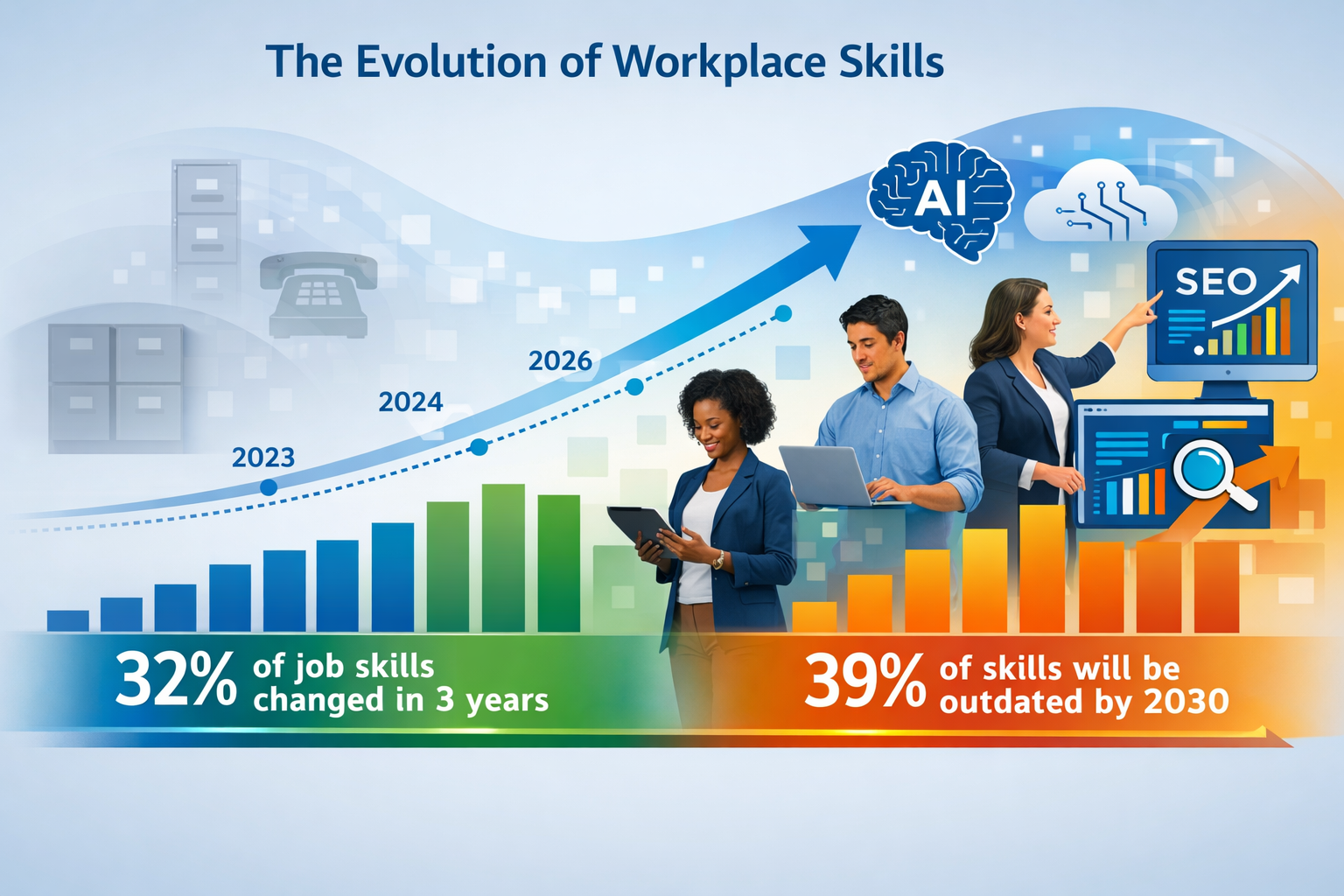
The traditional career playbook—get a degree, land a job, work hard, get promoted—has been rewritten. In the last three years alone, 32% of the skills needed for the average job have changed[1]. That’s not a gradual evolution; it’s a professional revolution happening in real time.
For workers in upstate New York’s manufacturing sector, healthcare facilities, and small businesses, this rapid change creates genuine anxiety. The jobs that sustained previous generations now require entirely different skill sets. A production supervisor needs to understand automation software. A healthcare administrator must navigate telehealth platforms. A local business owner should grasp digital marketing fundamentals like SEO.
The skills gap isn’t just affecting individual careers—it’s reshaping entire organizations. According to recent data, 63% of employers identify skills gaps as the biggest barrier to business transformation[1]. This means the challenge workers face isn’t personal failure; it’s a systemic shift that requires systemic solutions.
The Economic Reality Behind the Skills Crisis
Here’s a number that should concern anyone thinking about their financial future: only 0.5% of global GDP is currently invested in adult lifelong learning[5]. Yet increasing investment in reskilling and upskilling could boost global GDP by $6.5 trillion by 2030[5]. That massive gap represents both a crisis and an opportunity.
For working families struggling with economic inequality and stagnant wages, this matters deeply. The workers who adapt and learn continuously will capture a disproportionate share of future economic gains. Those who don’t risk being left behind in an economy that increasingly rewards specialized, up-to-date skills.
How Lifelong Learning Opens Doors You Didn’t Know Existed
When Marcus Johnson, a customer service representative at a Rome, NY call center, started taking free online courses in data analytics during his lunch breaks, he didn’t expect much. He was simply curious about the numbers his team generated. Six months later, that curiosity translated into a promotion to operations analyst—and a 30% salary increase.
Marcus’s story illustrates a crucial truth: lifelong learning isn’t about collecting credentials; it’s about developing relevant capabilities that solve real problems.
The New Currency of Career Advancement
Traditional markers of professional success—tenure, degrees, job titles—still matter, but they’re no longer sufficient. In 2026, the real currency is demonstrable skills that align with organizational needs.
Consider these compelling statistics:
| Career Development Impact | With Learning Programs | Without Learning Programs |
|---|---|---|
| Confidence in retention | 67% | 50% |
| Confidence in attracting talent | 71% | 58% |
| AI adoption leadership | 42% higher likelihood | Baseline |
Source: Learning and Development Statistics[1]
Organizations that invest in employee development don’t just retain workers better—they become more competitive, innovative, and resilient. For individual workers, this creates a clear pathway: align your learning with organizational priorities, and you become indispensable.
Digital Skills: The Universal Career Accelerator
Digital literacy has evolved from a specialized skill to a fundamental requirement across virtually every industry. Whether someone works in healthcare, manufacturing, education, or small business, understanding digital tools and platforms is non-negotiable.
SEO (Search Engine Optimization) provides a perfect example. A local business owner who understands SEO basics can drive customer traffic without expensive advertising. A nonprofit director who grasps SEO principles can amplify their organization’s message. A job seeker who optimizes their LinkedIn profile using SEO concepts becomes more discoverable to recruiters.
The beauty of digital skills like SEO is their accessibility. Unlike traditional credentials that require years of schooling and significant debt, digital competencies can be developed through:
- 📚 Free online courses from platforms like Google Digital Garage, HubSpot Academy, and Coursera
- 🎯 Micro-learning modules that take 15-30 minutes and focus on specific skills
- 👥 Peer learning communities where professionals share knowledge and experiences
- 🔍 Hands-on practice through personal projects, volunteer work, or side hustles
The democratization of learning means that a motivated worker in Utica has access to the same educational resources as someone in Silicon Valley. The only barriers are time, awareness, and initiative.
Learning From Trusted Experts: Why It Matters More Than Ever
In an era of information overload and misinformation, the source of learning matters as much as the content itself. YouTube tutorials and blog posts have value, but structured learning from recognized experts provides something different: credibility, depth, and career-relevant validation.
When employers see that a candidate has completed training from industry-recognized experts or established institutions, it signals seriousness and quality. This matters especially as skills-based hiring becomes the dominant model by 2026[2].
The Rise of Micro-Credentials and Targeted Learning
Traditional four-year degrees aren’t disappearing, but they’re being supplemented—and sometimes replaced—by more flexible learning pathways. Micro-learning has become the backbone of career growth[2], allowing workers to rapidly build targeted skills without committing to long-term programs.
This shift benefits working families in several ways:
✅ Lower cost: Micro-credentials typically cost hundreds rather than thousands of dollars
✅ Faster completion: Weeks or months instead of years
✅ Immediate application: Skills can be applied to current work immediately
✅ Stackable credentials: Multiple micro-credentials can build toward larger certifications
✅ Employer recognition: Growing acceptance among hiring managers and HR departments
For someone balancing work, family, and financial constraints, micro-learning offers a realistic pathway to career advancement. A parent in New Hartford can complete a digital marketing certification while kids are asleep. A shift worker in Utica can learn Python programming during downtime.
AI and the Learning Imperative
The explosion of artificial intelligence has created both urgency and opportunity in professional development. AI-related course enrollments grew 195% year-over-year[1], reflecting intense demand from workers seeking to stay relevant.
But here’s the critical insight: AI won’t replace workers who learn; it will replace workers who don’t. Understanding how to work alongside AI tools, prompt them effectively, and integrate them into workflows has become essential across industries.
Organizations recognize this reality. A striking 85% of employers say upskilling is a top five-year priority[1], acknowledging that external hiring alone cannot close emerging skills gaps. For individual workers, this creates a clear opportunity: develop AI literacy now, and become the person who helps your organization navigate the transition.
Staying Curious: The Mindset That Matters Most
Technical skills matter, but the most valuable asset in a rapidly changing economy is something less tangible: curiosity. The workers who thrive aren’t necessarily the smartest or most credentialed—they’re the ones who remain genuinely interested in how things work and how they might work better.
Reading industry publications, attending webinars, participating in professional associations, and asking questions all signal a growth mindset that employers value. In the Mohawk Valley, this might mean:
- 📰 Following local economic development news to understand emerging opportunities
- 🤝 Joining regional professional networks to build connections and share knowledge
- 💡 Volunteering for projects that stretch current capabilities
- 🎓 Attending town hall meetings and community forums to understand civic and economic priorities
- 📊 Tracking trends in your industry through trade publications and thought leaders
This kind of informal learning doesn’t come with certificates, but it builds something equally valuable: contextual intelligence that helps workers anticipate changes and position themselves advantageously.
The Retention Advantage: Why Employers Care About Your Learning
Here’s something that might surprise workers feeling stuck: career development is now one of the strongest retention levers for organizations[1]. Employers lose valuable institutional knowledge and face significant costs when experienced workers leave. Investing in employee development has become a strategic priority.
This creates leverage for workers. Approaching a supervisor with a specific learning plan—”I’d like to develop skills in X to help with Y business challenge”—demonstrates initiative while aligning personal growth with organizational needs. Many employers will support this learning through:
- 💰 Tuition reimbursement programs
- ⏰ Paid time for professional development
- 🎯 Access to corporate learning platforms
- 👨🏫 Mentorship from senior leaders
- 🏆 Recognition and advancement opportunities for skill development
Workers don’t have to navigate lifelong learning alone. Smart organizations understand that employee growth and business success are interconnected.
Practical Steps: Building Your Lifelong Learning Plan
Knowing that lifelong learning matters is one thing. Actually doing it requires a practical approach that fits into already-busy lives. Here’s a realistic framework for working professionals:
Step 1: Identify Your Skills Gap
Start by honestly assessing where you are versus where you want to be. Ask yourself:
- What skills do people in my target position have that I lack?
- What technologies or tools is my industry adopting that I don’t understand?
- What feedback have I received from supervisors about areas for growth?
- What tasks do I avoid because they feel outside my comfort zone?
Step 2: Prioritize High-Impact Learning
Not all skills are equally valuable. Focus on capabilities that:
- ✅ Align with organizational priorities and business needs
- ✅ Are in demand across multiple employers (career insurance)
- ✅ Build on existing strengths rather than starting from zero
- ✅ Have clear, measurable outcomes you can demonstrate
For 2026, high-impact areas include:
- Digital marketing and SEO fundamentals
- Data analysis and visualization
- AI tool literacy and prompt engineering
- Project management methodologies
- Communication and stakeholder management
- Cloud platform basics (Microsoft 365, Google Workspace)
Step 3: Create a Realistic Learning Schedule
Consistency beats intensity. Thirty minutes of focused learning three times per week will produce better results than occasional marathon sessions. Build learning into existing routines:
- 🌅 Morning coffee time: Read industry news or watch a tutorial
- 🚗 Commute time: Listen to educational podcasts
- 🥗 Lunch breaks: Complete micro-learning modules
- 🌙 Evening downtime: Practice new skills on personal projects
Step 4: Learn From Trusted Sources
Quality matters. Prioritize learning from:
- Industry-recognized platforms: LinkedIn Learning, Coursera, edX, Udacity
- Professional associations: Industry-specific organizations offering certifications
- Established institutions: Community colleges, state universities with online programs
- Reputable companies: Google, HubSpot, Salesforce offering free training
- Verified experts: Instructors with proven track records and credentials
Step 5: Apply and Demonstrate New Skills
Learning without application is just entertainment. Make new skills visible by:
- 🎯 Volunteering for projects that use new capabilities
- 📝 Documenting your learning journey on LinkedIn
- 💼 Creating portfolio pieces that showcase competencies
- 🗣️ Sharing knowledge with colleagues through informal teaching
- 📊 Tracking measurable improvements in your work
Step 6: Seek Feedback and Iterate
Regular check-ins help ensure your learning aligns with career goals:
- Schedule quarterly conversations with supervisors about development
- Ask mentors for honest assessment of your progress
- Request specific feedback after applying new skills
- Adjust your learning plan based on what’s working and what isn’t
The Community Dimension: Learning Together
Individual learning matters, but collective learning transforms communities. When workers across the Mohawk Valley invest in continuous development, the entire region benefits through:
- 💼 Stronger workforce that attracts new employers and investment
- 🏢 More competitive local businesses that can compete regionally and nationally
- 📈 Higher wages as workers develop more valuable capabilities
- 🤝 Knowledge sharing that elevates everyone’s skills
- 🌱 Economic resilience that weathers industry disruptions
Local libraries, community colleges, workforce development programs, and nonprofit organizations offer learning resources specifically designed for working adults. Taking advantage of these community assets isn’t just smart individual strategy—it’s civic participation that strengthens the local economy.
Organizations like the Workforce Development Board of Herkimer, Madison and Oneida Counties provide free or low-cost training aligned with regional employer needs. These programs understand the specific challenges facing upstate New York workers and offer practical pathways to better opportunities.
Overcoming Common Barriers to Lifelong Learning
Understanding the value of continuous learning is one thing. Actually making it happen requires addressing real obstacles that working people face:
“I Don’t Have Time”
Reality check: Half of all workers have completed training, upskilling, or reskilling in the past three years[1]. They’re not less busy—they’ve made it a priority.
Solution: Start smaller than feels meaningful. Ten minutes daily compounds into 60+ hours annually. Micro-learning modules fit into existing gaps in your schedule.
“I Can’t Afford It”
Reality check: Thousands of high-quality courses are completely free. Employers increasingly offer tuition support. Community resources provide no-cost training.
Solution: Explore free platforms first. Investigate employer benefits you might not be using. Check local library offerings and workforce development programs.
“I’m Too Old to Learn New Things”
Reality check: Neuroplasticity research shows brains remain capable of learning throughout life. Experience actually provides advantages in contextualizing new information.
Solution: Focus on building from existing knowledge rather than starting from scratch. Leverage your experience to understand why new skills matter and how they apply.
“I Don’t Know Where to Start”
Reality check: Information overload is real, but structured pathways exist for virtually every career field and skill area.
Solution: Start with your current employer’s learning platform. Ask colleagues what they’re learning. Consult professional associations for recommended development paths.
Conclusion: Your Move on the Career Ladder Starts Today
The career ladder hasn’t disappeared—it’s been transformed. The rungs that once represented years of service and gradual advancement now represent demonstrated capabilities and continuous growth. This shift creates both challenge and opportunity for workers across the Mohawk Valley and beyond.
You want to move up the career ladder but aren’t sure quite how to do so. You’re not alone in feeling this way, but you can get ahead by knowing an important element in growing your career: lifelong learning. That doesn’t necessarily mean you have to go back to school, although some people do. It could instead refer to exploring new tech, reading up on industry trends, and staying curious. Digital skills, such as SEO, are an example of how learning can improve professional success. One of the best ways to develop these skills is by learning from trusted experts in the field.
The economic data is clear: skills are expiring faster than ever, employers are prioritizing development, and workers who embrace continuous learning are positioning themselves for success. By 2030, 39% of today’s skills will be outdated[1]. The question isn’t whether to invest in learning—it’s how quickly you’ll start.
Take Action This Week
Don’t let this be another article you read and forget. Take concrete steps:
- Identify one skill that would make you more valuable in your current role or target position
- Find a trusted learning source offering training in that skill (start with free options)
- Block 30 minutes on your calendar this week for your first learning session
- Tell someone about your learning goal to create accountability
- Apply the skill within one week of learning it, even in a small way
The workers who will thrive in 2026 and beyond aren’t necessarily the most talented or credentialed—they’re the most adaptable and committed to growth. That can be you.
The Mohawk Valley’s future depends on workers who invest in themselves, employers who support development, and communities that value continuous learning. Your career advancement isn’t just about personal success—it’s about contributing to a more resilient, prosperous region.
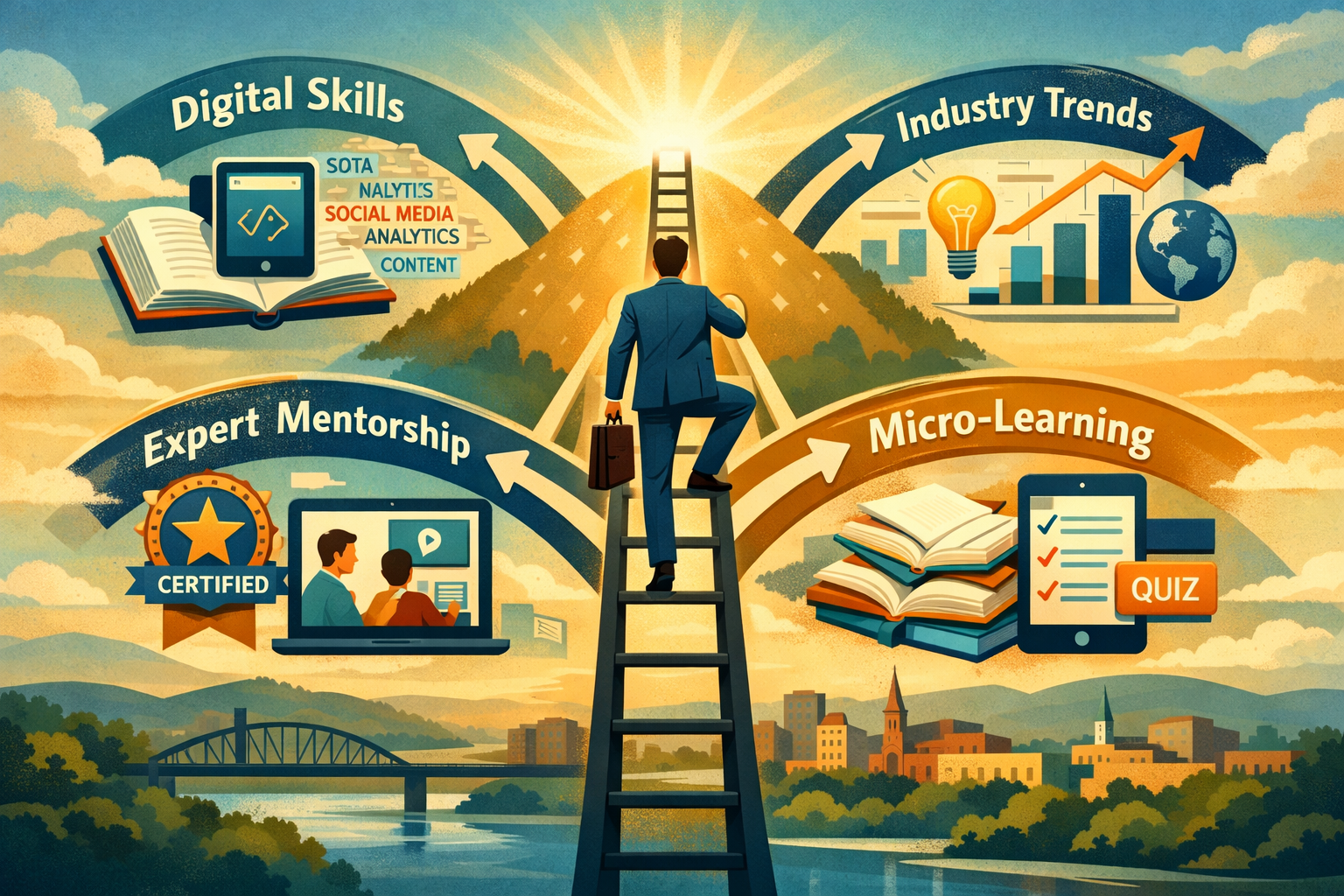
The ladder is there. The rungs are accessible. The only question is whether you’ll take the first step up.
References
[1] Learning And Development Statistics – https://www.aihr.com/blog/learning-and-development-statistics/
[2] 10 Trends In Career Advising And Development For 2026 – https://www.icadlearn.com/post/10-trends-in-career-advising-and-development-for-2026
[5] Reskilling Revolution Preparing 1 Billion People For Tomorrows Economy – https://www.weforum.org/stories/2026/01/reskilling-revolution-preparing-1-billion-people-for-tomorrows-economy/


