


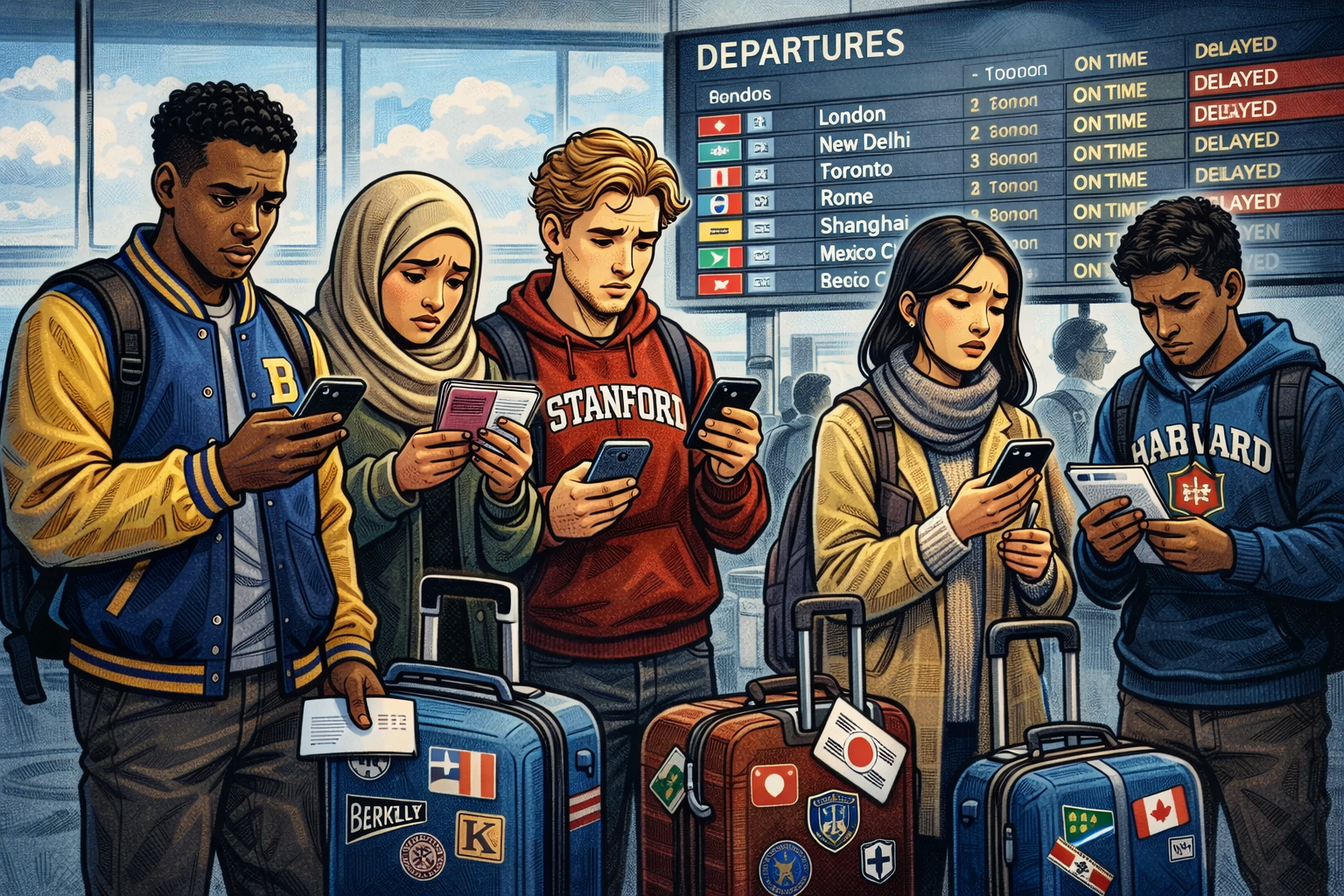
Unprecedented Holiday Travel Advisory Leaves Immigrants Facing Difficult Choices
Immigration lawyers and universities across America are issuing an unusual warning this holiday season: immigrants, even those with legal status, should avoid international travel during Christmas and New Year. The advisory comes as the federal government signals more restrictive immigration policies and enhanced screening at airports and borders. With the Trump administration considering expanding restricted nationalities from 19 to 30 countries, many immigrants face a tough decision between visiting family abroad and protecting their ability to return home to America.
Why Immigration Experts Are Sounding the Alarm
The warnings are not coming from fringe voices. Major universities and established law firms have sent urgent messages to international students, faculty, and immigrants.
Cornell University’s Office of Global Learning warned that a travel ban “is likely to go into effect soon after inauguration.” The university advised students to return to the United States before spring semester classes begin on January 21, 2025.
The University of Southern California’s Office of International Services sent similar guidance. “A new presidential administration will take office on January 20, 2025, and may issue one or more executive orders impacting travel to the U.S. and visa processing,” the letter stated. “While there’s no certainty such orders will be issued, the safest way to avoid any challenges is to be physically present in the U.S.”
WR Immigration, a major immigration law firm, advised clients directly: “There may be new travel bans on day one so while I am advising clients not to panic, I am recommending returning before January 20, 2025, if possible.”
Which Countries Face Heightened Risk?
The concerns are not hypothetical. During the first Trump administration, citizens from several countries faced sudden travel restrictions.
According to immigration law firm Fragomen, individuals who were born in or are citizens of the following countries were subject to certain travel bans during the first Trump administration:
- Chad
- Eritrea
- Iran
- Iraq
- Kyrgyzstan
- Libya
- Myanmar
- Nigeria
- North Korea
- Somalia
- Sudan
- Syria
- Tanzania
- Venezuela
- Yemen
Fragomen noted that “new countries could be added to this list, particularly China and India.” The firm emphasized that foreign nationals from these countries should consider consulting with counsel before finalizing travel plans for on or after January 20, 2025.
More Than 400,000 Students Affected
The warnings have created anxiety among hundreds of thousands of international students. According to the Higher Ed Immigration Portal, more than 400,000 undocumented students are enrolled in U.S. higher education.
Professor Chloe East of the University of Colorado Denver told the BBC: “All international students are worried right now. Students are incredibly overwhelmed and stressed out as a result of the uncertainty around immigration.”
Aoi Maeda, an international student from Japan studying at Earlham College in Indiana, expressed concerns about her academic future. “I am planning to graduate in May 2026, but now that the administration is going to be a little bit more dangerous, I’m less hopeful about things going well,” she said.
Social Media Screening: A New Layer of Scrutiny
Adding to traveler concerns, the federal government has dramatically expanded social media screening for anyone trying to enter the United States.
The Guardian reported that tourists to the United States would have to reveal their social media activity from the last five years under new Trump administration plans. The mandatory new disclosures would apply to 42 countries whose nationals are currently permitted to enter the U.S. without a visa, including Britain, France, Australia, Germany, and Japan.
According to a notice published in the Federal Register, U.S. Customs and Border Protection (CBP) proposed collecting:
- Social media accounts used over the last five years
- Telephone numbers used over the last five years
- Email addresses used over the last decade
- Face, fingerprint, DNA, and iris biometrics
- Names, addresses, birthdates, and birthplaces of family members
While CBP said in 2024 it searched about 47,000 devices of the 420 million people who crossed the U.S. border that year, experts said the number may be much higher under the new Trump administration.
The Brennan Center for Justice documented how social media monitoring has expanded dramatically since 2015. The State Department now requires roughly 15 million people who apply for immigrant and nonimmigrant visas each year to disclose their social media identifiers.
Student Visas Face Additional Scrutiny
International students face particular challenges. A March 2025 internal State Department cable directed consular officers to refer “certain student and exchange visitor (F, M, and J) visa applicants to the Fraud Prevention Unit (FPU) for a mandatory social media check.”
The Trump administration has demanded that prospective foreign students unlock their social media profiles. Those who refuse will be suspected of hiding their activity. Several high-profile foreign-born students have been detained for voicing support for Palestinians.
Niels Frenzen, a law professor at USC and director of its immigration clinic, said: “We have been doing know-your-rights sessions and lots of students have come in for individual sessions just to check in even if their paperwork is all in order.”
Enhanced Security Screening at Ports of Entry
Travelers should prepare for thorough screening when returning to the United States. According to Fragomen’s holiday travel guidelines, travelers can expect:
Biometric Data Collection: Your fingerprints, photograph, and travel documents will be scanned against U.S. national security and police databases.
Intensive Questioning: You may face questions about your immigration status, travel history, purpose of visit, background, arrests or convictions, employment, and other issues.
Device Searches: Officers may search your electronic devices, including phones and laptops. CBP claims the authority to search the devices of any prospective entrant to the U.S. While entrants can refuse, they may then be denied entry.
“It’s important to remain patient during the inspection process,” Fragomen advised. “Before you travel, check your employer’s procedures for dealing with searches of company-owned phones, laptops, and other devices.”
What Immigrants Should Do Now
Immigration experts recommend several precautions for anyone planning international travel:
Check Your Passport: Ensure your passport is valid for at least six months beyond your expected departure from the United States.
Verify Your Visa: Make sure your visa stamp reflects your current status, is unexpired, and has remaining valid entries if applicable.
Obtain Advance Parole: If you are applying for adjustment of status, determine whether you need advance permission to travel.
Review Pending Applications: Understand how travel might affect any pending immigration applications with USCIS.
Carry Complete Documentation: Bring original approval notices, employment verification letters, recent paystubs, and other evidence of your status.
Consider Delaying Travel: If possible, return to the U.S. before January 20, 2025, when the new policies may take effect.
The Bigger Picture: Immigration Under Pressure
These travel warnings reflect a broader shift in U.S. immigration policy. The Trump administration has pledged to enact the largest deportation operation in history and use the U.S. military to help. Officials in the incoming administration have suggested they will build vast holding facilities for undocumented immigrants on the deportation list.
Boston University’s International Students & Scholars Office urged caution: “Each international student and scholar immigration situation is different. We encourage you to speak to your ISSO advisor if you have questions. Avoid making decisions based on social media, news reports and rumors that predict potential new policies and regulations.”
The university noted that “legislative and regulatory changes take time. There are formal procedures to issue Executive Orders, legislation, regulations, and policy changes.”
Real People, Real Consequences
Behind the policy debates are real people facing difficult decisions. Many immigrants have not seen their families in years due to the pandemic and subsequent travel complications. The holiday season is traditionally a time for family reunions, making this advisory particularly painful.
For students like Aoi Maeda, the uncertainty adds stress to an already challenging experience of studying far from home. “I feel like us international students with a visa might get affected, and it’ll become easier to deport us,” she told the BBC.
Professor East emphasized the human toll: “A lot of students have concerns about their visas and whether they’ll be allowed to continue their education.”
Tourism Industry Feels the Impact
The stricter policies are having economic consequences. Tourism to the U.S. has already dropped dramatically in Trump’s second term. California tourism authorities are predicting a 9% decline in foreign visits to the state this year, while Hollywood Boulevard in Los Angeles reported a 50% fall in foot traffic over the summer.
Statistics Canada reported that Canadian residents who made return trips to the U.S. by car dropped 36.9% in July 2025 compared with July 2024. Commercial airline travel from Canada dropped by 25.8% in July compared with the previous year.
Looking Ahead: Uncertainty Remains
The full scope of new immigration policies remains unclear. While some changes can be implemented quickly through executive orders, others require lengthy regulatory processes.
What is clear is that immigrants and international students face a period of significant uncertainty. The warnings from universities and law firms reflect genuine concerns based on the experiences of the first Trump administration.
As we approach the holidays, thousands of immigrants must weigh the desire to see family against the risk of being unable to return to their homes, jobs, and studies in America.
Your Voice Matters
This situation affects real people in our communities. International students contribute to our universities, immigrants strengthen our workforce, and diversity enriches our society.
We encourage you to stay informed about these developments and support immigrant communities during this uncertain time. Share this article with anyone who might be affected by these travel warnings.
What do you think about these travel restrictions? Have they affected you or someone you know? Leave a comment below and share your story. Your voice matters in this conversation.
Thank you for reading the Mohawk Valley Voice. We appreciate your continued support as we bring you important stories that affect our community. Come back soon for more in-depth coverage of the issues that matter to you.


