


New Discovery Challenges Everything We Know About Ocean Floor Formation
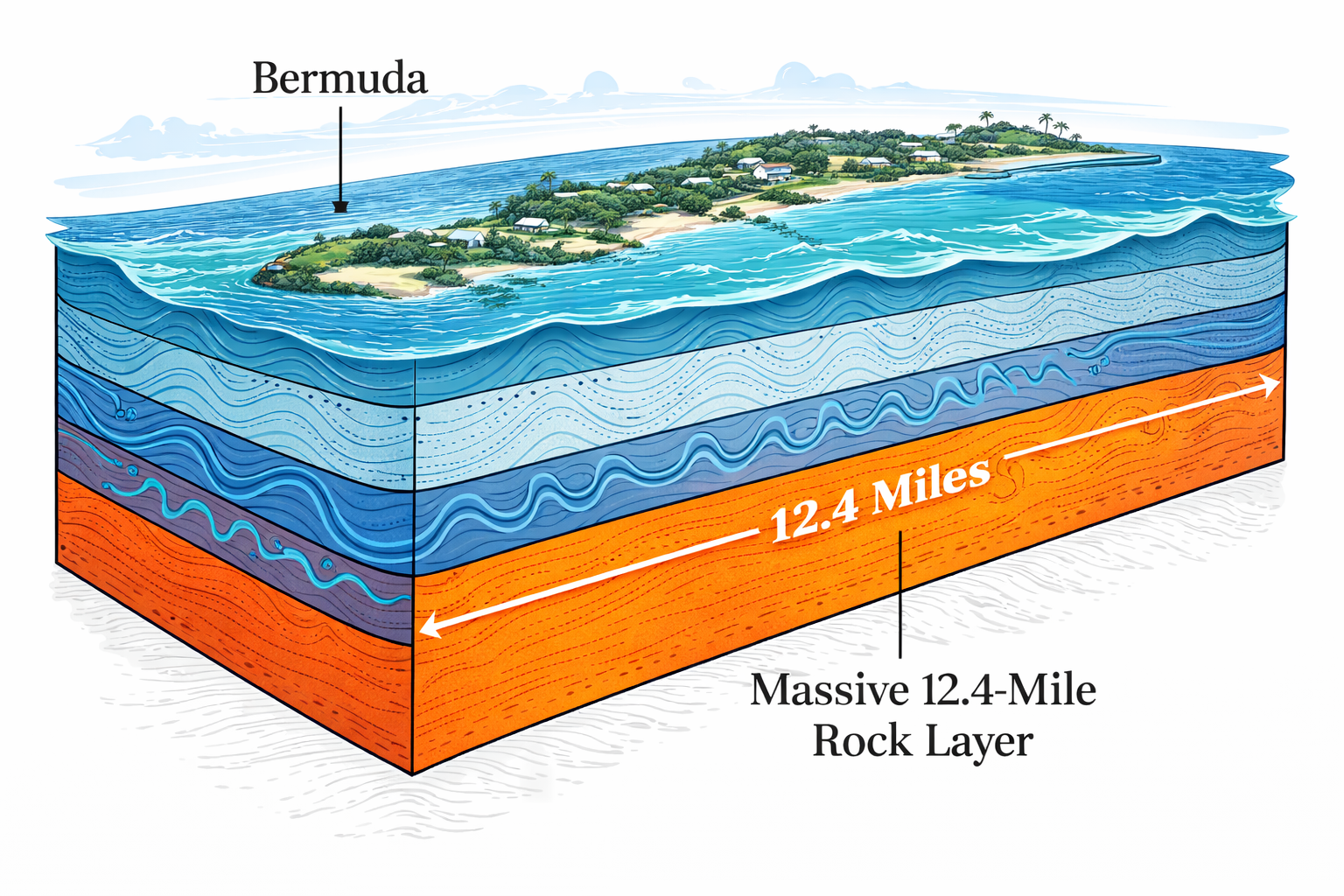
Scientists have discovered a massive 12.4-mile-thick rock layer beneath Bermuda that’s completely unlike anything else found on our planet. This groundbreaking find sits just below the oceanic crust and is roughly twice as thick as similar formations under other islands, leaving researchers scrambling to understand what makes Bermuda so unique.
The discovery came through careful analysis of seismic waves by Dr. William Frazer from Carnegie Science in Washington DC and Professor Jeffrey Park from Yale University. Their work reveals that something extraordinary is happening beneath this tiny Atlantic island, and it could reshape our understanding of how ocean floors form and evolve.
What Makes This Discovery So Unusual
The rock layer beneath Bermuda measures an impressive 12.4 miles thick. To put that in perspective, that’s about twice the thickness of similar formations found under other oceanic islands around the world.
Dr. Frazer and Professor Park made this discovery by studying seismic waves from distant earthquakes. These waves were recorded at a monitoring station on Bermuda, allowing the scientists to track how the waves changed as they traveled through rock up to 31 miles beneath the island’s surface.
This detective work revealed something completely unexpected. The layer’s composition and size don’t match the typical patterns we see elsewhere on Earth. It’s a geological anomaly that demands explanation.
How Scientists Made This Breakthrough Discovery
The research team used sophisticated seismology techniques to peer deep beneath Bermuda’s surface. Here’s how they did it:
The Detection Process:
- Monitored seismic waves from earthquakes occurring around the globe
- Tracked wave behavior as they passed through Bermuda’s underground layers
- Analyzed changes in wave speed and direction
- Mapped the structure up to 31 miles below the island
- Identified an unusually thick layer of rock material
This method is similar to how doctors use ultrasound to see inside the human body. The seismic waves act like sound waves, bouncing off different materials and creating a picture of what lies beneath our feet.
The precision required for this work is remarkable. Scientists must account for countless variables including earthquake location, wave type, and local geological conditions. One small error could throw off the entire analysis.
Understanding Oceanic Swells and Island Formation
Bermuda sits on what geologists call an oceanic swell. This is an area where the ocean floor rises higher than the surrounding seabed. Understanding oceanic swells helps explain why this discovery is so puzzling.
Normal Oceanic Swell Formation:
- Hot material from deep within Earth rises toward the surface
- This material pushes up through the oceanic crust
- The process creates volcanic islands like Hawaii
- The surrounding seabed lifts up as well
- A predictable pattern of rock layers forms
Hawaii provides the textbook example of this process. Hot material from Earth’s mantle creates a volcanic hot spot. Over millions of years, this builds islands and raises the ocean floor around them. The resulting rock formations follow well-understood patterns.
But Bermuda doesn’t fit this model. The rock layer beneath it is far thicker than expected. This suggests something different is happening here, something we haven’t seen before.
Why This Discovery Matters for Science
This finding challenges fundamental assumptions about how oceanic islands form and what lies beneath them. Scientists now face several important questions that could reshape our understanding of Earth’s geology.
The discovery has implications beyond just Bermuda. If one island can have such an unusual formation, what about other islands? Could there be similar surprises waiting beneath other parts of the ocean floor?
Understanding this layer could also help us learn more about Earth’s internal processes. The mechanisms that created this formation might be working in other places too, influencing everything from earthquake patterns to mineral deposits.
Key Scientific Questions:
- What created this unusually thick layer?
- Why is it unique to Bermuda?
- How old is this formation?
- Does it affect earthquake activity in the region?
- Are there other similar formations we haven’t discovered yet?
The Bermuda Triangle Connection
Bermuda sits at one point of the infamous Bermuda Triangle, an area long associated with mysterious disappearances and strange phenomena. While this scientific discovery has nothing to do with those legends, it does add a genuine mystery to the region.
The Bermuda Triangle has captured public imagination for decades. Stories of vanishing ships and aircraft have fueled countless theories and investigations. Most of these disappearances have rational explanations related to weather, human error, or equipment failure.
However, this new geological discovery reminds us that the ocean still holds many real secrets. The earth beneath our feet, and beneath our seas, remains largely unexplored. Every new discovery like this one shows how much we still have to learn.
What Happens Next in This Research
The scientists who made this discovery are now planning follow-up studies. They need to gather more data to understand exactly what this layer is made of and how it formed.
Future research will likely involve:
Planned Investigation Steps:
- Additional seismic studies from different angles
- Computer modeling of the layer’s formation
- Comparison with other oceanic islands
- Analysis of rock samples if possible
- Collaboration with other research institutions
Dr. Frazer and Professor Park have opened a new chapter in our understanding of Bermuda’s geology. Their work demonstrates the value of careful, methodical scientific investigation. Sometimes the biggest discoveries come from looking at familiar places in new ways.
Other research teams will probably want to verify these findings and conduct their own studies. That’s how science works. One discovery leads to more questions, which lead to more research, which leads to greater understanding.
Implications for Our Understanding of Earth
This discovery reminds us that Earth remains a planet of mysteries. Despite our advanced technology and centuries of scientific study, we’re still uncovering fundamental surprises about how our world works.
The ocean floor covers most of our planet’s surface, yet we’ve explored less than 20 percent of it in detail. We actually know more about the surface of Mars than we do about the deepest parts of our own oceans.
Discoveries like this one beneath Bermuda push science forward. They force us to reconsider our assumptions and develop new theories. They remind us to stay curious and keep asking questions.
For the scientific community, this finding represents an exciting challenge. It’s a puzzle that needs solving, a mystery that demands explanation. That’s what drives scientists to do their work.
Conclusion: A New Chapter in Earth Science
The discovery of this massive rock layer beneath Bermuda marks an important moment in geological research. Scientists have found something that challenges our current understanding of how oceanic islands form and what lies beneath them.
This 12.4-mile-thick layer, twice as large as anything similar on Earth, raises fascinating questions about our planet’s processes and history. Dr. William Frazer and Professor Jeffrey Park have given us a genuine mystery to solve, one that will likely keep researchers busy for years to come.
As we continue to explore our planet, we’ll undoubtedly find more surprises. Each discovery adds another piece to the puzzle of how Earth works. This Bermuda finding reminds us that even in our modern age of advanced technology, our world still has secrets waiting to be uncovered.
We encourage you to share this story with others who appreciate scientific discovery. Leave a comment below with your thoughts on what might have created this unusual formation. And keep checking back at Mohawk Valley Voice for more deep dives into the stories that matter.


