


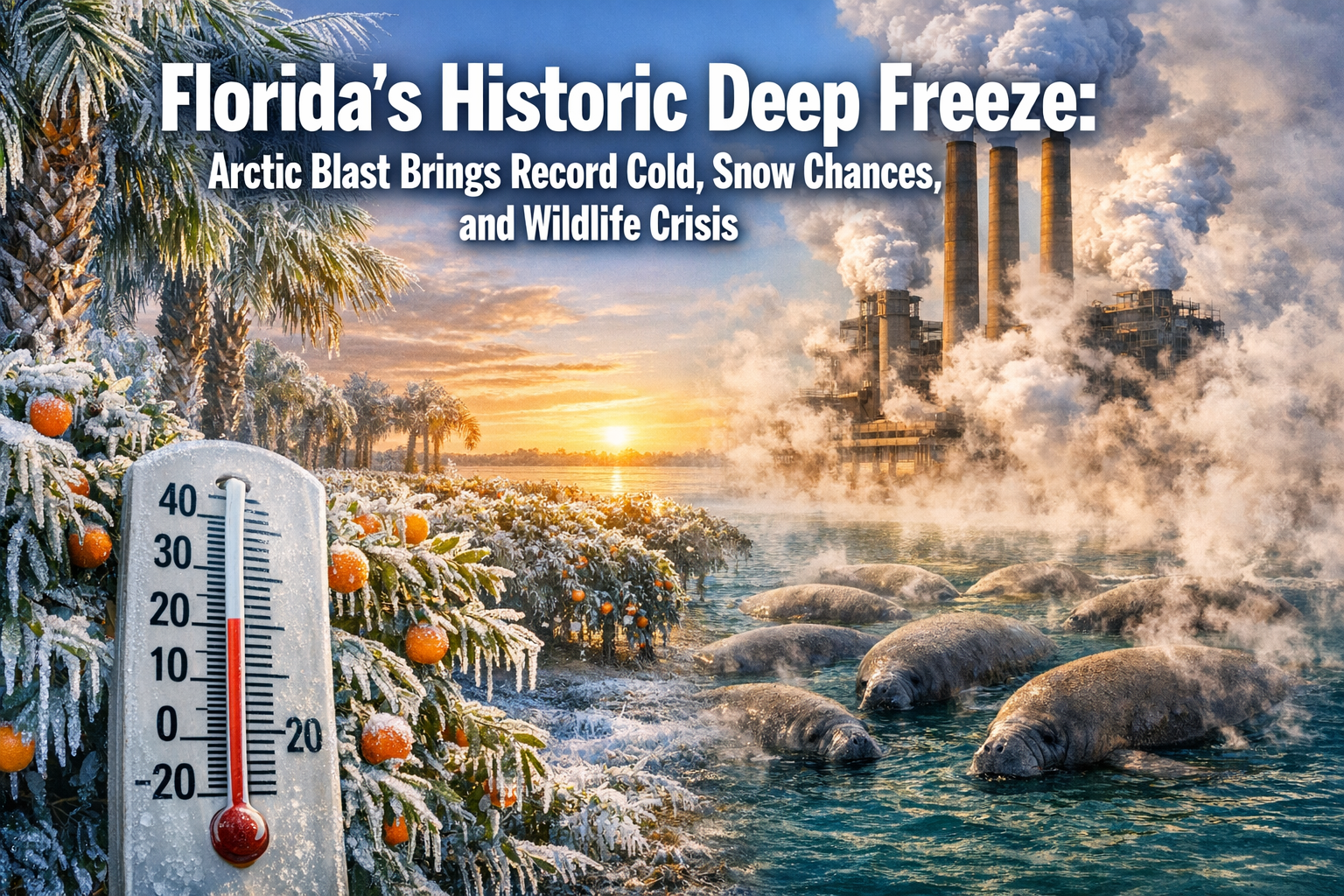
When Floridians woke up this week, they faced something most never expected to see in their lifetime: a genuine Arctic blast transforming the Sunshine State into a winter wonderland of crisis and adaptation. Saturday, Florida faces record-setting cold with temperatures dipping into the 20s near Lake Okeechobee, while Tampa Bay has a 10 to 20 percent chance of light snowfall with no accumulation—a meteorological phenomenon so rare it’s drawing national attention. A giant cyclone in the Atlantic is drawing cold air east, as a cold front that moved through earlier this week pulls an Arctic blast from Canada into the Eastern Seaboard and the Carolinas, creating blizzard threats that extend far beyond their typical northern boundaries.
This isn’t just uncomfortable weather. Zoo keepers are preparing animals with heaters and blankets, moving reptiles indoors, while invasive iguanas face high mortality and manatees gather at warm-water outflows of about a dozen power plants. Despite the cold, Tampa will go ahead with Gasparilla on Saturday, and the Tampa Bay Lightning will face the Boston Bruins Sunday at the Tampa Bay Buccaneers’ home NFL stadium. Most theme parks and zoos stay open, but water parks close. The deep freeze is already causing power outages across the South, with thousands without power as windchill may make northern Mississippi feel as cold as minus 5 degrees Fahrenheit.
For those of us watching from upstate New York, this extreme weather event offers a stark reminder: climate instability affects everyone, regardless of latitude. The same atmospheric disruptions that bring polar vortex conditions to Florida can intensify winter storms across the Mohawk Valley and beyond.
Key Takeaways
⛄ Record-Breaking Cold: Central and South Florida are experiencing their coldest temperatures in over a decade, with hard freeze conditions bringing temperatures into the mid-to-upper 20s across regions that typically see one or fewer freezing days per year.
🌊 Wildlife in Crisis: Invasive iguanas face mass die-offs, while manatees seek refuge at power plant outflows; zoo animals require emergency heating and shelter as facilities work around the clock to protect vulnerable species.
🎉 Life Goes On: Despite historic cold, Tampa’s Gasparilla festival and outdoor NHL game proceed as planned, demonstrating Florida’s resilience even as water parks close and power outages affect thousands.
🌀 Massive Weather System: A giant Atlantic cyclone is pulling unprecedented Arctic air southward, creating blizzard conditions in the Carolinas and pushing the freezing line toward the Everglades.
⚡ Infrastructure Strain: Power outages are spreading across the South as energy demand surges and systems face stress from extreme cold rarely encountered in these regions.
Understanding Florida’s Arctic Invasion: The Meteorological Perfect Storm
The current deep freeze gripping Florida represents a convergence of atmospheric conditions that meteorologists describe as both rare and increasingly concerning. Central Florida is experiencing one of its coldest stretches in years, with rare hard freeze conditions increasingly likely Sunday and Monday mornings, bringing temperatures into the mid-to-upper 20s [1].
How Cold Air Reached the Sunshine State
The mechanism behind this historic cold snap involves a massive disruption of typical atmospheric patterns. A giant cyclone spinning in the Atlantic Ocean is acting like a vacuum, drawing Arctic air far south of its normal range. This cold front, which moved through earlier this week, opened the door for a sustained Arctic blast from Canada to pour down the Eastern Seaboard and into the Carolinas before continuing its southward march [2].
The result? Wind chills plunging into the teens and single digits across much of Central Florida—temperatures more commonly associated with winter in the Mohawk Valley than the subtropics [1].
Sunday morning is forecasted to be the coldest of the current stretch, with many areas likely dropping to mid-to-upper 20s, meeting hard freeze criteria for most areas west of I-95 [1]. Near Orlando, forecast models show temperatures potentially dropping to 23-25 degrees, with the freezing line extending toward the Everglades [2].
South Florida’s Coldest Air Since 2010
South Florida is bracing for its coldest air in more than a decade, with forecasted temperatures representing the most frigid stretch since 2010 in Palm Beach County and the Treasure Coast [3]. This isn’t just a cold night or two—it’s a sustained freeze that challenges infrastructure, agriculture, and wildlife adapted to subtropical conditions.
Wind chills in South Florida may fall into the 20s, with some locations along the Treasure Coast experiencing even colder wind chills [3]. Coastal Palm Beach County typically experiences one or fewer freezing days per year, making any dip to 32 degrees or below a significant and rare weather event [3].
Consider this sobering fact: West Palm Beach’s all-time record low temperature is 24 degrees, set way back in 1894 [3]. Current forecasts are approaching this historic benchmark—a temperature not seen in 132 years.
The Duration Factor: A Multi-Day Deep Freeze
What makes this cold snap particularly dangerous is its duration. Another hard freeze is possible Monday morning across inland areas of Florida, with some locations potentially not seeing temperatures above freezing for 12 or more hours [1]. This extended exposure to freezing conditions poses severe risks to agriculture, infrastructure, wildlife, and vulnerable populations.
Freeze watches, freeze warnings, and cold-weather advisories are expected throughout South Florida, especially overnight when temperatures bottom out [3]. These aren’t routine weather alerts—they’re emergency notifications for a region where many buildings lack adequate heating and residents may not own appropriate cold-weather clothing.
Wildlife, Agriculture, and Infrastructure Under Siege
The ecological and economic impacts of this historic freeze extend far beyond human discomfort. Florida’s unique ecosystem and agricultural industry face threats that will take weeks or months to fully assess.
Zoo Animals Require Emergency Protection
Across Florida, zoo keepers are working overtime to protect animals never designed by evolution to withstand these temperatures. Zoo keepers are preparing animals with heaters and blankets, moving reptiles indoors as facilities implement emergency cold-weather protocols developed for exactly these rare scenarios [2].
At facilities from Miami to Jacksonville, staff are:
- Installing space heaters in outdoor enclosures for tropical species
- Distributing thermal blankets to larger mammals
- Moving reptile exhibits indoors to climate-controlled environments
- Providing heated shelters for birds and primates
- Monitoring animals around the clock for signs of cold stress
These emergency measures require significant resources and staffing. For smaller facilities with limited budgets, the challenge becomes even more acute—a reminder that climate instability creates costs that ripple through every sector of society.
Invasive Iguanas Face Mass Die-Off
While zoo animals receive protection, Florida’s invasive iguana population faces a different fate. Invasive iguanas face high mortality during these cold snaps, a phenomenon that has become known as “iguana rain” when the cold-blooded reptiles literally fall from trees in a state of cold-induced paralysis [2].
These non-native species, which have caused significant ecological damage to Florida’s native ecosystems, become immobilized when temperatures drop below approximately 40 degrees Fahrenheit. Extended exposure to temperatures in the 20s proves fatal for many individuals.
While this might seem like a silver lining for ecosystem management, it raises complex questions about how we respond to invasive species in an era of climate instability. Natural die-offs provide temporary population control, but surviving individuals often rebound quickly during warmer periods.
Manatees Seek Refuge at Power Plants
Perhaps the most poignant wildlife story involves Florida’s beloved manatees. These gentle marine mammals, already listed as threatened, gather at warm-water outflows of about a dozen power plants across the state during cold snaps [2].
Manatees cannot survive in water temperatures below 68 degrees Fahrenheit for extended periods. When ocean and river temperatures plummet, these animals instinctively seek the warm water discharged by power plants—an adaptation to human infrastructure that has become critical to their winter survival.
The irony is stark: fossil fuel power plants, contributors to the climate instability that creates these extreme weather events, now serve as literal lifelines for an endangered species. This dependency creates vulnerability—what happens when these plants eventually close as we transition to renewable energy? Forward-thinking conservation planning must address these questions now.
Agricultural Losses Mount
Florida’s $155 billion agricultural industry faces devastating losses from this freeze. Citrus groves, strawberry fields, and tropical fruit operations across Central and South Florida are implementing emergency measures:
- Running irrigation systems to create protective ice layers
- Deploying wind machines to circulate warmer air
- Burning smudge pots in some operations
- Covering crops with protective fabric where possible
Despite these efforts, significant crop losses are inevitable. The full economic impact won’t be known for weeks, but preliminary estimates suggest hundreds of millions of dollars in damage. These losses will translate to higher prices for consumers nationwide and economic hardship for farming communities across Florida.
Power Outages and Infrastructure Challenges Across the South
The deep freeze is already causing power outages across the South, with thousands without power as energy systems face unprecedented demand and equipment failures [2]. This infrastructure crisis extends far beyond Florida, affecting communities from Texas to the Carolinas.
Energy Demand Surges Beyond Capacity
Electrical grids designed for air conditioning loads in summer face entirely different challenges when heating demand surges during extreme cold. In regions where many homes rely on electric heat pumps or resistance heating, demand can spike dramatically.
The problem intensifies because cold weather affects power generation capacity. Natural gas supplies face pressure as heating demand competes with power generation needs. Wind turbines can ice over. Even solar panels produce less energy during cloudy winter conditions.
Thousands of residents are experiencing rolling blackouts or extended outages as utilities struggle to balance supply and demand. For vulnerable populations—elderly residents, those with medical equipment, families with young children—these outages pose serious health and safety risks.
Windchill Creates Dangerous Conditions
Windchill may make northern Mississippi feel as cold as minus 5 degrees Fahrenheit [2]—temperatures that would be notable even in upstate New York, let alone the Deep South. These conditions create immediate dangers:
- Frostbite risk within minutes of exposure
- Hypothermia threats for anyone without adequate shelter
- Frozen pipes in homes never designed for these temperatures
- Vehicle failures as batteries and fluids struggle in extreme cold
- Road hazards from ice on bridges and overpasses
Communities across the South lack the infrastructure, equipment, and experience that northern regions take for granted. Snow plows are scarce. Salt supplies are limited. Many residents don’t own winter coats adequate for these conditions.
The Carolinas Face Blizzard Conditions
While Florida deals with record cold, the Carolinas are expecting a blizzard scenario with heavy snowfall and high wind probabilities through Sunday morning, with accumulation potential of 6+ inches [2]. This represents a different but equally serious crisis.
Blizzard conditions combine heavy snow, strong winds, and low visibility to create life-threatening situations. Roads become impassable. Power lines snap under ice and wind. Emergency services struggle to respond to calls.
The same Atlantic cyclone pulling Arctic air into Florida is generating this blizzard scenario—a massive weather system affecting millions across multiple states simultaneously.
Life Goes On: Florida’s Resilience on Display
Despite these historic conditions, Floridians are demonstrating remarkable resilience and determination to maintain normalcy where safely possible.
Gasparilla Festival Proceeds as Planned
Tampa will go ahead with Gasparilla on Saturday [2], the city’s beloved pirate-themed festival that draws hundreds of thousands of participants annually. This decision reflects careful planning and adaptation rather than recklessness.
Festival organizers have implemented cold-weather modifications:
- Warming stations throughout the parade route
- Emergency medical teams positioned for cold-related incidents
- Public messaging encouraging appropriate clothing
- Contingency plans for rapid response if conditions deteriorate
The decision to proceed recognizes that community traditions matter, especially during challenging times. Gasparilla represents Tampa’s identity and spirit—canceling would have significant cultural and economic impacts.
Outdoor NHL Game at Football Stadium
In perhaps the most ambitious cold-weather event, the Tampa Bay Lightning will face the Boston Bruins Sunday at the Tampa Bay Buccaneers’ home NFL stadium [2]. This outdoor hockey game, planned long in advance, takes on new significance given the unusual weather.
Ironically, the Arctic blast creates nearly ideal conditions for outdoor ice hockey—a sport rarely played outdoors in Florida. The NHL has experience managing outdoor games in various weather conditions, and teams are prepared with heated benches, warm-up facilities, and player safety protocols.
For Boston Bruins players and fans, the cold will feel familiar. For Tampa Bay Lightning supporters, it’s a novelty that adds unique character to the event.
Theme Parks Adapt Operations
Most theme parks and zoos stay open, but water parks close [2]—a sensible adaptation that allows operations to continue while prioritizing visitor safety.
Major theme park operators like Walt Disney World and Universal Studios have implemented cold-weather protocols:
- Closing water attractions and splash zones
- Providing warming areas throughout parks
- Adjusting parade and show schedules as needed
- Monitoring ride operations for cold-weather impacts
- Increasing availability of hot beverages and food
These adaptations allow tourism to continue—critical for Florida’s economy—while acknowledging the unusual conditions. For visitors from northern states, the “cold” weather might actually feel pleasant compared to conditions back home.
Climate Instability: What This Means for All of Us
This historic Florida freeze offers important lessons that extend far beyond the Sunshine State. For readers in the Mohawk Valley and across upstate New York, these events illustrate broader patterns of climate instability that affect us all.
Polar Vortex Disruptions Becoming More Common
The atmospheric conditions creating this Florida freeze—specifically, the disruption of the polar vortex that allows Arctic air to plunge southward—are becoming more frequent. Climate scientists have documented increasing instances of polar vortex disruptions correlated with Arctic warming.
Here’s the counterintuitive reality: as the Arctic warms faster than other regions (a phenomenon called Arctic amplification), it can actually increase the frequency of extreme cold outbreaks in mid-latitude regions. The temperature difference between Arctic and temperate zones drives the jet stream. When that difference decreases, the jet stream becomes wavier and less stable, allowing cold air to spill southward.
Infrastructure Vulnerability Across Regions
Florida’s infrastructure struggles during this cold snap mirror challenges we face in the Mohawk Valley during extreme heat waves or ice storms. No region’s infrastructure is designed for every possible extreme—we optimize for typical conditions.
As climate instability increases the frequency of extreme events outside historical norms, infrastructure vulnerability becomes a universal challenge. This requires:
- Investment in resilient systems designed for wider temperature ranges
- Redundancy in critical infrastructure like power generation
- Emergency preparedness for scenarios previously considered unlikely
- Cross-regional learning about adaptation strategies
- Federal support for infrastructure upgrades in vulnerable communities
Economic Ripple Effects
Agricultural losses in Florida will affect food prices nationwide. Power outages disrupt supply chains. Tourism impacts ripple through interconnected economies. These aren’t isolated regional problems—they’re national economic challenges.
For working families already struggling with economic inequality and cost-of-living pressures, climate-driven price increases add another burden. This is why climate action and economic justice are inseparable issues.
Preparing for an Unstable Climate Future
What can communities do to prepare for increasing climate instability? The Florida freeze offers several lessons:
Invest in Resilient Infrastructure
Communities must invest in infrastructure designed for a wider range of conditions than historical averages would suggest. This includes:
- Electrical grids with greater capacity and redundancy
- Building codes that account for extreme temperature swings
- Water systems protected against both drought and flooding
- Transportation infrastructure adaptable to various weather extremes
These investments require public funding and political will—which means citizen engagement and advocacy are essential.
Develop Comprehensive Emergency Plans
Every community needs updated emergency plans that account for climate instability scenarios. These plans should address:
- Vulnerable population protection (elderly, disabled, low-income residents)
- Emergency shelter capacity with heating and cooling
- Communication systems for rapid public notification
- Interagency coordination between utilities, emergency services, and government
- Resource pre-positioning for rapid response
Regular drills and plan updates ensure readiness when extreme events occur.
Support Climate Action at All Levels
Ultimately, addressing climate instability requires reducing greenhouse gas emissions and transitioning to clean energy. This means supporting:
- Federal climate legislation with meaningful emissions reductions
- State-level renewable energy development and grid modernization
- Local sustainability initiatives in municipal operations
- Corporate accountability for emissions and climate impacts
- International cooperation on climate agreements
Individual actions matter, but systemic change requires political engagement and advocacy.
Build Community Resilience
Strong communities weather crises better than fragmented ones. Building social connections and mutual aid networks creates resilience:
- Neighborhood check-in systems for vulnerable residents
- Community warming/cooling centers during extreme weather
- Local food systems that reduce supply chain vulnerability
- Skills sharing for emergency preparedness
- Inclusive planning that centers marginalized voices
These community-building efforts strengthen social fabric while improving practical resilience.
Conclusion: From Crisis to Action
Saturday’s historic Florida freeze—with record-setting cold near Lake Okeechobee, potential snowfall in Tampa Bay, and widespread impacts from wildlife to power systems—represents more than a weather anomaly. It’s a preview of the climate instability future we’re creating through continued greenhouse gas emissions.
The images of frozen iguanas, manatees huddling at power plants, and zoo keepers wrapping blankets around tropical animals should move us to action. The thousands without power in the South, the agricultural workers watching crops freeze, and the families struggling to stay warm in homes never designed for these conditions deserve better than thoughts and prayers—they deserve systemic solutions.
Here’s what you can do right now:
- Contact your representatives in Congress and the state legislature to support climate action legislation and infrastructure investment. Make your voice heard that climate resilience is a priority.
- Support local climate initiatives in your community, from renewable energy projects to emergency preparedness improvements. Attend town hall meetings and school board decisions where these issues are discussed.
- Build community connections by checking on vulnerable neighbors during extreme weather and participating in mutual aid networks. Civic participation starts at home.
- Stay informed through quality journalism that connects local impacts to broader climate patterns. Share fact-based information to counter misinformation.
- Vote for candidates at every level who prioritize climate action, environmental justice, and infrastructure investment. Elections have consequences for climate policy.
The Florida freeze will pass, temperatures will return to normal, and the immediate crisis will fade from headlines. But the underlying instability will remain and intensify unless we take meaningful action. From the Mohawk Valley to the Sunshine State, we’re all in this together—and together, we can build a more resilient, sustainable future.
The choice is ours. The time is now.
References
[1] How Low Will Temps Go? Rare Cold Blast to Send Florida Into Hard Freeze – https://www.clickorlando.com/weather/2026/01/28/how-low-will-temps-go-rare-cold-blast-to-send-florida-into-hard-freeze/
[2] Jan 29, 2026: Polar Vortex | Carolina Blizzard | Historic Florida Freeze – https://www.youtube.com/watch?v=ktfCLiwHNOo
[3] South Florida Braces for Coldest Air in More Than a Decade – https://cbs12.com/news/local/south-florida-braces-for-coldest-air-in-more-than-a-decade-palm-beach-indian-river-okeechobee-st-lucie-martin-county-south-florida-treasure-coast-news-sunshine-state-iguana-freeze-watches-freeze-warnings-and-coldweather-advisories-meteorologists-weather


