


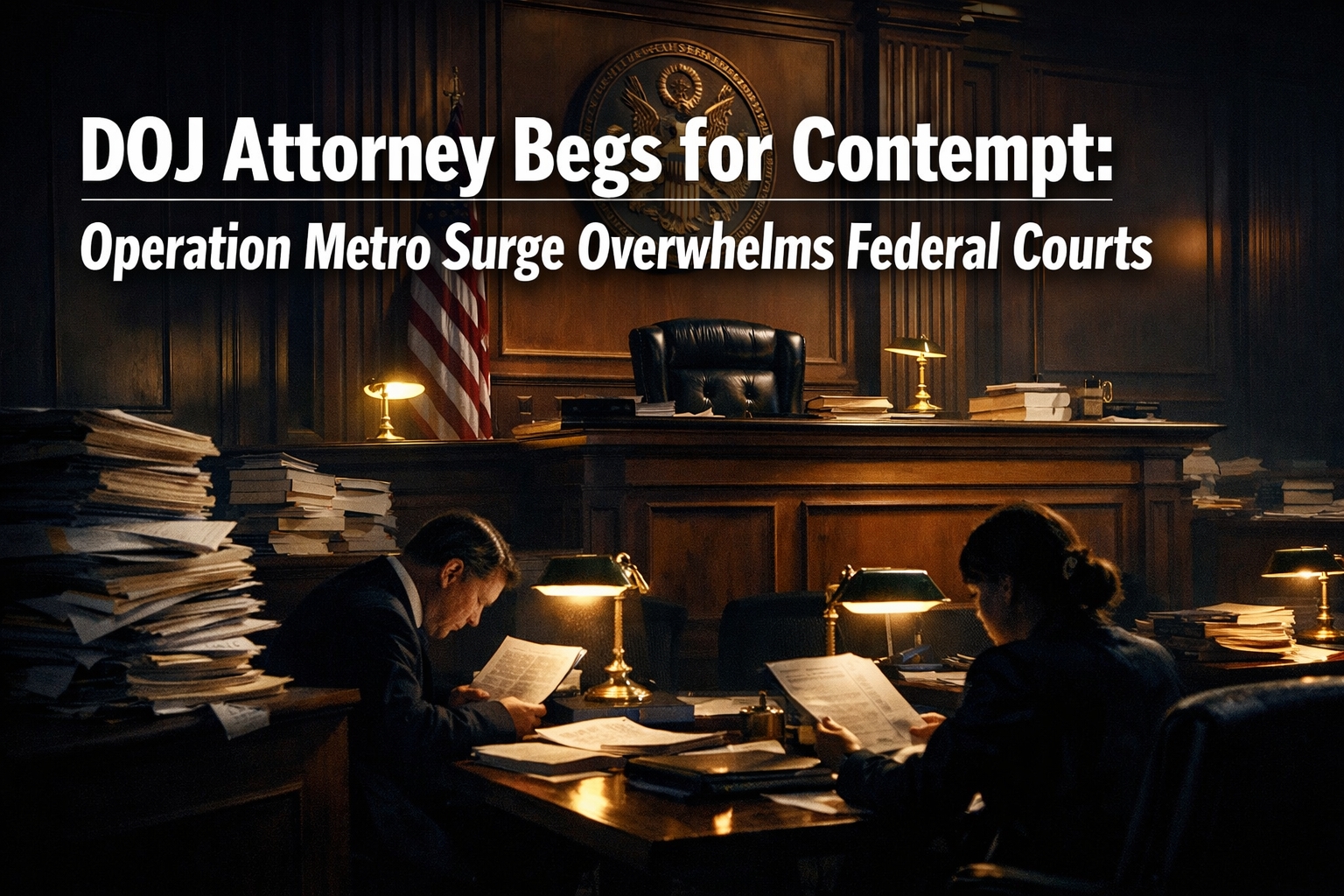
Imagine being so exhausted from your government job that you literally beg a federal judge to hold you in contempt of court—just so you can get 24 hours of sleep. That’s exactly what happened this week in a Minneapolis courtroom, and it reveals something deeply troubling about how immigration enforcement operations are overwhelming our legal system and potentially violating constitutional rights.
On Tuesday, DOJ attorney Julie Le told a federal court she is overwhelmed by legal challenges from Operation Metro Surge, Fox 9 reports. Operation Metro Surge overwhelmed local logistics and ICE’s readiness, with the U.S. Attorney’s Office accepting volunteers like Le last month amid rising habeas petitions. According to Fox 9 Minneapolis, Le asked the judge, “I wish you would just hold me in contempt of court so I can get 24 hours of sleep” and said “I am here to make sure the agency understands how important it is to comply with court orders.” Judge Blackwell ordered a show-cause hearing after finding ignored orders in 5 habeas cases and warned detainees without criminal records were wrongfully held despite release orders. While Le said new procedures are being implemented to ensure ICE compliance, she called it like “pulling teeth” requiring nonstop work, while Tom Homan suggested reducing street presence in Minneapolis and Kristi Noem said ICE agents would wear body cams.
This isn’t just about one overworked attorney. It’s about what happens when massive enforcement operations move faster than the legal system can handle—and when people’s constitutional rights get trampled in the process.
Key Takeaways
⚖️ DOJ attorney Julie Le publicly expressed exhaustion in federal court, asking to be held in contempt just to get rest amid overwhelming habeas corpus petitions from Operation Metro Surge
📊 Operation Metro Surge has resulted in approximately 3,000 arrests since early December 2025, deploying over 2,000 DHS agents to the Twin Cities area[2][6]
🚨 Judge Blackwell found ICE ignored court orders in 5 habeas cases, with detainees without criminal records wrongfully held despite release orders
⚠️ Two U.S. citizens were fatally shot by federal officers during the operation, prompting a Justice Department civil rights investigation[1]
📹 New accountability measures include body cameras for ICE agents and revised procedures to ensure compliance with court orders[5]
When Your Attorney Begs for Jail Time: The Courtroom Breakdown

Let me paint you a picture of what desperation looks like in 2026. You’re standing in a federal courtroom. You’re a Department of Justice attorney—someone who’s supposed to represent the government with professionalism and composure. And you’re so exhausted, so overwhelmed, that you ask the judge to throw you in jail.
Not because you’ve done something wrong. But because it’s the only way you can imagine getting any rest.
That’s where Julie Le found herself this Tuesday. As a volunteer attorney brought in to handle the tsunami of habeas corpus petitions flooding the courts from Operation Metro Surge, Le has been working around the clock trying to ensure that Immigration and Customs Enforcement complies with court orders. And according to her own testimony, it’s been like “pulling teeth.”
The scale of what we’re talking about is staggering. Since Operation Metro Surge began in early December 2025, approximately 3,000 people have been arrested across the Twin Cities[2]. Over 2,000 DHS agents—including ICE and Customs and Border Protection officers—descended on Minneapolis and surrounding communities[6]. That’s a massive deployment of federal law enforcement in a concentrated area.
But here’s the thing about our constitutional system: even during large-scale enforcement operations, people have rights. When someone is detained, they have the right to challenge that detention through habeas corpus petitions—a legal mechanism that dates back centuries and is literally written into our Constitution. It’s one of the most fundamental protections against government overreach.
And that’s exactly what’s been happening. Hundreds of people detained during Operation Metro Surge have filed habeas petitions. Each one requires legal review. Each one demands that the government justify why someone is being held. Each one takes time, resources, and attention from attorneys like Julie Le.
Operation Metro Surge: When Enforcement Outpaces Legal Process
The U.S. Attorney’s Office was so overwhelmed by the volume of cases that they started accepting volunteers last month. Think about that for a moment. The federal government launched a massive immigration enforcement operation but didn’t adequately prepare for the legal consequences. They didn’t have enough attorneys. They didn’t have systems in place to handle the habeas petitions. They apparently didn’t anticipate that detaining thousands of people might result in… people exercising their constitutional rights.
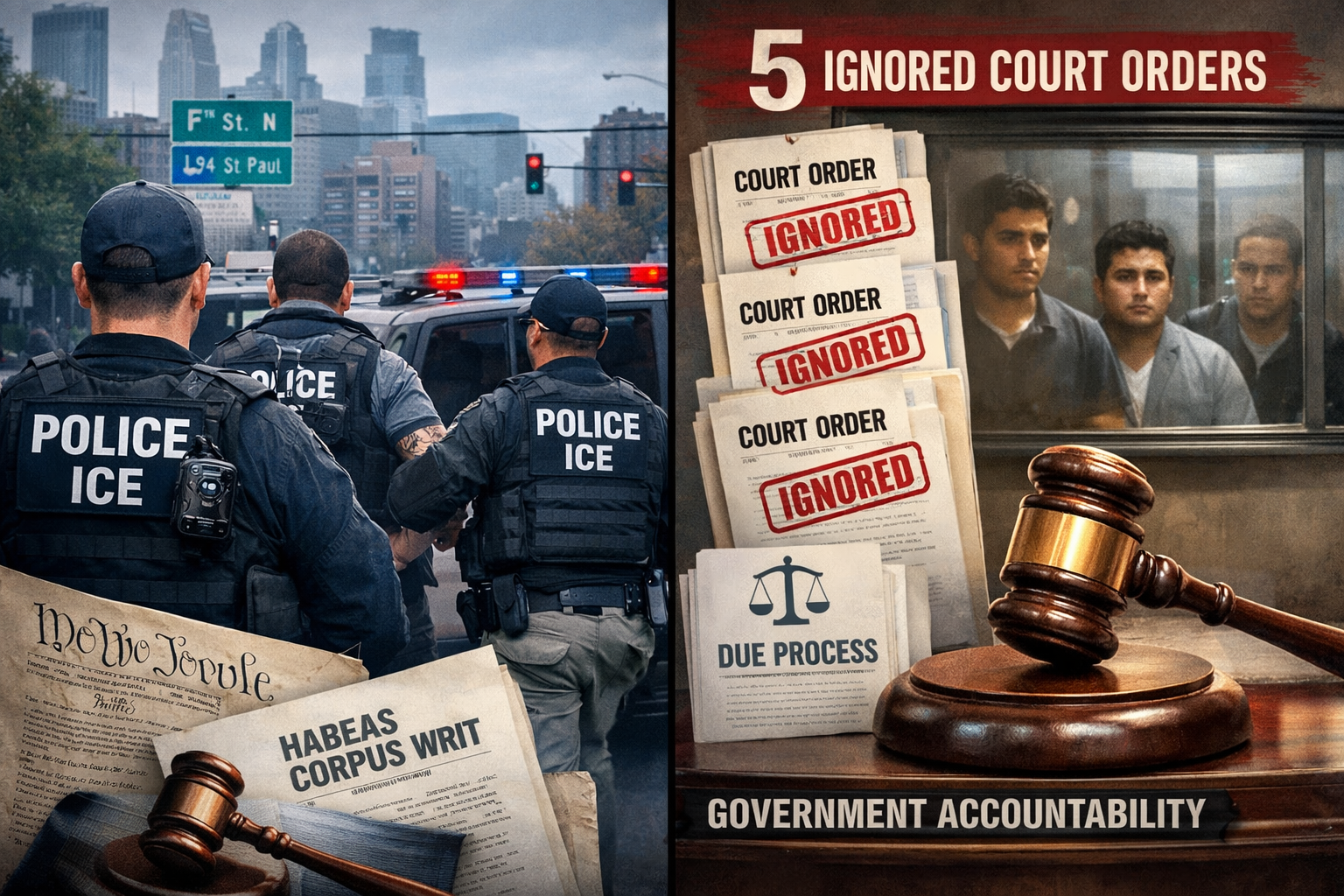
Judge Blackwell’s findings are particularly damning. In at least five habeas corpus cases, the judge found that ICE had simply ignored court orders. These weren’t minor administrative oversights. These were direct violations of judicial authority. The judge ordered detainees released, and ICE didn’t comply.
Even more troubling: some of these detainees had no criminal records. They were being held despite court orders for their release, despite having no criminal history, despite the fact that a federal judge had determined their detention was unlawful.
This is exactly the kind of government overreach that habeas corpus is designed to prevent. When a judge says someone should be released and the executive branch simply ignores that order, we’re not talking about bureaucratic inefficiency anymore. We’re talking about a constitutional crisis.
Judge Blackwell ordered a show-cause hearing—essentially telling ICE officials to come to court and explain why they shouldn’t be held in contempt for ignoring judicial orders. That’s a serious step. Federal judges don’t take kindly to being ignored, and for good reason. The separation of powers depends on each branch respecting the authority of the others.
The Human Cost of Overwhelmed Systems
While attorneys like Julie Le are working themselves to exhaustion, real people are sitting in detention facilities, separated from their families, waiting for a legal system that can’t keep up.
And the consequences of this rushed, under-resourced operation have been deadly. Two U.S. citizens—Renee Good and Alex Pretti—were fatally shot by federal officers in separate incidents during Operation Metro Surge[1]. Let me repeat that: U.S. citizens were killed during an immigration enforcement operation. The Justice Department has launched a civil rights investigation, but those two people are still dead.
These deaths highlight what happens when massive enforcement operations prioritize speed and numbers over careful, deliberate action. When you deploy 2,000 agents to make 3,000 arrests in a matter of weeks, mistakes happen. Tragic, irreversible mistakes.
The Response: Body Cameras, New Procedures, and Political Posturing
In response to mounting criticism and judicial findings, federal officials have announced some changes. Homeland Security Secretary Kristi Noem announced that ICE agents would be required to wear body cameras[5]. That’s a step in the right direction—police reform advocates have been pushing for body cameras for years as a basic accountability measure.
Julie Le told the court that new procedures are being implemented to ensure ICE compliance with court orders. But her characterization of the process as “pulling teeth” doesn’t inspire confidence. If ensuring that a federal agency follows court orders requires nonstop work and feels like an impossible struggle, something is fundamentally broken.
Meanwhile, Tom Homan—who has been instrumental in designing and promoting Operation Metro Surge—suggested reducing the operation’s street presence in Minneapolis. That’s a telling admission. When even the architects of an enforcement operation acknowledge it needs to be scaled back, you know there are serious problems.
But here’s what concerns me as someone who believes in both the rule of law and immigrant rights: these reactive measures don’t address the fundamental problem. The operation was launched without adequate preparation for the legal and logistical consequences. Body cameras are great, but they don’t help if there aren’t enough attorneys to process habeas petitions. New compliance procedures are necessary, but they don’t bring back the two U.S. citizens who were killed.
What This Means for Government Accountability
A federal judge in Minnesota, U.S. District Judge Katherine Menendez, denied the state’s request for a preliminary injunction to halt Operation Metro Surge on January 31, 2026[1][2]. That means the operation can legally continue, at least for now. But legal authorization doesn’t mean an operation is being conducted properly or constitutionally.
The fact that ICE ignored court orders in multiple cases, that detainees without criminal records were wrongfully held, and that the legal system is so overwhelmed that DOJ attorneys are begging for contempt citations—these are signs of a system under severe strain.
This matters for everyone, regardless of where you stand on immigration policy. If federal agencies can ignore court orders during immigration enforcement, what’s to stop them from ignoring court orders in other contexts? If massive operations can be launched without adequate legal infrastructure, what does that mean for due process rights across the board?
Why This Should Matter to Mohawk Valley Residents
You might be reading this in Utica or Rome or anywhere in upstate New York and thinking, “This is happening in Minneapolis. Why should I care?”
Here’s why: what happens in Minneapolis can happen here. Immigration enforcement operations aren’t limited to border states or major metropolitan areas. ICE operates throughout the country, including right here in the Mohawk Valley. If the federal government is willing to launch an operation that overwhelms the legal system in Minnesota, there’s nothing preventing similar operations in New York.
Our immigrant communities in Utica and across Oneida County contribute to our economy, our culture, and our civic life. Many are refugees who came here legally, building new lives after fleeing violence and persecution. When we see immigration enforcement operations that ignore court orders and overwhelm legal protections, we should all be concerned about how those operations might impact our neighbors.
Moreover, this is fundamentally about government accountability and the rule of law. Those aren’t partisan issues. Whether you’re progressive or conservative, you should care when federal agencies ignore court orders. Whether you support strict immigration enforcement or comprehensive reform, you should care when operations are so poorly planned that government attorneys are working themselves to exhaustion.
The Broader Pattern of Immigration Rights Violations
Operation Metro Surge isn’t happening in isolation. It’s part of a broader pattern of immigration enforcement that often prioritizes numbers and visibility over careful, constitutional implementation. We’ve seen family separations, prolonged detentions, inadequate legal representation, and now, operations that move so fast the legal system can’t keep up.
Habeas corpus exists for a reason. It’s called “the great writ” because it’s one of our most fundamental protections against arbitrary detention. When someone is arrested and held by the government, they have the right to go before a judge and challenge that detention. The government has to justify it. That’s not a loophole or a technicality—it’s a cornerstone of our legal system.
When agencies like ICE ignore habeas corpus orders, they’re not just violating individual rights. They’re undermining the entire system of checks and balances that prevents government abuse.
What We Can Do: Civic Engagement and Accountability
So what can we do about this? How can residents of the Mohawk Valley and concerned citizens everywhere respond to what’s happening in Minneapolis?
First, stay informed. Stories like Julie Le’s courtroom plea don’t always make national headlines, but they reveal crucial information about how our government operates. Local journalism and progressive news outlets are essential for bringing these stories to light. Support them. Read them. Share them.
Second, contact your representatives. Congressional oversight exists to hold executive agencies accountable. If ICE is ignoring court orders and overwhelming the legal system, members of Congress need to investigate. Call or email your U.S. Representative and Senators. Tell them you’re concerned about constitutional violations during immigration enforcement operations. Ask them what they’re doing to ensure ICE complies with court orders.
Third, support immigrant rights organizations. Groups like the ACLU, the National Immigration Law Center, and local immigrant advocacy organizations are on the front lines of these legal battles. They’re filing habeas petitions, representing detainees, and documenting abuses. They need resources to continue that work.
Fourth, get involved locally. Attend town hall meetings. Join community organizing efforts. Support sanctuary policies that protect immigrant community members. Push for local law enforcement to decline participation in federal immigration enforcement operations that violate constitutional rights.
Fifth, demand transparency. Body cameras are a start, but we need comprehensive data about Operation Metro Surge and similar enforcement actions. How many people have been detained? How many had criminal records? How many were U.S. citizens? How many habeas petitions have been filed? How many court orders have been ignored? This information should be public.
The Path Forward: Balancing Enforcement and Rights
Here’s the thing: you can believe in immigration enforcement and still oppose operations that violate constitutional rights. You can support border security and still demand that ICE follow court orders. These aren’t contradictory positions.
What we’re seeing in Minneapolis is what happens when enforcement becomes untethered from legal process. When the priority is making arrests rather than ensuring those arrests are lawful and sustainable, the system breaks down. Attorneys become overwhelmed. Courts can’t keep up. People’s rights get violated. And in the worst cases, people die.
There’s a better way. Immigration enforcement can be conducted with adequate legal preparation. Agencies can have enough attorneys to handle habeas petitions. Systems can be in place to ensure court orders are followed immediately. Operations can be planned with realistic timelines that don’t require deploying thousands of agents in a matter of weeks.
But that requires political will. It requires prioritizing constitutional rights over optics. It requires seeing immigrants as human beings with legal protections, not just numbers in an enforcement quota.
Conclusion: When the System Breaks, We All Lose
Julie Le’s desperate plea for contempt of court is darkly funny in a way—the kind of gallows humor that emerges when systems are pushed past their breaking point. But it’s also profoundly troubling. It reveals a federal operation that was launched without adequate preparation, that has overwhelmed the legal system, that has resulted in court orders being ignored and constitutional rights being violated.
This isn’t just an immigration issue. It’s a government accountability issue. It’s a rule of law issue. It’s a question of whether we’re going to maintain the constitutional protections that prevent arbitrary detention and government overreach.
The facts are clear: Operation Metro Surge has made approximately 3,000 arrests with over 2,000 agents deployed[2][6]. ICE has ignored court orders in multiple habeas cases[1]. Detainees without criminal records have been wrongfully held. Two U.S. citizens have been killed[1]. And DOJ attorneys are so overwhelmed they’re begging judges for relief.
These aren’t the hallmarks of a well-planned, constitutional operation. They’re the signs of a system in crisis.
As citizens—whether in Minneapolis or the Mohawk Valley—we have a responsibility to demand better. We need to hold our elected officials accountable. We need to support the attorneys and advocates fighting for constitutional rights. We need to stay informed and engaged.
Because when the legal system breaks down, when federal agencies ignore court orders, when enforcement operations overwhelm due process protections—we all lose. Our constitutional rights are only as strong as our commitment to defending them, even when (especially when) they’re being violated in someone else’s community.
What you can do today:
- Contact your U.S. Representative and Senators about ICE accountability
- Support immigrant rights organizations like the ACLU and local advocacy groups
- Attend local town hall meetings and voice concerns about constitutional rights
- Stay informed through progressive journalism and fact-based reporting
- Share this story with others who care about government transparency and the rule of law
The courtroom where Julie Le begged for contempt is hundreds of miles away. But the principles at stake—habeas corpus, judicial authority, constitutional rights, government accountability—matter everywhere. Including right here in upstate New York.
References
[1] 2026 01 31 Federal Judge Says Ices Operation Metro Surge Can Continue In Minnesota – https://wbex.iheart.com/content/2026-01-31-federal-judge-says-ices-operation-metro-surge-can-continue-in-minnesota/
[2] Federal Judge Rejects Minnesota Request Block Ice Led Operation Metro Surge – https://www.foxnews.com/us/federal-judge-rejects-minnesota-request-block-ice-led-operation-metro-surge
[3] Ag Lawsuit – https://www.minneapolismn.gov/news/2026/january/ag-lawsuit/
[4] Watch – https://www.youtube.com/watch?v=cWSfTRgzzEY
[5] Judge Denies Request Stop Operation Metro Surge Jan 31 2026 – https://www.cbsnews.com/minnesota/live-updates/judge-denies-request-stop-operation-metro-surge-jan-31-2026/
[6] 00190 Dhs Complaint – https://www.ag.state.mn.us/Office/Communications/2026/docs/00190_DHS_Complaint.pdf
[7] Watch – https://www.youtube.com/watch?v=A8U6r1_kTCM
SEO Meta Title: DOJ Attorney Begs for Contempt as ICE Operation Overwhelms Courts


