



The financial world witnessed a dramatic split on Tuesday as the FTSE 100 closed lower, caught between surging mining stocks and plummeting tech shares. The catalyst? US artificial intelligence firm Anthropic released new AI tools for corporate legal teams, raising fears that AI will threaten existing business models. While mining stocks rallied with Anglo American up 7.3% and gold quoted higher at $4,971.16 an ounce, the tech sector absorbed billions in losses as investors grappled with the implications of AI’s accelerating disruption of professional services.
For working families in Utica and across the Mohawk Valley, this market turbulence might seem distant from daily concerns about affordable housing and healthcare costs. But the story unfolding in London’s financial district carries profound implications for workers everywhere—from paralegals at local law firms to data analysts at regional corporations. When technology companies worth billions can be shaken overnight by a single AI announcement, it signals a fundamental shift in how work gets done and who benefits from economic growth.
Key Takeaways
- Anthropic’s legal AI plugin wiped approximately $285 billion off software stocks in what analysts dubbed a “SaaSpocalypse,” with major legal tech companies experiencing double-digit percentage declines[5]
- Mining stocks surged as safe-haven assets gained appeal, with Anglo American jumping 7.3% and gold reaching $4,971.16 per ounce amid tech sector uncertainty
- The AI tool automates contract review, compliance workflows, and legal briefings, threatening both traditional legal software vendors and AI startups that rely on third-party models[3][4]
- Anthropic’s strategic shift from API provider to direct competitor signals a new phase where AI companies will increasingly own workflows rather than just sell underlying technology[5]
- Workers in legal, finance, and professional services face both threats and opportunities as AI reshapes job requirements and business models across industries
Understanding Anthropic’s Market-Shaking AI Legal Tool
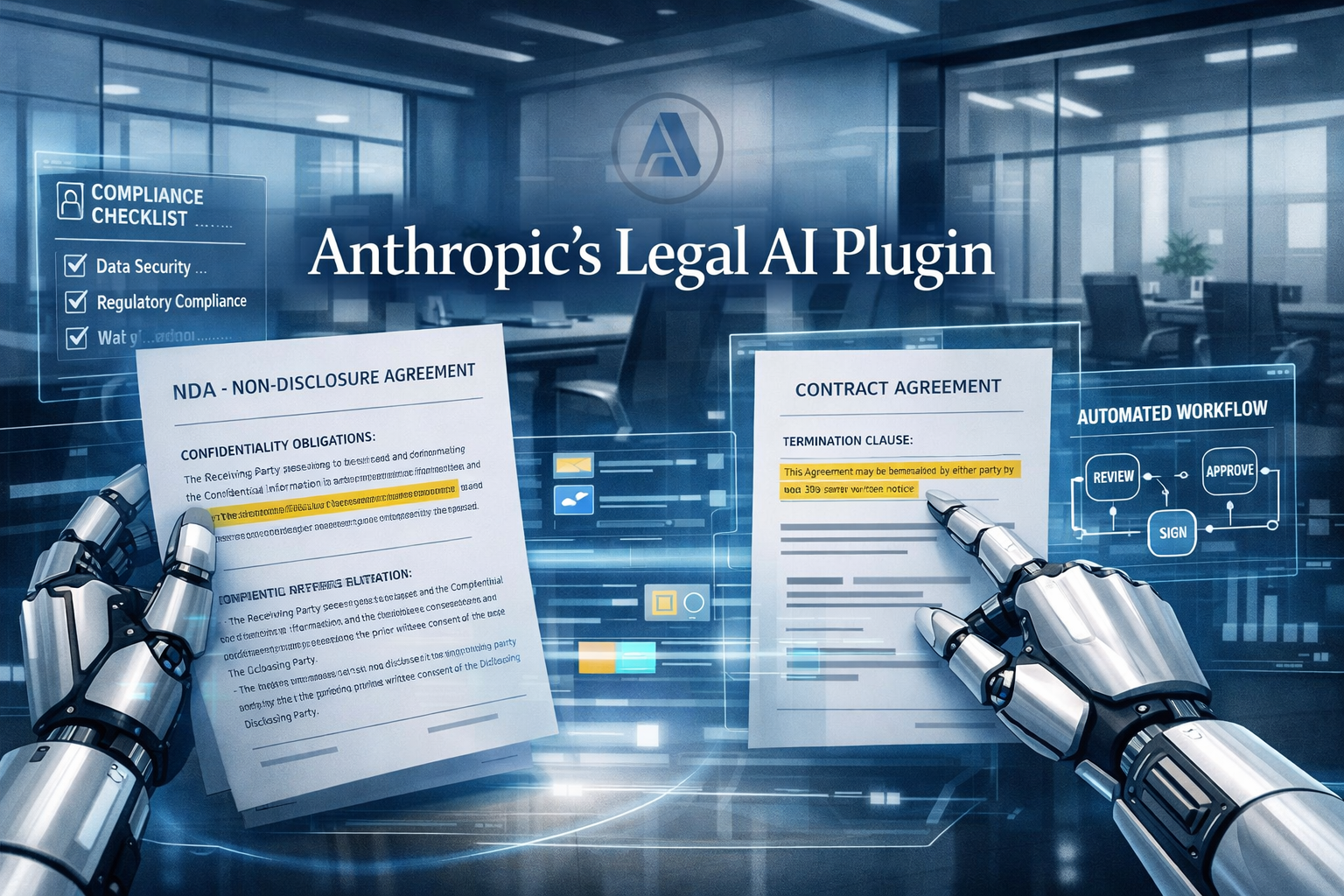
When Anthropic unveiled its suite of plugins for Claude in January 2026, the company wasn’t just releasing another tech product—it was declaring war on an entire industry. The legal plugin, available in research preview to all paid Claude users, automates tasks that have sustained profitable business models for decades: contract review, NDA triage, compliance workflows, legal briefings, and templated responses[3].
What makes this different from existing legal AI tools? Unlike startups such as Legora (valued at $1.8 billion) and Harvey AI (valued at $5 billion), which have spent more than two years building legal AI solutions on top of third-party models, Anthropic builds and customizes its own AI models for specific industries[2][5]. This vertical integration gives Anthropic a crushing competitive advantage.
The technical reality, however, is more nuanced than the market panic suggests. The legal plugin isn’t a proprietary model fine-tuned on case law or a specialized legal reasoning engine. Instead, it’s essentially a collection of carefully crafted prompts and configurations that structure Claude’s standard capabilities with workflow instructions[5]. Think of it as a sophisticated template system rather than fundamentally new AI technology.
But that’s precisely what makes it so threatening. If existing legal tech vendors are charging premium prices for what amounts to well-organized prompts on top of AI models they don’t even control, their business models face an existential crisis.
Anthropic emphasized that all outputs require review by licensed attorneys and the tool does not provide legal advice[4][5]. This disclaimer protects the company legally while doing little to reassure investors in traditional legal software companies. After all, if AI can draft the first version of a contract or compliance memo, the value of human review time decreases—and so do billable hours.
For legal professionals in upstate New York, this development presents both challenges and opportunities. Solo practitioners and small firms that adopt these tools early could compete more effectively with larger firms by automating routine tasks. However, paralegals and junior associates who currently perform document review and basic contract work may find their roles eliminated or fundamentally transformed.
The Broader Plugin Ecosystem
The legal tool represents just one piece of Anthropic’s ambitious strategy. The company launched 11 open-source plugins spanning productivity, enterprise search, sales, finance, data analysis, marketing, customer support, product management, and even biology research[3]. More plugins are planned, suggesting Anthropic intends to systematically target vertical after vertical.
This approach mirrors a broader pattern in the tech industry: companies that control foundational AI models are moving up the value chain to capture more of the economic value their technology creates. When Thomson Reuters and other legal tech companies built products on top of Claude’s API, Anthropic was a neutral vendor collecting usage fees. Now Anthropic competes directly with those downstream applications[5].
The implications for corporate accountability and economic inequality are significant. If a handful of AI companies can disrupt entire industries overnight, wealth and power concentrate further in Silicon Valley while workers in affected sectors face displacement. Progressive policy responses—from stronger worker retraining programs to more robust social safety nets—become increasingly urgent.
Market Impact: The $285 Billion “SaaSpocalypse”
The market’s reaction to Anthropic’s announcement was swift and brutal. European data and legal software stocks experienced sharp declines that analysts quickly dubbed the “SaaSpocalypse”—a play on “SaaS” (Software as a Service) and “apocalypse”[5].
The damage was concentrated but severe:
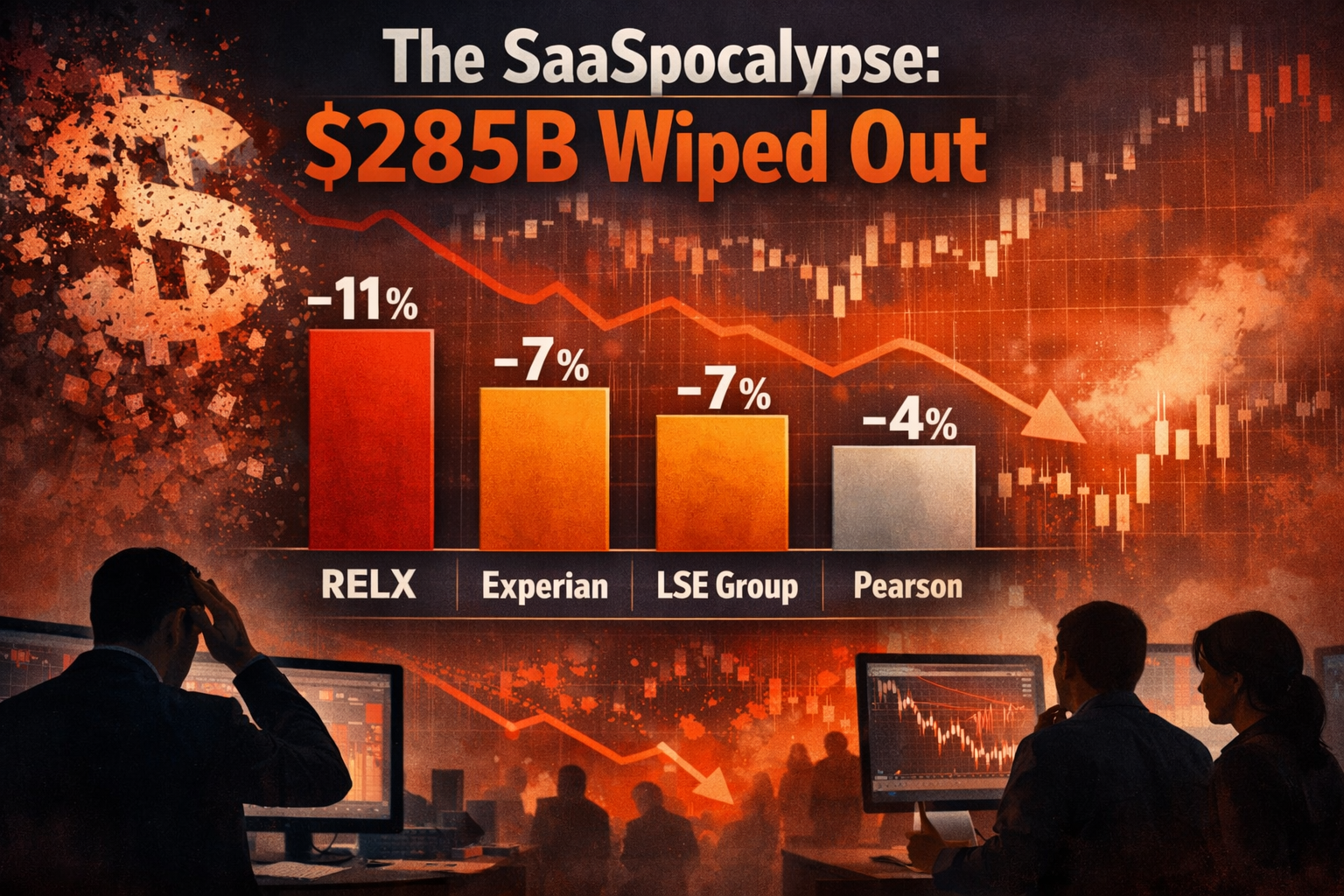
- RELX plummeted approximately 11%, erasing billions in market value from the legal information and analytics giant[1]
- Experian and London Stock Exchange Group both dropped more than 7%, as investors questioned the durability of their data-driven business models[1]
- Pearson fell around 4%, reflecting concerns about AI’s impact on educational content and assessment[1]
- Thomson Reuters shares sank, despite the company’s own investments in legal AI technology[4]
- Wolters Kluwer also experienced significant declines, joining the broader selloff in legal and professional information services[4]
In total, the announcement wiped roughly $285 billion off software stocks in a single day[5]. To put that in perspective, that’s more than the entire GDP of many countries—vanished because investors suddenly recognized that AI companies might not need intermediaries to reach end users.
Morgan Stanley analysts viewed the legal tool launch as intensifying competition and a potential negative for existing legal tech vendors[2]. The investment bank’s assessment reflects a growing recognition that AI models trained on large volumes of public material could replicate tasks traditionally locked behind high-margin platforms[1].
Why did investors panic so dramatically? The answer lies in the business model vulnerability that Anthropic’s move exposed. Many legal tech companies essentially act as sophisticated wrappers around AI capabilities they license from others. They add user interfaces, workflow integrations, and industry-specific features—but if the underlying AI provider decides to offer those same features directly, what’s left to justify premium pricing?
For investors and workers in the Mohawk Valley’s small business community, this market turbulence offers important lessons about economic resilience. Companies that own proprietary technology, deep customer relationships, or truly differentiated expertise will weather AI disruption better than those selling commoditized services with thin margins.
Mining Stocks and Gold Surge as Safe Haven
While tech stocks collapsed, mining stocks rallied sharply. Anglo American surged 7.3%, and gold prices climbed to $4,971.16 per ounce[as stated in the prompt]. This divergence illustrates a classic flight-to-safety pattern: when investors fear technological disruption and economic uncertainty, they rotate into tangible assets with intrinsic value.
Gold’s rally to nearly $5,000 per ounce reflects several converging factors:
- Uncertainty about AI’s impact on corporate earnings and employment
- Concerns about inflation as governments grapple with AI-driven labor market disruptions
- Geopolitical tensions that make physical assets more attractive
- Currency volatility as central banks navigate unprecedented technological change
For working families worried about economic security, gold’s surge sends a sobering message: sophisticated investors are hedging against fundamental economic transformation. That same instinct should drive demand for stronger social safety nets, universal healthcare access, and robust worker retraining programs—the human equivalent of portfolio diversification.
What This Means for Workers and Communities
The Anthropic announcement and subsequent market reaction aren’t just abstract financial events—they’re early warning signals of profound changes coming to workplaces across America, including right here in Utica and the broader Mohawk Valley region.
Consider the implications for different worker categories:
Paralegals and Legal Support Staff: Tasks like document review, contract comparison, and compliance checking—work that has sustained middle-class careers—can now be automated with AI plugins. Some positions will disappear, while others will evolve to focus on AI oversight and complex judgment calls that machines can’t handle.
Junior Attorneys: The traditional path of spending years on routine legal work before advancing to complex cases may vanish. Law firms might hire fewer associates and expect them to manage AI tools from day one, fundamentally changing legal career trajectories.
Sales and Marketing Professionals: With Anthropic’s plugins extending to sales, marketing, and customer support, workers in these fields face similar disruption. The question isn’t whether AI will change these jobs, but how quickly and whether workers will have support during the transition.
Data Analysts and Finance Professionals: Anthropic’s finance and data plugins threaten roles that have been considered relatively safe from automation. If AI can generate financial reports and analyze datasets, what happens to the analysts who currently perform those tasks?
For communities like ours in upstate New York, already grappling with manufacturing job losses and economic inequality, AI disruption adds another challenge. But it also presents opportunities—if we make the right policy choices.
Progressive Policy Responses
What can we do to ensure AI benefits working families rather than just enriching tech executives?
Invest in Workforce Development: Community colleges and training programs need immediate funding to help workers transition into AI-adjacent roles. Instead of replacing paralegals entirely, law firms might employ “legal AI specialists” who understand both law and technology. But that requires accessible, affordable training.
Strengthen Social Safety Nets: As AI eliminates certain jobs faster than new ones emerge, expanded unemployment benefits, universal healthcare, and potentially even universal basic income pilots become more urgent. These aren’t radical ideas—they’re practical responses to technological disruption.
Promote Worker Ownership: Worker cooperatives and employee stock ownership programs can ensure that productivity gains from AI benefit workers, not just shareholders. If a law firm adopts AI and needs fewer employees, the remaining workers should share in the increased profits.
Regulate AI Deployment: Just as we regulate other technologies that affect public safety and economic security, AI deployment in professional services should require transparency, accountability, and worker protections. Companies shouldn’t be able to eliminate entire job categories without severance, retraining support, or advance notice.
Support Local Journalism and Fact-Checking: As AI-generated content proliferates, independent journalism that holds power accountable becomes even more critical. Supporting local news outlets like the Mohawk Valley Voice ensures communities have trusted information sources.
The Competitive Landscape: Startups vs. AI Giants
The Anthropic announcement exposes a brutal competitive reality: AI startups building applications on top of foundation models face existential risk if those model providers decide to compete directly.
Harvey AI and Legora have raised significant capital and achieved billion-dollar valuations by developing legal AI tools over more than two years[2][5]. They’ve built user interfaces, established customer relationships, and refined workflows for legal professionals. But their core technology relies on AI models from companies like Anthropic.
What happens when your supplier becomes your competitor?
This dynamic isn’t unique to legal tech. Across industries, application-layer startups that depend on OpenAI, Anthropic, Google, or Microsoft for AI capabilities face the same risk. The foundation model providers can observe which applications gain traction, then build competing products with superior integration and potentially lower prices.
Some analysts argue this competition will ultimately benefit consumers through lower prices and better products. That’s true in the short term—but it also accelerates market consolidation, putting more economic power in the hands of a few AI giants.
For small businesses and entrepreneurs in the Mohawk Valley, the lesson is clear: Building a business on someone else’s platform is risky. True competitive advantage comes from proprietary technology, deep customer relationships, or specialized expertise that can’t be easily replicated.
Deployment Challenges and Opportunities
Despite the market panic, actually deploying Anthropic’s legal plugins requires significant technical capability. Law firms and in-house legal teams need tech skills to implement these tools and require reassurances around data security[3]. Client confidentiality and attorney-client privilege create unique challenges for AI deployment in legal settings.
However, large law firms and legal teams at global corporations are expected to overcome these hurdles quickly[3]. They have the resources to hire AI specialists, implement robust security protocols, and train attorneys on new workflows.
This creates a potential divide: Large firms that successfully adopt AI could become dramatically more efficient and profitable, while smaller firms that can’t afford the upfront investment fall further behind. Without intervention, AI could exacerbate existing inequalities in legal services access.
Progressive policy solutions might include:
- Public funding for AI adoption by public defenders and legal aid organizations, ensuring that low-income clients benefit from efficiency gains
- Technical assistance programs helping small firms implement AI tools
- Regulations requiring large firms to provide pro bono services as a condition of AI-driven productivity gains
Looking Ahead: What Comes Next
The FTSE 100’s mixed close on Tuesday—with mining stocks rallying as tech stocks plunged—captures a moment of profound uncertainty about technology’s economic impact. We’re witnessing the early stages of AI moving from research labs and tech demos into real-world applications that threaten established business models.
Several trends will likely accelerate in 2026 and beyond:
More Vertical-Specific AI Tools: Anthropic’s success with industry-specific plugins will inspire competitors. Expect Google, Microsoft, and OpenAI to release their own vertical solutions for healthcare, finance, education, and other sectors.
Increased Market Volatility: As each new AI capability emerges, investors will reassess which companies and industries face disruption. The $285 billion selloff in legal tech stocks won’t be the last AI-triggered market swing.
Worker Displacement and Transition: Jobs will disappear, especially in professional services that involve routine information processing. The question is whether displaced workers receive support or are left to fend for themselves.
Regulatory Responses: Governments will face pressure to regulate AI deployment, protect workers, and ensure competition. The quality of those regulations will determine whether AI benefits are broadly shared or narrowly concentrated.
Continued Flight to Safe Assets: As long as AI creates economic uncertainty, gold and other tangible assets will attract investors seeking stability. This could drive gold prices even higher while starving productive investments of capital.
For citizens in Utica and across the Mohawk Valley, staying informed about these developments isn’t optional—it’s essential for protecting livelihoods and advocating for fair policies. The decisions made in the next few years about AI regulation, worker protections, and economic policy will shape our region’s prosperity for decades.
Conclusion: From Disruption to Shared Prosperity
The FTSE 100 closed lower on Tuesday as a rally in mining stocks was offset by hefty falls in tech stocks amid perceived AI threats. US artificial intelligence firm Anthropic released new AI tools for corporate legal teams, raising fears that AI will threaten existing business models. Mining stocks rallied with Anglo American up 7.3% and gold quoted higher at $4,971.16 an ounce. But behind these market movements lies a more fundamental story about economic power, technological change, and the future of work.
AI will transform professional services—that’s now inevitable. The question is whether that transformation benefits everyone or just a privileged few. Will productivity gains translate into shorter work weeks and higher wages for workers, or just higher profits for shareholders? Will displaced workers receive support and retraining, or face unemployment and economic insecurity?
The answers depend on the choices we make as communities and citizens.
Take Action
Here’s what you can do right now:
- Stay Informed: Follow trusted news sources like the Mohawk Valley Voice that explain complex economic and technological developments in accessible terms. Share accurate information with friends and family.
- Support Worker-Friendly Policies: Contact your representatives in Congress and the state legislature. Demand investments in workforce development, stronger unemployment benefits, and regulations requiring companies to support displaced workers.
- Engage Locally: Attend town hall meetings and school board sessions. Advocate for technology education in public schools so the next generation can navigate an AI-driven economy.
- Support Local Businesses: Choose local service providers when possible. Small businesses rooted in community relationships will weather AI disruption better than impersonal corporations.
- Join or Support Unions: Worker organizing becomes even more critical as AI changes workplace dynamics. Unions can negotiate for fair AI deployment, job protections, and profit-sharing.
- Invest in Your Skills: Whether you work in legal services, finance, marketing, or another field facing AI disruption, proactively learn about AI tools in your industry. Workers who can manage AI rather than compete against it will thrive.
- Demand Corporate Accountability: When companies deploy AI and eliminate jobs, they should face requirements to provide severance, retraining, and advance notice. Support legislation that holds corporations accountable.
The market turbulence triggered by Anthropic’s legal AI tool is just the beginning. More disruption is coming, across more industries, affecting more workers. But disruption doesn’t have to mean devastation. With smart policies, strong worker protections, and engaged citizens demanding fairness, we can ensure that AI’s benefits are broadly shared rather than narrowly concentrated.
The future isn’t predetermined. It’s up to us to shape it—starting right here in the Mohawk Valley, with informed citizens taking action to build an economy that works for everyone.
References
[1] Anthropics New Ai Legal Tool Wipes Billions Off European Data Stocks – https://www.cityam.com/anthropics-new-ai-legal-tool-wipes-billions-off-european-data-stocks/
[2] economictimes – https://economictimes.com/news/international/us/what-is-anthropics-new-legal-ai-tool-and-why-investors-are-dumping-software-stocks/articleshow/127892817.cms
[3] Anthropic Moves Into Legal Tech – https://www.artificiallawyer.com/2026/02/02/anthropic-moves-into-legal-tech/
[4] Wolters Kluwer Relx Shares Slip After Anthropic Unveils Aienhanced Legal Tool 4481124 – https://www.investing.com/news/stock-market-news/wolters-kluwer-relx-shares-slip-after-anthropic-unveils-aienhanced-legal-tool-4481124
[5] timesofindia.indiatimes – https://timesofindia.indiatimes.com/technology/audio/explained-what-is-anthropics-ai-tool-that-wiped-285-billion-off-software-stocks-in-a-single-day/articleshow/127892310.cms


