


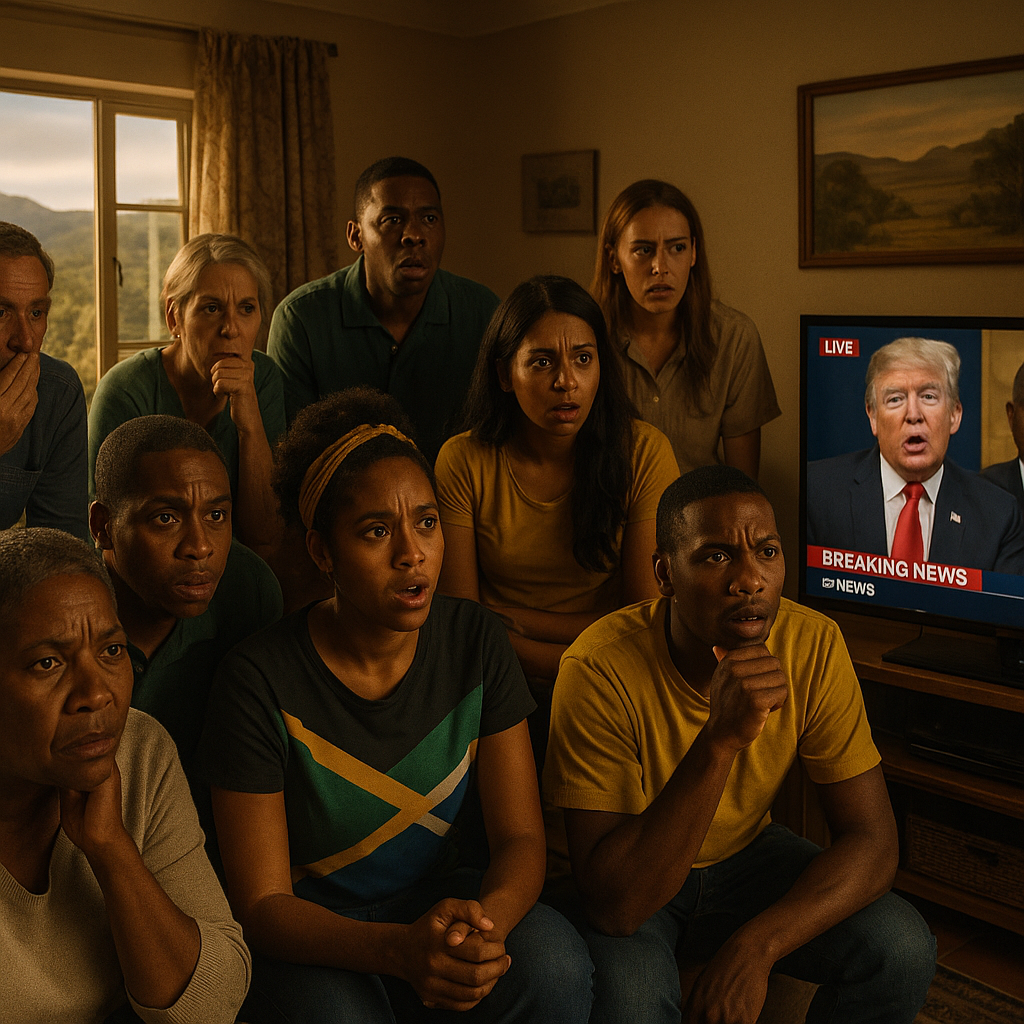
Fact-Checking Trump’s Claims and South Africa’s Powerful Response
South Africa is reeling after former US President Donald Trump made baseless claims of “white genocide” during a meeting with President Cyril Ramaphosa. The controversy erupted when Trump presented misleading evidence alleging racial persecution and uncompensated land seizures. In this article, we lay out the facts, debunk the myths, and examine how South Africans—from government officials to ordinary citizens—are rejecting misinformation and demanding accountability.
The Meeting That Sparked a Firestorm
On May 21, 2025, President Ramaphosa visited the White House to discuss trade and economic cooperation. What was intended to be a productive dialogue soon devolved into a tense confrontation as Trump diverted the discussion toward inflammatory claims. Trump presented a series of videos and news clips alleging that white South African farmers are being targeted in a systematic campaign of “genocide” and that their land is being confiscated without compensation. Among these assertions, he referenced the chant “Kill the Boer” as supposed evidence of state-endorsed racial persecution.
Ramaphosa’s response was measured and decisive. He stated,
“There is just no genocide in South Africa. Violence affects all our people, and our government does not support the extremist views presented here today.”
Trump also defended a controversial move by his administration to grant refugee status to 59 white South Africans, claiming they were victims of persecution. South African officials, however, lambasted this decision, describing it as both ironic and misleading given the nation’s ongoing struggle with socio-economic inequalities and a history marred by apartheid.
Fact-Checking Trump’s Claims
Are White Farmers Victims of Genocide?
Trump’s narrative of “white genocide” is not supported by the facts. South Africa’s official crime statistics reveal that farm murders make up less than 1% of the country’s total annual murders. For instance, during the 2022-2023 period, there were 51 farm murders out of 27,494 total murders. Experts such as Gareth Newham from the Institute for Security Studies explain that these attacks are typically driven by robbery rather than by a racially motivated campaign. Moreover, a South African high court has dismissed claims of genocide as “clearly imagined and not real.” Multiple fact-checking organizations, including FactCheck.org and Reuters, have thoroughly debunked Trump’s assertions.
Is the Government Seizing Land Without Compensation?
Contrary to Trump’s claims, there is no evidence of uncompensated land confiscation targeting white farmers. While South Africa’s government has introduced legislation aimed at rectifying historical land inequalities, the Expropriation Act explicitly provides for compensation in most instances. The law was designed to address the distortions of apartheid and colonialism by promoting fair land reform—not to single out white farmers for seizure. To date, there have been no reported cases of land taken without appropriate compensation.
The Real Story: Crime, Inequality, and Misinformation
South Africa continues to grapple with high rates of violent crime, but these challenges affect all communities. The majority of murder victims in the country are Black South Africans, and the drivers of violence are complex, rooted primarily in poverty and inequality. By focusing narrowly on white farmers, Trump’s narrative distorts the multifaceted reality of South Africa’s social and economic issues. Analysts, including scholars like Nechama Brodie and Anthony Kaziboni, have highlighted that the selective attention on farm attacks ignores the broader context and fosters divisive myths for political gain.
South Africa Responds: Shock, Anger, and Defiance
Official Reactions
South African leadership wasted no time in condemning Trump’s unfounded assertions. President Ramaphosa reiterated in a public statement,
“There is just no genocide in South Africa,”
underscoring that violence in the nation is not racially exclusive but a pervasive problem driven by economic hardship and social instability. Vincent Magwenya, the presidential spokesperson, dismissed the videos Trump presented as “a poor compilation of old footage” and “a complete lie.”
Members of the South African delegation, including the Minister of Agriculture, also refuted the allegations. They emphasized that the individuals featured in Trump’s evidence were from fringe political groups rather than official government narratives.
Media and Public Outcry
South Africa’s media landscape has been ablaze with criticism of Trump’s divisive rhetoric. Local outlets have decried the spread of misinformation, noting that such false narratives not only misrepresent the country’s reality but also threaten to exacerbate racial tensions. International media from Reuters to ABC News have echoed these sentiments, highlighting that Trump’s claims are part of a broader trend of using sensationalism to distract from substantive issues.
On social media, anger and disbelief have surged. Many South Africans have taken to platforms to express their frustration. One prominent user wrote,
“Trump’s lies hurt our country and distract from our real challenges. We stand united against misinformation.”
These reactions reflect a broad consensus among citizens that the focus should remain on genuine issues of poverty, inequality, and national development rather than on manufactured controversies.
Notable Voices
Respected South African journalists, academics, and community leaders have joined the online debate. They call for honest reporting and urge both national and international media to move beyond sensationalism. Some critics also pointed out the problematic role of influential figures—such as Elon Musk, a South African-born entrepreneur—who have previously amplified similar narratives. Their involvement has drawn further condemnation, intensifying the debate around the responsibilities of influential voices in shaping public discourse.
The Diplomatic Fallout
The fallout from the meeting has been swift and far-reaching. Despite President Ramaphosa’s best efforts to redirect the conversation toward trade and investment—which included discussions on expanding cooperation in technology and renewable energy—Trump’s focus on divisive topics has strained US-South Africa relations. Analysts warn that such rhetoric could push South Africa to seek closer ties with other global powers such as China and Russia, with substantial implications for international geopolitics and economic strategy.
Nonetheless, the South African government remains committed to its reform agenda. Officials reaffirm that efforts toward land reform and correcting historical injustices will continue entirely within the framework of law and respect for human rights. The administration insists that these policies are aimed at fostering unity, promoting transparency, and providing equal opportunities for all citizens.
Conclusion: The Danger of Misinformation
Trump’s claims do more than misrepresent the facts—they endanger the prospects for constructive dialogue both at home and abroad. By peddling false narratives about “white genocide” and uncompensated land seizures, he diverts attention from the real challenges that South Africa faces. This controversy serves as a potent reminder of the damage misinformation can inflict on public trust and international relations.
It is incumbent upon citizens, the press, and policy-makers alike to hold leaders accountable and to vigorously defend the truth. As South Africa continues its journey toward a more inclusive and just society, let this be a call to action for a commitment to factual accuracy, respectful debate, and the pursuit of policies that truly benefit the nation. Stand with those who insist on truth and justice—our collective future depends on it.


