


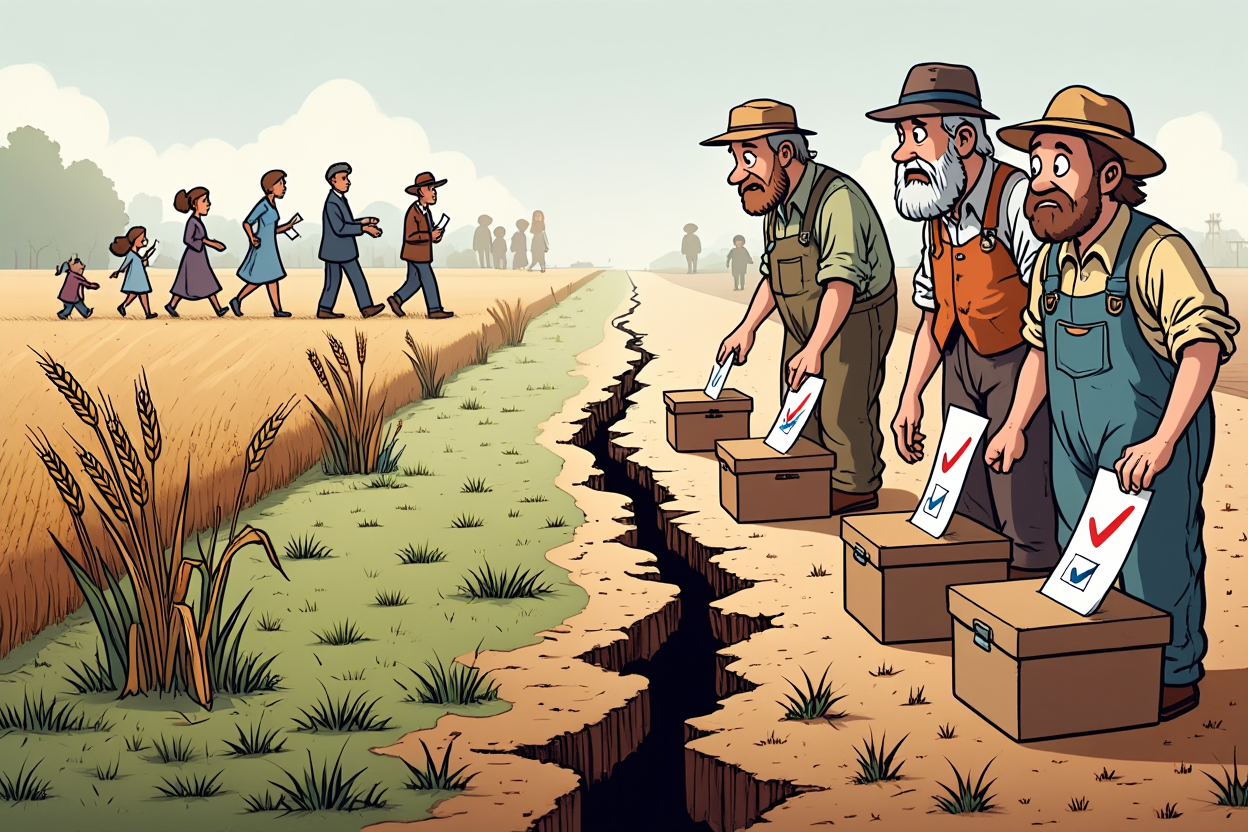
A deep-red community that voted 91% for Trump now confronts the harsh reality of mass deportation policies
When Immigration Raids Hit Home: Idaho Town Reels After ICE Sweep
In the small farming town of Wilder, Idaho, residents are asking a question they never expected to face: “What in the world is going on?” The answer is both simple and devastating—they’re experiencing the direct consequences of the immigration policies they overwhelmingly supported at the ballot box.
On October 19, 2025, federal agents descended on La Catedral Arena, a horse-racing track that had long served as a gathering place for Wilder’s Latino community. What unfolded that day has left this town of 1,725 people—where 91% of voters backed Donald Trump in 2024—struggling to survive. According to The New York Times, at least 75 people have been deported so far, and the economic fallout is just beginning.
The Raid That Changed Everything
The operation at La Catedral Arena wasn’t a quiet arrest. John Carter, a Trump voter whose security company worked at the racetrack, witnessed federal agents pointing automatic rifles and deploying flash-bang grenades. Raw Story reports that approximately 200 law enforcement officers from 10 different agencies participated in the raid.
“Other federal, state and local agencies, including Immigration and Customs Enforcement, showed up soon after, sending many in the crowd running into neighboring fields or hiding in their cars,” wrote New York Times reporter Anna Griffin. “The local sheriff rode through on horseback, and a black, military-style helicopter circled low in the sky.”
The scene was chaotic and frightening. Adults caring for toddlers had their hands zip-tied. Teenagers—including Carter’s own 14-year-old daughter—were restrained. Everyone at the track was herded together and detained for hours.
According to Idaho Capital Sun, ICE took 105 people into custody that day.
Was This Really About Gambling?
Federal officials claimed the raid targeted an illegal gambling operation. Four people—Ivan Tellez, Samuel Bejarano, Dayana Fajardo, and Alejandro Estrada—were arrested on gambling-related charges. But immigration attorney Neal Dougherty told The New York Times that the focus was clearly elsewhere.
“The one thing everyone got asked was, ‘Where were you born?'” Dougherty explained. “Not, ‘Did you see gambling?’ Not, ‘Did you participate in gambling?’ Just, ‘Where were you born?'”
This raises serious questions about whether the gambling investigation was simply a pretext for immigration enforcement—a tactic that allowed agents to detain anyone present, regardless of their connection to alleged criminal activity.
Economic Devastation in a Trump Stronghold
The human cost of the raid is immeasurable, but the economic impact is becoming painfully clear. Chris Gross, a second-generation mint farmer, expressed what many in Wilder are now realizing: “We rely on Hispanic labor. Nobody thought something like this could happen here.”
The timing couldn’t be worse. As planting season approaches, farmers face a critical labor shortage. Many workers who weren’t detained have gone into hiding, too frightened to show up for work. Others have left the area entirely.
David Lincoln, a longtime Wilder resident who runs a rural economic development nonprofit, didn’t mince words when speaking to The New York Times. The raid, he said, has “nearly destroyed” the town.
“What happens if everyone who is Hispanic thinks they’re at risk?” Lincoln asked. “There’s fear now that didn’t exist here before. I don’t know how you make that go away.”
The Irony of Voting Against Your Own Interests
Here’s the uncomfortable truth: Wilder voted overwhelmingly for the very policies that are now tearing their community apart. This isn’t happening in a liberal coastal city—it’s happening in deep-red Idaho, where residents believed their remote location would shield them from aggressive immigration enforcement.
They were wrong.
The New Republic notes that roughly 60% of Wilder’s population identifies as Latino. These aren’t strangers or outsiders—they’re neighbors, coworkers, and essential members of the community. Yet the town’s political leadership seems disconnected from this reality.
Mayor Steve Rhodes dismissed the raid’s impact, telling The New York Times: “These were not our people. What happened out at that track had nothing to do with Wilder.”
But that’s simply not true. The 75 people deported were part of Wilder’s workforce, its economy, and its social fabric. Their absence is being felt in every corner of the community.
A Climate of Fear
The psychological toll extends beyond those directly affected. Gross told reporters that now, when anyone—Hispanic or not—sees a black SUV driving through town, “they freeze up.” School Superintendent Alex Zamora captured the community’s confusion: “There was just such confusion. What in the world is going on in Wilder?”
This is what mass deportation looks like on the ground. It’s not just about removing people—it’s about creating an atmosphere of fear and suspicion that poisons entire communities.
The Broader Pattern
Wilder isn’t alone. Common Dreams reports that similar dynamics are playing out in southern Texas, where construction trade groups are sounding alarms about immigration raids that are delaying projects, raising prices, and forcing businesses into bankruptcy.
Mario Guerrero, chief executive of the South Texas Builders Association—who also voted for Trump—told The Wall Street Journal that raids are “terrorizing job sites” and grinding economic activity to a halt.
These stories reveal a fundamental disconnect: Many Americans supported Trump’s immigration rhetoric without fully understanding—or perhaps caring—about the practical consequences. They assumed enforcement would target “bad hombres” in distant cities, not the workers who harvest their crops or build their homes.
What Comes Next?
The question facing Wilder is whether this community can recover. With 75 people already deported and many more in hiding, the town’s agricultural economy hangs in the balance. Crops don’t wait for political debates to be resolved. If there aren’t enough workers to plant and harvest, food rots in the fields and farmers go bankrupt.
Some might say Wilder is getting exactly what it voted for. But that’s too simple. The people being deported didn’t vote for Trump—many couldn’t vote at all. The children left behind when parents are detained didn’t vote for this. The businesses closing their doors didn’t vote for economic collapse.
Immigration policy isn’t abstract. It affects real people in real communities. And when enforcement is carried out with maximum force and minimum discretion, everyone suffers—including those who thought they were safe.
Lessons We Should Learn
The Wilder raid offers several important lessons:
1. Immigration enforcement has economic consequences. You can’t remove a significant portion of the workforce without devastating local economies.
2. Fear is a terrible policy tool. When entire communities live in fear, productivity drops, businesses suffer, and social cohesion breaks down.
3. Rhetoric has real-world impacts. Campaign promises about “tough” immigration enforcement translate into armed agents zip-tying teenagers at community events.
4. We’re all connected. What happens to immigrant communities affects everyone—farmers, business owners, schools, and local governments.
5. Cruelty isn’t effective. Deploying 200 officers with automatic weapons to arrest people at a horse race isn’t law enforcement—it’s intimidation.
A Call to Action
If you’re troubled by what happened in Wilder, speak up. Contact your representatives in Congress and demand humane immigration reform. Support organizations like the ACLU that provide legal assistance to immigrant communities. And most importantly, remember this story when you vote.
Immigration policy should balance security concerns with economic reality and basic human decency. What happened in Wilder fails on all three counts.
The people of Wilder are learning a hard lesson: When you vote for policies that dehumanize others, don’t be surprised when those policies come home to roost. The question is whether the rest of America will learn that lesson before more communities are “nearly destroyed.”


