


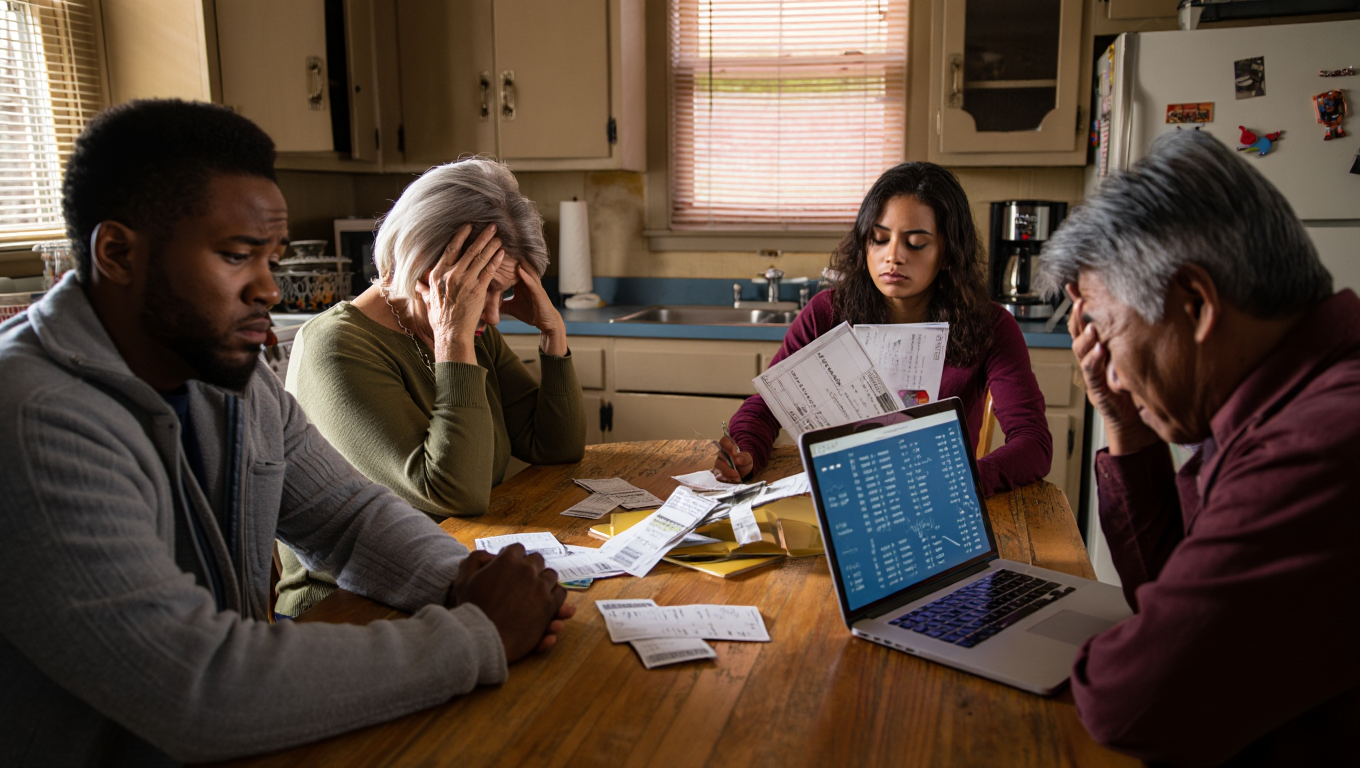
American Optimism Plummets to Two-Decade Low as Future Outlook Dims
New Gallup data reveals only 59% of Americans feel hopeful about their future—the lowest measure in nearly 20 years. What’s driving this national gloom?
Americans are losing faith in their future at an alarming rate. In 2025, only about 59% of Americans gave high ratings when asked to evaluate how good their life will be in about five years—the lowest annual measure since Gallup began asking this question almost 20 years ago. This sharp decline in American optimism signals a troubling shift in how we view our collective future, with Democrats and Hispanic communities bearing the heaviest burden of this national pessimism.
The numbers tell a stark story. Future optimism has dropped 9.1 percentage points since 2020, meaning an estimated 24.5 million fewer Americans now feel hopeful about what lies ahead. Even more concerning, fewer than half of Americans—just 48%—now qualify as “thriving,” according to Gallup’s National Health and Well-Being Index.
The Depth of America’s Gloom
What makes this decline particularly striking is how it differs from past patterns. Historically, when Americans felt good about their present circumstances, they tended to feel optimistic about the future. Those two lines moved together on Gallup’s charts like dance partners in sync.
Not anymore.
“While current life is eroding, it’s that optimism for the future that has eroded almost twice as much over the course of about that last 10 years or so,” said Dan Witters, research director of the Gallup National Health and Well-Being Index, in an interview with the Associated Press.
Think about that for a moment. Americans aren’t just worried about today—they’re losing hope about tomorrow. That’s a fundamentally different kind of anxiety, one that cuts deeper into the national psyche.
How Gallup Measures Our Hope
The findings come from a straightforward but powerful question. Gallup asks Americans to rate their current and future lives on a scale from 0 to 10, with 10 representing the best possible life. Those who rate their future at 8 or higher are categorized as optimists.
To be classified as “thriving,” you need to rate your current life at 7 or higher AND your anticipated future at 8 or higher. By that measure, America is no longer a thriving nation—at least not for the majority.
The 2025 survey included 22,125 interviews with U.S. adults across four quarterly measurement periods, making it one of the most comprehensive assessments of American well-being available.
Democrats Take It “In the Chops”
Political identity has always influenced how Americans view their future, especially during transitions of power. When a new party takes the White House, supporters typically grow more optimistic while opponents become more pessimistic. These shifts usually balance each other out.
But 2025 broke that pattern.
As President Donald Trump returned to the White House for his second term, Democrats’ optimism crashed from 65% to 57%—an 8-point drop. Republicans did grow more hopeful, but not nearly enough to offset the Democratic decline.
“The regime change in the White House almost certainly was a big driving factor in what’s happened,” Witters explained. “And a lot of that was just because the people who identified as Democrats really took it in the chops.”
Here’s what’s particularly interesting: Even Republicans aren’t as optimistic as they were during Trump’s first term. Despite controlling both the White House and Congress, Republican optimism remains significantly lower than it was in 2020. A January AP-NORC poll found that while most Republicans still support the president, his economic performance hasn’t met many people’s expectations.
This suggests something deeper than partisan politics is at work. When even the winning side feels gloomy, we’re dealing with systemic concerns that transcend political affiliation.
Hispanic Communities Hit Hardest
The sharpest decline in optimism occurred among Hispanic Americans, whose future outlook dropped from 69% to 63% during Trump’s first year back in office. That 6-point drop was more severe than among white or Black Americans.
Why the disproportionate impact? Witters points to several factors:
Economic stress: AP-NORC polling found that Hispanic adults reported higher levels of economic anxiety than other groups. The lingering effects of inflation continue to hit hardest in communities already struggling with affordability.
Healthcare concerns: Access to quality, affordable healthcare remains a persistent worry in Hispanic communities.
Immigration enforcement: This may be the most visible factor. A Pew Research Center poll conducted in October found that about 6 in 10 Latinos had seen or heard of Immigration and Customs Enforcement raids or arrests in their community within the past six months.
“(Deportations are) something that everybody can see and look at with their own eyes,” Witters noted. “But if you’re Hispanic, I think it’s fair to think that that might hit a little closer to home.”
Trump’s favorability among Hispanics fell throughout 2025, according to AP-NORC polling. When immigration enforcement becomes highly visible in your neighborhood, when friends and family members live in fear, optimism about the future becomes harder to maintain.
The Inflation Factor
To understand why optimism has declined so dramatically since 2021, we need to look at what happened between then and now. The steepest drop occurred from 2021 to 2023—even as the COVID-19 pandemic was gradually receding.
This timeline closely matches when inflation peaked. Annual inflation rates hit 7.0% in 2021 and remained elevated at 6.5% in 2022. These weren’t just abstract economic statistics—they represented real affordability challenges that continue to affect American families today.
During this period, the decline in optimism was greatest among Black adults, who disproportionately suffered inflation’s effects. Black Americans experienced elevated levels of food insecurity, housing instability, and healthcare access problems compared to their white and Hispanic counterparts.
Crucially, from 2021 to 2024, no significant differences appeared among Democrats, Republicans, and independents. This suggests that national challenges like pandemics and inflation affect American optimism regardless of political identity. Economic pain doesn’t check your voter registration card.
A Nation No Longer Thriving
Perhaps the most sobering statistic comes from Gallup’s overall life evaluation measure. As of the fourth quarter of 2025, only 48% of American adults qualify as “thriving”—down more than 11 points from the 59.2% high measured in June 2021.
That June 2021 peak came six months after the first public rollout of COVID-19 vaccines, when hope seemed justified. We’d survived the worst of the pandemic. Vaccines were rolling out. Life was returning to something resembling normal.
What happened since then?
The latest 48% estimate ranks as the sixth-lowest of 176 measurement periods dating back to January 2008. The only times Americans felt worse were during the Great Recession (October, November, and December 2008) and the early stages of the pandemic (April 2020).
We’re living through a crisis of hope comparable to the worst economic collapse since the Great Depression and a once-in-a-century pandemic. Let that sink in.
What This Means for America’s Future
This data should concern all of us, regardless of political affiliation. A nation that’s lost hope in its future struggles to make the investments—in education, infrastructure, innovation, and community—that actually create better tomorrows.
When people don’t believe things will get better, they make different choices. They delay major purchases. They postpone starting families. They become more risk-averse in their careers. They disengage from civic life.
This pessimism becomes self-fulfilling.
The good news? We’ve been here before and recovered. After the Great Recession, American optimism eventually rebounded. After the initial pandemic shock, hope returned—at least temporarily.
But recovery won’t happen automatically. It requires addressing the real concerns driving this pessimism:
-
Economic security: Inflation may have cooled, but affordability challenges persist. Wages need to catch up with the cost of living.
-
Political stability: The sharp partisan divide in optimism suggests we need leadership that can unite rather than divide.
-
Community support: Hispanic communities, in particular, need reassurance that they’re valued members of American society, not targets of enforcement.
-
Honest communication: Americans need leaders who acknowledge challenges while offering realistic paths forward.
The Path Forward
History shows that American optimism can recover, but it requires more than wishful thinking. It demands concrete action on the issues that matter most to everyday Americans: jobs that pay living wages, affordable healthcare, safe communities, and a sense that the future holds opportunity rather than anxiety.
The question isn’t whether we can restore American optimism—we can. The question is whether we have the collective will to do so.
What gives you hope for the future? What changes would make you more optimistic about the next five years? These aren’t just polling questions—they’re the conversations we need to have in our communities, our workplaces, and our homes.
Because a nation’s future is shaped not just by policies and politics, but by whether its people believe that future is worth building.
What do you think about these findings? Are you among the 59% who feel optimistic, or the 41% who don’t? Share your thoughts in the comments below, and don’t forget to share this story with others who care about America’s future.


