


Federal immigration officers, acting without a judicial warrant or consent, entered the Brooklyn home of Hayk Safaryan early one morning last summer, took him into custody and seized his personal documents as well, according to a federal lawsuit challenging the arrest’s legality. Safaryan, 44, an Armenian immigrant who has lived in the United States for more than two decades, was sitting at his computer and eating breakfast when the officers knocked, according to written court testimony from his wife Léah Lazonick. After Safaryan opened the door, the officers asked him for identification, and as Safaryan went to retrieve his wallet, “a heavily armed SWAT team of about six people stormed inside” and detained him.[2]
This case has become a flashpoint in ongoing debates about immigration enforcement tactics, Fourth Amendment protections, and the rights of immigrants—even those facing criminal allegations. What happened that morning in Brooklyn raises urgent questions about how far federal authorities can go when entering private homes, and whether the intersection of immigration status and criminal accusations creates a constitutional gray zone that puts everyone’s civil liberties at risk.
Key Takeaways
- Federal immigration officers entered Safaryan’s home without a judicial warrant, relying only on an administrative ICE warrant, which legal experts say doesn’t meet Fourth Amendment standards for home entry
- A habeas corpus lawsuit challenges the legality of the detention, arguing that the warrantless entry violated constitutional protections against unreasonable searches and seizures
- Safaryan faces separate criminal charges for allegedly defrauding a Park Slope couple of approximately $318,000 in a contractor scam, complicating public perception of his civil rights case
- The case highlights growing concerns about immigration enforcement tactics that may bypass constitutional safeguards, affecting not just undocumented immigrants but legal residents and citizens
- Implications extend beyond one individual, potentially setting precedents for how federal authorities can enter homes across upstate New York and nationwide
The Morning Everything Changed: What Happened at Safaryan’s Door

The scene that unfolded at Hayk Safaryan’s Brooklyn residence last summer follows a pattern that immigration rights advocates say is becoming disturbingly common. According to court testimony from his wife, the morning started ordinarily enough—Safaryan was working at his computer while eating breakfast when the knock came.[2]
What happened next transformed a routine morning into what Lazonick described as a “traumatic nightmare.” After Safaryan opened the door and the officers requested identification, the situation escalated dramatically. As he turned to retrieve his wallet, approximately six heavily armed officers in tactical gear rushed into the home and detained him.[2]
The critical legal question: Did these officers have the constitutional authority to enter the home?
According to the habeas complaint challenging his detention, the answer is no. Immigration and Customs Enforcement (ICE) officers typically operate under administrative warrants—internal documents signed by ICE officials, not judges. These administrative warrants authorize officers to detain individuals for immigration violations, but legal precedent has consistently held that they don’t provide authority to enter private homes without consent.[2]
“The Fourth Amendment protects all people in the United States—citizens and non-citizens alike—from unreasonable searches and seizures. A home is the most protected space under our Constitution.”
This distinction matters enormously. While ICE can arrest individuals in public spaces or workplaces with administrative warrants, entering a private residence typically requires either explicit consent, exigent circumstances (like an emergency), or a judicial warrant signed by a judge who has determined probable cause exists.
Understanding the Legal Framework: Administrative vs. Judicial Warrants
The difference between administrative and judicial warrants isn’t just legal technicality—it’s a fundamental constitutional protection that affects everyone, regardless of immigration status.
Judicial warrants require:
- Application to a neutral judge or magistrate
- Demonstration of probable cause
- Specific description of the place to be searched or person to be seized
- Judicial review and signature
Administrative ICE warrants involve:
- Internal ICE authorization only
- No judicial oversight or probable cause determination
- No constitutional authority to enter homes without consent
This distinction exists precisely to prevent the kind of scenario the Safaryan family experienced. The Fourth Amendment’s framers understood that government agents entering private homes represents one of the most serious intrusions on personal liberty and privacy.
For communities across upstate New York—including immigrant families in Utica, Rome, and throughout the Mohawk Valley—this case raises urgent questions about government accountability and the limits of federal power. If immigration officers can enter any home without judicial oversight, what’s to stop other federal agencies from doing the same?
The Contractor Fraud Allegations: A Separate but Complicating Factor
While the constitutional questions surrounding Safaryan’s arrest deserve serious examination regardless of any criminal allegations, the reality is that he faces significant charges that complicate public perception of his case.
On February 3, 2025, Brooklyn District Attorney Eric Gonzalez announced that Safaryan had been indicted on second-degree grand larceny charges for allegedly stealing approximately $318,000 from a Park Slope couple who had hired him for brownstone renovations.[1]
The Alleged Scheme: Following the Money
According to the criminal indictment, the timeline of the alleged fraud unfolded as follows:
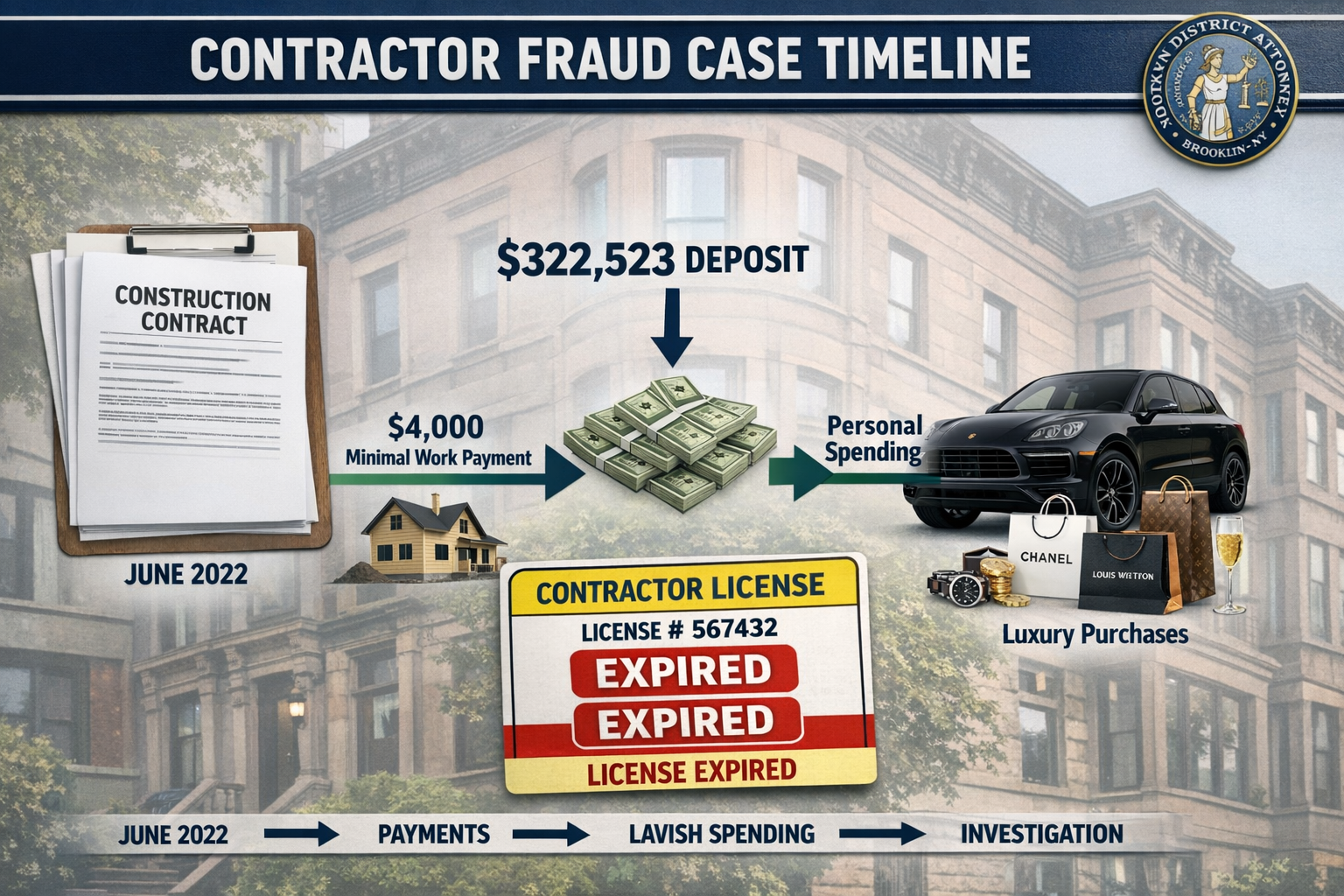
June 15, 2022: The victims signed a construction contract with Safaryan for a total budgeted project cost of $1,290,000.[1]
June 17, 2022: The couple wired an initial deposit of $322,523 to Safaryan.[1]
What happened next: Investigators allege that of this substantial deposit, Safaryan spent only approximately $4,000 on actual project-related work—specifically, a site safety plan. The remaining funds allegedly went to personal expenses including:[1]
- 💳 $28,000 down payment on a 2018 Porsche Macan SUV
- 🏠 $17,750 on back rent payments
- 👜 Thousands of dollars on designer goods from Prada and Alexander McQueen
- 🏨 Thousands more on hotels, bars, restaurants, and an Airbnb in Riverhead, New York
Spring 2023: After initially providing shifting explanations for project delays, Safaryan allegedly ceased all communication with the victims.[1]
Critical detail: Safaryan’s general contractor’s license expired on February 6, 2023, and was never renewed—meaning he was allegedly operating without proper licensing for a significant portion of the time he held the victims’ money.[1]
The Current Legal Status
As of February 2025, Safaryan was arraigned on the grand larceny charges and released without bail. He’s scheduled to return to court on April 2, 2025.[1]
District Attorney Gonzalez emphasized the human impact: “This defendant allegedly took advantage of a couple’s dream of renovating their home by stealing hundreds of thousands of dollars that they entrusted to him and spending it on luxury items for himself.”[1]
Why Criminal Charges Don’t Negate Constitutional Rights
Here’s where many Americans—including well-meaning citizens in communities like Utica and throughout Oneida County—sometimes get tripped up on a crucial principle: Constitutional rights don’t disappear because someone is accused of a crime.
This isn’t about excusing fraud or defending contractor scams that hurt working families. If Safaryan committed the crimes alleged, he should face the full consequences under New York law. That’s what the criminal justice system exists to address.
But the constitutional violation alleged in the habeas complaint is separate. Even if Safaryan is guilty of every charge against him, federal officers still can’t legally enter someone’s home without a proper warrant or consent. That protection exists for everyone—including people accused of crimes.
Why this matters for all of us:
If we allow constitutional protections to erode for people we don’t like or who are accused of crimes, we create precedents that eventually affect everyone. Today it might be an immigrant contractor accused of fraud. Tomorrow it could be a citizen activist, a journalist investigating government corruption, or your neighbor caught in a case of mistaken identity.
The Fourth Amendment doesn’t include an exception that says “unless the person might be guilty of something.” It protects all of us, all the time, from unreasonable government intrusion into our homes.
The Broader Context: Immigration Enforcement in 2026
The Safaryan case doesn’t exist in isolation. Across the country, immigration enforcement tactics have intensified, raising concerns among civil liberties advocates, immigration rights organizations, and constitutional scholars.
Trends in Immigration Enforcement
Recent data shows that ICE home raids have increased significantly, with officers increasingly entering residences during early morning hours when families are most vulnerable. These operations often involve:
- Tactical gear and overwhelming force that can traumatize families, including children
- Collateral arrests of individuals not named in administrative warrants who happen to be present
- Seizure of documents and personal property without clear legal authority
- Minimal judicial oversight of the operations before they occur
For immigrant communities throughout upstate New York—including substantial populations in Utica, Rome, and the broader Mohawk Valley region—these enforcement patterns create pervasive fear that affects daily life, willingness to report crimes, access to healthcare, and children’s educational experiences.
The Chilling Effect on Civil Society
When federal officers can enter homes without judicial warrants, the impact extends far beyond the individuals directly arrested:
- Families become afraid to answer their doors, even for legitimate purposes
- Immigrants avoid seeking help from police, hospitals, or schools, fearing deportation
- Children experience trauma from witnessing armed officers detaining parents
- Communities lose trust in government institutions meant to serve them
This erosion of trust undermines public safety, public health, and civic participation—outcomes that harm everyone, regardless of immigration status.
What the Law Actually Says: Fourth Amendment Protections
The constitutional framework here isn’t ambiguous, even if its application sometimes gets murky in practice.
The Fourth Amendment states: “The right of the people to be secure in their persons, houses, papers, and effects, against unreasonable searches and seizures, shall not be violated, and no Warrants shall issue, but upon probable cause, supported by Oath or affirmation, and particularly describing the place to be searched, and the persons or things to be seized.”
Key Supreme Court Precedents
Several landmark cases establish clear principles:
Payton v. New York (1980): The Supreme Court held that absent exigent circumstances or consent, police officers need a warrant to enter a home to make an arrest, even when they have probable cause.
Lange v. California (2021): The Court reaffirmed that police pursuit of a suspected misdemeanant doesn’t automatically justify warrantless home entry.
These precedents apply to all government agents, including immigration enforcement officers. While ICE has sometimes argued that immigration enforcement operates under different rules, courts have consistently rejected the notion that the Fourth Amendment doesn’t apply to immigration arrests in homes.
The Consent Question
ICE frequently claims that residents “consented” to officers entering their homes. But immigration rights attorneys point out that:
- Consent must be voluntary and informed
- Many residents don’t understand they can refuse entry
- Language barriers complicate genuine consent
- The presence of armed officers in tactical gear creates inherently coercive circumstances
In Safaryan’s case, according to his wife’s testimony, officers asked for identification—not permission to enter. When Safaryan turned to retrieve his wallet, officers rushed in. This sequence of events doesn’t suggest voluntary consent; it suggests a pretext to gain entry.[2]
Implications for Mohawk Valley Communities and Beyond
For readers in Utica, Rome, New Hartford, and throughout the Mohawk Valley, this case might seem geographically distant. But the legal principles at stake affect communities across upstate New York.
Why This Matters Locally
The Mohawk Valley has seen significant demographic changes in recent decades, with refugee resettlement programs bringing families from Bosnia, Burma, Somalia, and other nations to Utica and surrounding areas. These new Americans have revitalized neighborhoods, started businesses, and contributed to the region’s economy and culture.
But they’re also vulnerable to the same enforcement tactics that affected Safaryan. If federal officers can enter homes without judicial warrants in Brooklyn, they can do the same in Utica, Rome, or any other community.
Local implications include:
- 🏘️ Housing and tenant rights: Landlords and tenants need to understand what authority officers actually have
- 👨👩👧👦 Family stability: Children’s welfare suffers when parents are detained in traumatic home raids
- 💼 Economic impact: Small business owners and workers afraid of enforcement may avoid economic participation
- 🗳️ Civic engagement: Fear suppresses community organizing and political participation
- ⚖️ Legal precedent: Cases like Safaryan’s shape what’s permissible in future enforcement actions
What Residents Can Do
Knowledge is power when it comes to constitutional rights. Community members should understand:
You have the right to:
- Ask if officers have a judicial warrant (signed by a judge)
- Refuse entry if they only have an administrative warrant
- Remain silent and request an attorney
- Document the encounter if possible
You should:
- Keep important documents in a safe, accessible place
- Have an emergency plan for family members if someone is detained
- Know the contact information for immigration attorneys and advocacy organizations
- Participate in “know your rights” training offered by local organizations
The Path Forward: Legal Challenges and Policy Reform
Safaryan’s habeas corpus lawsuit challenging the legality of his detention represents one avenue for addressing these constitutional concerns. If successful, it could establish important precedents limiting ICE’s ability to conduct warrantless home entries.
Legal Strategies
Immigration rights organizations and civil liberties advocates are pursuing multiple approaches:
Individual litigation: Cases like Safaryan’s challenge specific arrests and seek remedies for constitutional violations
Class action lawsuits: Broader challenges to systemic enforcement practices that violate Fourth Amendment rights
Legislative advocacy: Pushing for laws that require judicial warrants for all home entries by federal agents
Community education: Ensuring immigrants and their families understand their rights
Policy Reform Proposals
Several reforms could address the constitutional concerns raised by this case:
✅ Require judicial warrants for all ICE home entries, with narrow exceptions for genuine emergencies
✅ Prohibit pretextual entries where officers use requests for identification or other ruses to gain entry
✅ Mandate body cameras for all immigration enforcement operations, with footage available for legal challenges
✅ Establish oversight mechanisms with meaningful accountability for constitutional violations
✅ Protect families and children by prohibiting enforcement actions at certain times and locations
✅ Create pathways to legal status that reduce the population living in immigration limbo
Taking Action: What You Can Do
For readers who care about constitutional rights, government accountability, and immigrant justice, there are concrete steps you can take:
Immediate Actions
📞 Contact your representatives: Tell your U.S. Senators and House members that you support requiring judicial warrants for all federal home entries. In the Mohawk Valley, that means reaching out to your congressional representative and Senators Schumer and Gillibrand.
📚 Educate yourself and others: Attend “know your rights” presentations offered by organizations like the New York Civil Liberties Union or local immigrant advocacy groups.
💰 Support legal defense funds: Organizations providing legal representation to immigrants facing detention need resources to challenge unconstitutional practices.
🗣️ Speak up in your community: When neighbors express anti-immigrant sentiments, gently remind them that constitutional protections benefit everyone.
Long-term Engagement
🗳️ Vote for accountability: Support candidates for local, state, and federal office who prioritize civil liberties and humane immigration policies.
🤝 Build community solidarity: Participate in or organize rapid response networks that mobilize when ICE enforcement occurs in your community.
📰 Support local journalism: Quality reporting on these issues—like you’re reading now in the Mohawk Valley Voice—requires reader support to continue.
🏛️ Engage with local government: Encourage your city council, county legislature, and school board to adopt policies that protect all residents’ rights regardless of immigration status.
Conclusion: Constitutional Rights Aren’t Negotiable
The case of Hayk Safaryan presents a complicated picture. On one hand, he faces serious criminal charges for allegedly defrauding a couple of hundreds of thousands of dollars—conduct that, if proven, deserves prosecution and consequences. On the other hand, the manner of his arrest by federal immigration officers raises fundamental constitutional questions that affect everyone’s rights.
These two realities can coexist. We can believe that contractor fraud should be punished while also insisting that federal officers follow the Constitution when entering people’s homes. We can support accountability for criminal conduct while opposing warrantless home invasions. We can want safe communities while recognizing that safety depends on government respecting constitutional limits.
The Fourth Amendment’s protections against unreasonable searches and seizures aren’t luxuries or technicalities—they’re fundamental safeguards that distinguish free societies from authoritarian ones. When we allow those protections to erode for any group—immigrants, criminal defendants, political dissidents, or anyone else—we make everyone less safe and less free.
For communities across the Mohawk Valley and upstate New York, this case serves as a reminder that constitutional rights require constant vigilance and defense. The immigrants who’ve revitalized Utica and contributed to our regional economy deserve the same protections as longtime residents. And those protections make all of us more secure.
As this case moves forward through the courts, it will test whether our legal system truly means it when it says constitutional rights apply to everyone, or whether those rights are negotiable based on immigration status and criminal allegations. The answer will shape immigration enforcement, Fourth Amendment jurisprudence, and the lived experience of immigrant communities for years to come.
The Mohawk Valley Voice will continue following this case and related issues of immigration rights, government accountability, and constitutional protections. Because in 2026, these questions aren’t abstract legal debates—they’re urgent matters affecting our neighbors, our communities, and the kind of society we want to build together.
References
[1] Brooklyn Contractor Indicted For Stealing Approximately 318000 From Park Slope Couple Renovating Brownstone – https://www.brooklynda.org/2025/02/03/brooklyn-contractor-indicted-for-stealing-approximately-318000-from-park-slope-couple-renovating-brownstone/
[2] Ice Knocks On A Door In Brooklyn A Traumatic Nightmare Follows – https://gothamist.com/news/ice-knocks-on-a-door-in-brooklyn-a-traumatic-nightmare-follows


