


When was the last time you saw Republicans in complete agreement on anything? If you’ve been following politics lately, you know that’s about as common as a snowstorm in July. But this week, something unusual is happening in Washington. The SAVE America Act, up for a vote next week in the House, has been a rare rallying point for a divided GOP—bringing together everyone from hardline conservatives to establishment Republicans in a coordinated push that’s captured President Trump’s personal attention and even drawn tech billionaire Elon Musk into the fray.
The procedural vote is scheduled for Tuesday, February 10, 2026, with full passage expected by week’s end. But this legislative push is about more than just one bill. It represents a fundamental test of Republican unity, a high-stakes gamble on election messaging, and a potential roadblock to the party’s other priorities. For voters in Utica and across the Mohawk Valley, understanding what’s really happening with this legislation matters—because it could fundamentally change how Americans register to vote and cast their ballots.
Key Takeaways
- The SAVE America Act heads to a House vote on Tuesday, February 10, 2026, with Republican leadership expecting passage despite internal party divisions on other issues
- The bill mandates proof of citizenship documents (passports, birth certificates) for voter registration, eliminates mail-only registration, and requires photo ID in every state
- President Trump and Elon Musk are personally pressuring GOP lawmakers to advance the legislation, creating what insiders call a “no-holds-barred pressure campaign”
- Senate passage faces near-certain failure due to Democratic filibuster rules requiring 60 votes—Republicans control only 53 seats
- The legislative push could tie up the Senate for weeks or months, potentially blocking other Republican priorities and testing leadership’s commitment to filibuster reform
What the SAVE America Act Actually Does
Let’s cut through the political noise and look at what this legislation actually requires. The SAVE America Act isn’t subtle—it represents one of the most comprehensive overhauls of voter registration and identification requirements in modern American history.
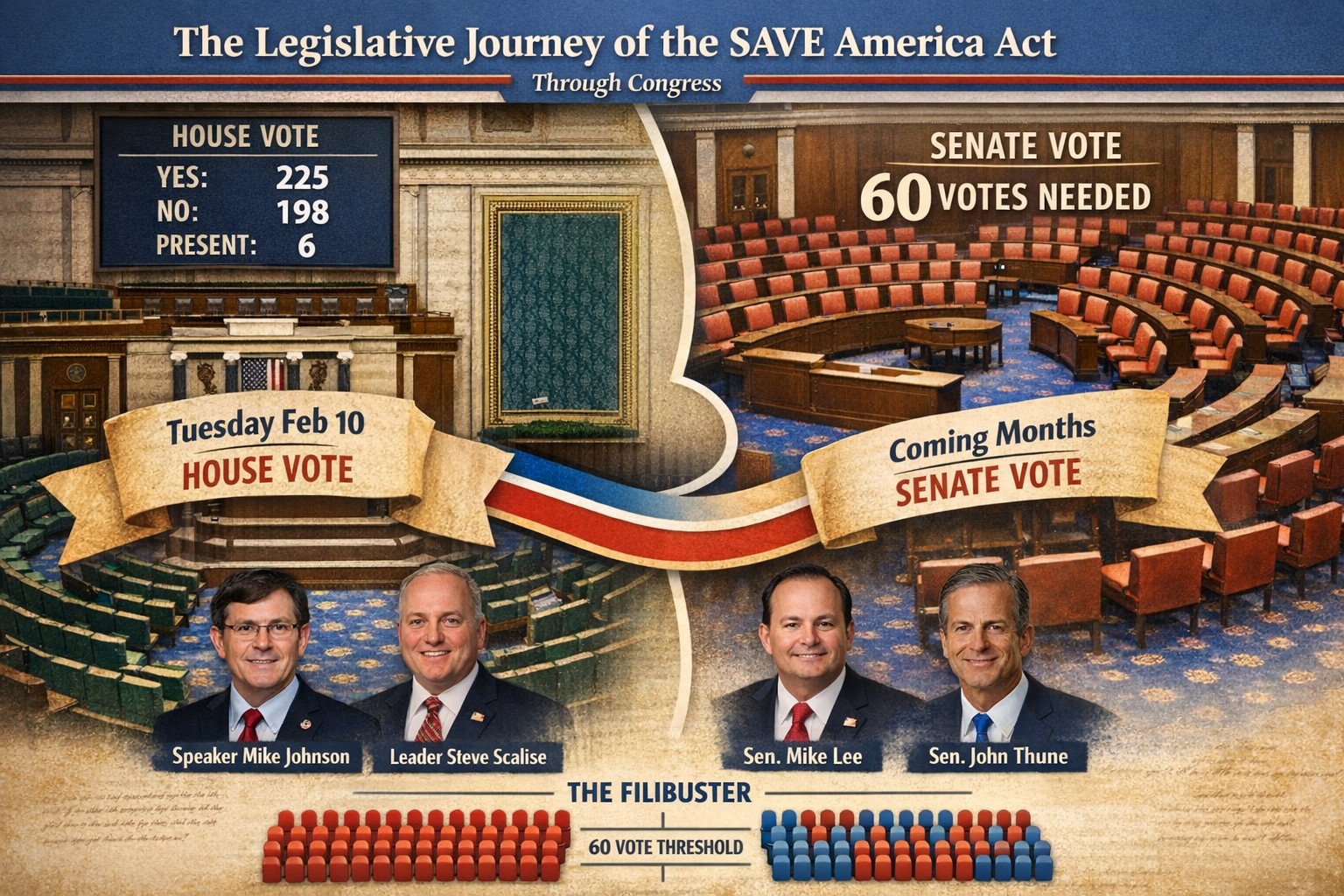
At its core, the bill mandates that every American must provide documentary proof of citizenship to register to vote.[6] We’re talking about passports, birth certificates, or naturalization papers—documents that millions of Americans don’t have readily available. Unlike the current system where you can attest to your citizenship status when registering, this bill requires hard documentation.
But that’s just the beginning. The legislation also:
- Eliminates mail-only voter registration in states that currently allow it[1]
- Requires photo identification in every state for casting a ballot
- Forces states to remove non-citizens from voter rolls and establish ongoing programs to identify ineligible voters[6]
- Creates a private right of action allowing individuals to sue election officials who fail to enforce the citizenship requirement[6]
Think about what this means in practice. If you’re a working parent in New Hartford who lost your birth certificate years ago, you’d need to track down a replacement before you could register. If you’re a senior citizen in Rome who never had a passport, you’d face the same hurdle. The bill’s supporters argue these are reasonable safeguards. Critics counter that they’re solutions in search of a problem—one that could disenfranchise eligible American voters.
The Brennan Center for Justice has warned that similar provisions “would still block millions of Americans from voting,” particularly affecting communities of color, low-income voters, and rural Americans who face greater barriers to obtaining documentation.[7]
Trump Freezes Gateway Funds Over Penn Station, Dulles Renaming
The SAVE America Act’s Unusual Journey: How a Divided GOP Found Common Ground
Here’s where the story gets interesting. The Republican Party in 2026 isn’t exactly known for lockstep unity. Internal battles over spending, immigration, and even leadership positions have dominated headlines for months. Yet the SAVE America Act has accomplished what seemed impossible: getting everyone from firebrands like Rep. Chip Roy to establishment figures like Speaker Mike Johnson on the same page.
The bill has passed the House twice in recent years but languished in the Senate for approximately one year.[5][8] So what changed? Two words: presidential pressure.
President Trump met with Majority Leader Steve Scalise on January 29, 2026, specifically to discuss advancing this legislation.[1] Less than a week later, on February 5, GOP Senators Mike Lee, Rick Scott, and Ron Johnson huddled with Trump to strategize on the Senate approach.[1] This isn’t background support—it’s hands-on presidential involvement in the legislative process.
And Trump isn’t working alone. Elon Musk has joined what sources describe as a “no-holds-barred pressure campaign” to push the bill forward.[1] While the exact nature of Musk’s involvement remains somewhat opaque, his participation signals to Republican lawmakers that this isn’t just another bill—it’s a loyalty test.
The pressure worked. After Republicans including Reps. Anna Paulina Luna, Chip Roy, and Tim Burchett pushed for an immediate vote, Speaker Mike Johnson agreed to proceed.[1] The procedural vote happens Tuesday, with full passage expected by week’s end.
“This represents a rare rallying point for a divided GOP, galvanizing hard-liners despite internal pressure to focus on affordability concerns instead.” – Political observers tracking the legislative push[1]
For a party that’s struggled to pass basic appropriations bills without internal rebellion, this unity is remarkable. It suggests that election integrity messaging—regardless of the underlying evidence for widespread non-citizen voting—remains the most powerful unifying force in Republican politics.
The Senate Math Problem: Why the SAVE America Act Faces Near-Certain Defeat
Now comes the hard part. The House can pass this bill with simple Republican unity. The Senate is a completely different story.
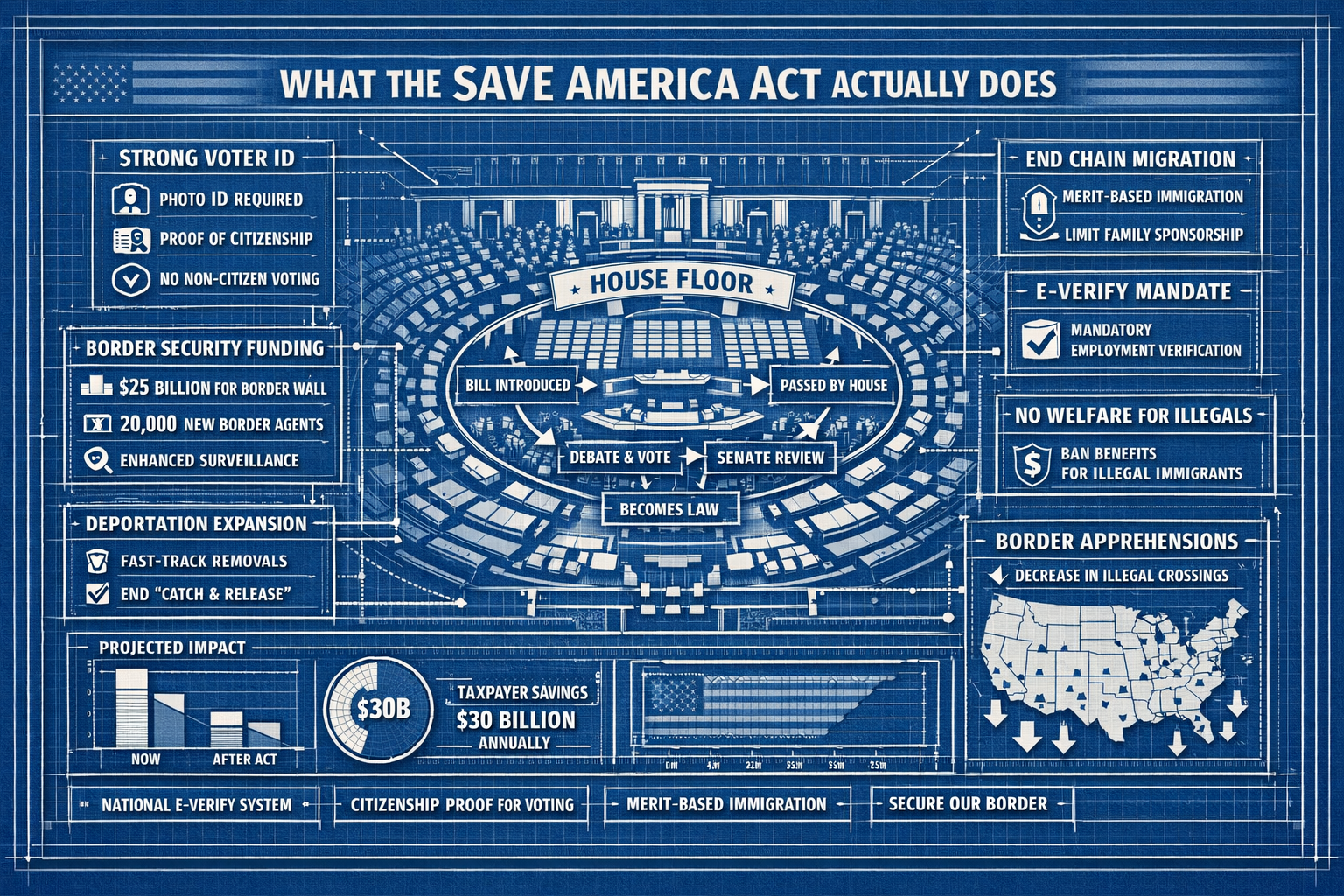
Republicans control only 53 Senate seats.[8] Under current filibuster rules, they need 60 votes to overcome Democratic opposition. That means they’d need seven Democrats to cross party lines and support legislation their party uniformly opposes. The chances of that happening? Senate Majority Leader John Thune himself has acknowledged the bill is “almost certain to stall out.”[1]
Thune has pledged to call the bill for a vote—he doesn’t have much choice given the pressure from Trump, conservative activists, and his own caucus. But he’s also being realistic about the mathematical reality. The Senate isn’t expected to vote until the “coming months,” and even then, passage faces what insiders describe as near-certain failure due to a Democratic filibuster.[1]
Here’s where it gets politically messy. Thune is facing intense right-wing pressure to soften filibuster rules to allow the bill to pass with a simple majority.[1] This isn’t a new debate—progressives pushed for filibuster reform during Democratic control, and now conservatives want the same thing for their priorities.
But Thune has been cautious. He’s stated he would only discuss potential rule changes with his conference and has rejected claims that he’s already agreed to modifications.[1] That’s political speak for “I’m not ready to blow up the filibuster for this bill.”
The Legislative Gridlock Scenario
Multiple senators are privately and publicly warning that this push could tie up the Senate floor for weeks or months, blocking other GOP priorities.[1] Think about what that means:
- Tax reform legislation gets delayed
- Appropriations bills pile up
- Judicial confirmations slow down
- Other Trump administration priorities gather dust
This is the hidden cost of the SAVE America Act becoming a rallying point for a divided GOP. Yes, it unifies the party rhetorically. But it also threatens to consume precious legislative time on a bill that won’t become law—at least not without dramatic rule changes that would fundamentally alter how the Senate operates.
What This Means for Voters in Utica and the Mohawk Valley
Let’s bring this home to upstate New York. If you’re reading this in Oneida County, you might be wondering: “How does this affect me?”
Right now, New York already requires some form of identification to vote, though the requirements are less stringent than what the SAVE America Act would mandate. You can use a utility bill, bank statement, or government check to verify your identity. Under the SAVE Act, you’d need a photo ID—and you would have needed documentary proof of citizenship to register in the first place.
For many Mohawk Valley residents, this wouldn’t pose a significant barrier. But consider these scenarios:
The college student at Utica University who registered to vote using their dorm address and student ID would need to produce a birth certificate or passport—documents they might not have brought to campus.
The working-class family in Rome where both parents work multiple jobs might struggle to take time off to visit the DMV or county clerk’s office to obtain the necessary documentation.
The elderly voter who’s been casting ballots in New Hartford for 50 years but never needed a passport might suddenly face bureaucratic hurdles they haven’t encountered since they first registered decades ago.
The naturalized citizen who became American years ago but whose naturalization papers are stored in a safety deposit box would need to retrieve those documents for every interaction with the voter registration system.
These aren’t hypothetical edge cases. According to voting rights organizations, millions of eligible American voters lack ready access to the documentation the SAVE Act would require.[7] The question isn’t whether these documents are theoretically obtainable—it’s whether the barriers they create are justified by the problem they’re meant to solve.
The Evidence Question: Is There Actually a Problem?
Here’s where progressive analysis and factual reporting intersect. The SAVE America Act is premised on the idea that non-citizen voting is a significant problem requiring federal intervention. But what does the evidence actually show?
Study after study has found that non-citizen voting is extraordinarily rare. We’re talking about a handful of cases among hundreds of millions of votes cast. The Brennan Center, Campaign Legal Center, and Bipartisan Policy Center have all documented that instances of non-citizens attempting to vote are statistically negligible and usually result from confusion rather than intentional fraud.[7][9][10]
States already have systems to verify citizenship. The National Voter Registration Act requires voters to attest to their citizenship under penalty of perjury—a federal felony carrying up to five years in prison. States cross-reference voter rolls with DMV records, Social Security databases, and other government systems to identify potential non-citizens.
Does the system catch everything? No system is perfect. But the question isn’t perfection—it’s proportionality. Are we creating barriers that will prevent thousands of eligible citizens from voting in order to stop a problem that affects dozens of ballots?
That’s the core progressive critique: This legislation is a solution in search of a problem, and the real-world effect will be to make voting harder for eligible Americans, particularly those in marginalized communities who already face greater barriers to political participation.
The Political Calculation: Why Republicans Are United Behind This Bill
Understanding the policy is important. Understanding the politics is essential.
The SAVE America Act isn’t really about preventing non-citizen voting—at least not primarily. It’s about election integrity messaging that resonates powerfully with Republican base voters. Polls consistently show that Republican voters believe non-citizen voting is a significant problem, regardless of what the evidence shows.
For GOP lawmakers, supporting this bill accomplishes several political objectives:
✅ Demonstrates loyalty to President Trump, who has made election integrity a signature issue
✅ Energizes base voters heading into the 2026 midterms and 2028 presidential election
✅ Creates a clear contrast with Democrats, who will oppose the bill and can be painted as soft on election security
✅ Provides cover for state-level voting restrictions by establishing federal precedent for stricter requirements
✅ Unifies a fractured caucus around a popular issue when other priorities divide the party
The fact that the bill will almost certainly fail in the Senate doesn’t diminish these political benefits—it might actually enhance them. Republicans can tell voters: “We tried to secure elections, but Democrats blocked us.” That’s a powerful campaign message, regardless of whether the underlying premise is accurate.
This is why the SAVE America Act has become a rare rallying point for a divided GOP. It’s not despite the Senate math problem—it’s partly because of it.
What Happens Next: The Legislative Timeline and Potential Outcomes
So where does this all go from here? Let’s map out the likely scenarios:
Scenario 1: House Passage, Senate Filibuster (Most Likely)
The House votes Tuesday, February 10, and passes the bill with near-unanimous Republican support. The legislation moves to the Senate, where Majority Leader Thune schedules a vote in the coming months. Democrats filibuster. The bill dies. Republicans campaign on Democratic obstruction. Nothing changes in actual voting law.
Probability: 75%
Scenario 2: Filibuster Reform, Narrow Passage (Possible but Unlikely)
Pressure from Trump, conservative activists, and right-wing media becomes so intense that Thune agrees to modify filibuster rules. The bill passes with 51-53 Republican votes. Democrats and voting rights organizations immediately challenge it in court. Legal battles ensue for years. Implementation gets blocked by federal judges.
Probability: 15%
Scenario 3: Bipartisan Compromise (Highly Unlikely)
Moderate Democrats and Republicans negotiate a scaled-back version with less stringent requirements. Both parties claim victory. A watered-down bill becomes law that changes little in practice.
Probability: 5%
Scenario 4: Complete Collapse (Unlikely but Possible)
Internal Republican divisions resurface. Some GOP senators decide the legislative time isn’t worth it. The bill never gets a Senate vote. Trump attacks Republican leadership. Chaos ensues.
Probability: 5%
The smart money is on Scenario 1. This bill is designed to pass the House, create a political message, and force Democrats to take a position that can be used against them in campaigns. Whether it becomes law is almost secondary to its political utility.
The Broader Context: Voting Rights in 2026
The SAVE America Act doesn’t exist in a vacuum. It’s part of a broader national conversation about voting rights, election integrity, and who gets to participate in American democracy.
Since 2020, Republican-controlled state legislatures have passed hundreds of bills restricting voting access—limiting mail-in voting, reducing early voting periods, imposing stricter ID requirements, and making it harder to register.[8] Supporters call these measures necessary security enhancements. Critics describe them as voter suppression targeting communities that tend to vote Democratic.
Meanwhile, Democratic proposals to expand voting access—automatic voter registration, same-day registration, expanded early voting, vote-by-mail—have stalled at the federal level and faced legal challenges in states.
The result is a patchwork system where voting is easy in some states and difficult in others, with the differences often breaking along partisan lines. Blue states make voting more accessible. Red states make it more restrictive. Purple states become battlegrounds for competing visions of democracy.
The SAVE America Act would impose a federal floor of restrictions—a baseline level of documentation and ID requirements that every state would have to meet. For states with looser requirements, this would represent a significant change. For states that already have strict rules, it would codify existing practice.
From a progressive perspective, this is moving in exactly the wrong direction. Instead of making voting easier and more accessible—treating it as a fundamental right that government should facilitate—we’re making it harder and more bureaucratic, treating it as a privilege that must be earned through documentary proof.
What You Can Do: Civic Action Steps
If you’ve read this far, you care about this issue. Here’s what you can do about it:
Contact Your Representatives
Rep. Brandon Williams represents much of the Mohawk Valley in Congress. His office needs to hear from constituents about how this legislation would affect real voters in Utica, Rome, and surrounding communities. Whether you support or oppose the bill, your voice matters.
- Phone: (202) 225-3665
- Local Office: (315) 732-0713
Senators Chuck Schumer and Kirsten Gillibrand will vote on this bill if it reaches the Senate. Let them know you’re paying attention.
Verify Your Voter Registration
Regardless of what happens with this bill, make sure you’re registered to vote and your information is current. Visit vote.ny.gov to check your status.
Attend Local Town Halls
When representatives hold town halls or community meetings, show up and ask questions about their positions on voting rights and election integrity. Public accountability matters.
Support Voting Rights Organizations
Groups like the Brennan Center for Justice, Campaign Legal Center, and Voting Rights Lab are tracking this legislation and fighting for accessible voting. Consider supporting their work.
Stay Informed and Share Accurate Information
Misinformation about voting is rampant. Be a source of factual, accurate information in your community. Share articles like this one that provide context and analysis, not just partisan talking points.
Vote in Every Election
The most powerful response to efforts that make voting harder is to vote anyway—in primaries, general elections, local school board races, and everything in between. Democracy requires participation.
Conclusion: A Rare Unity That Reveals Deeper Divisions
The SAVE America Act, up for a vote next week in the House, has been a rare rallying point for a divided GOP—but that unity reveals as much as it conceals. Yes, Republicans have found common ground on election integrity messaging. But the substance of that unity is a bill that will almost certainly fail in the Senate, potentially consume months of legislative time, and do nothing to address the actual security of American elections.
For voters in the Mohawk Valley and across the country, this legislative push is a reminder that voting rights remain contested terrain in American democracy. The question isn’t just about this one bill—it’s about our broader vision for democratic participation. Do we want to make voting easier or harder? More accessible or more restrictive? A right to be facilitated or a privilege to be earned?
The House will vote Tuesday. The Senate will likely deadlock in the coming months. But the real decision will be made by American voters in 2026, 2028, and beyond—if we stay engaged, stay informed, and refuse to let anyone make our voices harder to hear.
The fight for accessible democracy continues. Make sure you’re part of it.
References
[1] Save Act Surge Pressures Gop Leaders 00768511 – https://www.politico.com/newsletters/inside-congress/2026/02/06/save-act-surge-pressures-gop-leaders-00768511
[2] House Save Act Vote Filibuster 00768499 – https://www.politico.com/news/2026/02/06/house-save-act-vote-filibuster-00768499
[3] Senator Lee And Congressman Roy Introduce Expanded Save Act – https://www.fairus.org/legislation/congress/senator-lee-and-congressman-roy-introduce-expanded-save-act
[4] Rep Roy Senator Lee Launch Save America Act Renewed Push Election Integrity – http://roy.house.gov/media/press-releases/rep-roy-senator-lee-launch-save-america-act-renewed-push-election-integrity
[5] The Markup Gop Lawmakers Look To Revive Save Act – https://votingrightslab.org/2026/01/26/the-markup-gop-lawmakers-look-to-revive-save-act/
[6] congress.gov – https://www.congress.gov/bill/119th-congress/house-bill/22
[7] New Save Act Bills Would Still Block Millions Americans Voting – https://www.brennancenter.org/our-work/analysis-opinion/new-save-act-bills-would-still-block-millions-americans-voting
[8] Republicans Congress Election Integrity Bills Trump Proof Of Citizenship Photo Voter Id – https://www.votebeat.org/2026/01/30/republicans-congress-election-integrity-bills-trump-proof-of-citizenship-photo-voter-id/
[9] What You Need Know About Save Act – https://campaignlegal.org/update/what-you-need-know-about-save-act
[10] Five Things To Know About The Save Act – https://bipartisanpolicy.org/article/five-things-to-know-about-the-save-act/


