


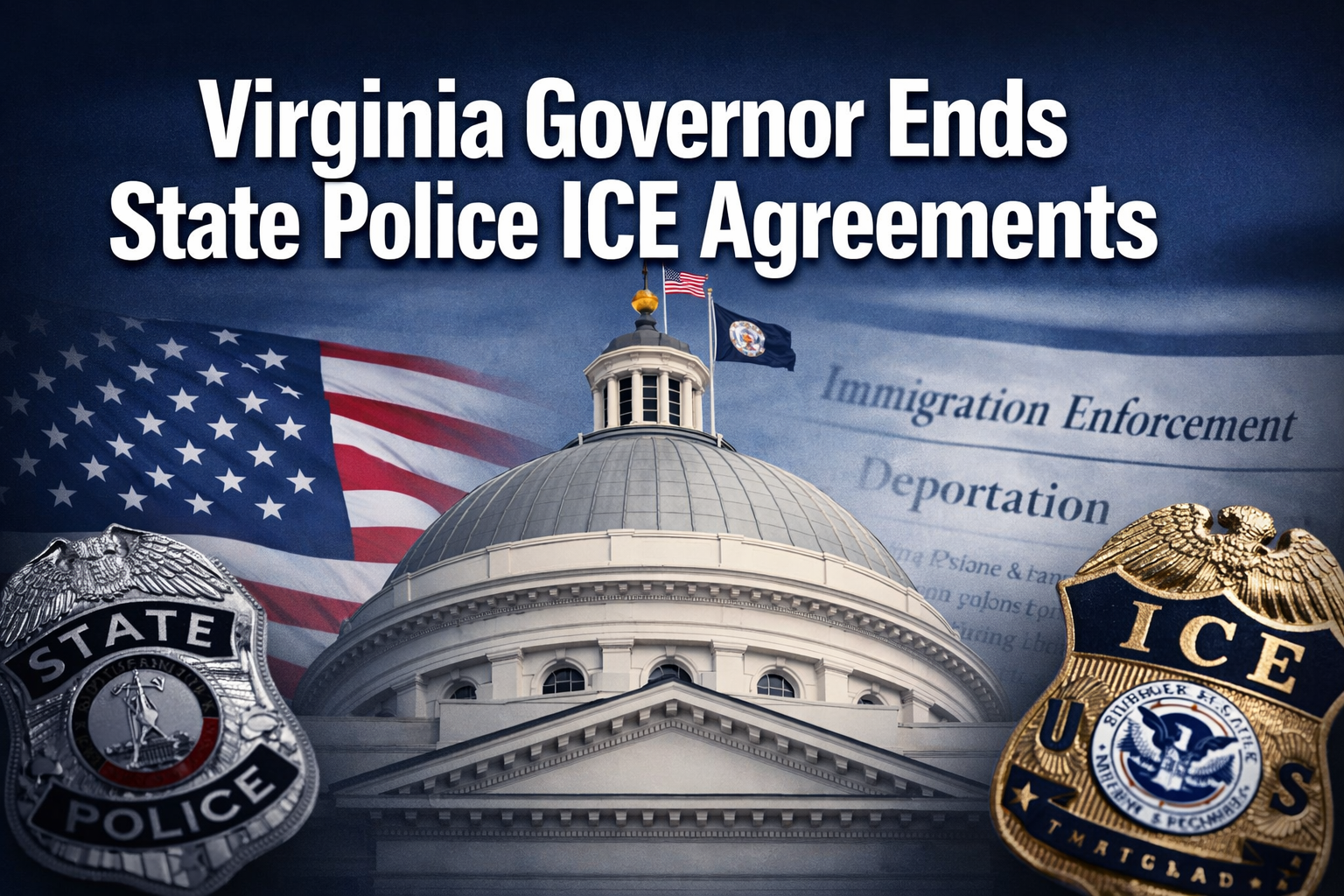
Virginia Governor Ends State Police ICE Cooperation: Spanberger Terminates Immigration Enforcement Agreements Amid Safety Debate
When Governor Abigail Spanberger signed an executive directive on Wednesday, February 4, 2026, she didn’t just end a policy—she reignited a national conversation about the role state law enforcement should play in federal immigration enforcement. Gov. Abigail Spanberger has formally ended an agreement allowing Virginia State Police and corrections officers to assist U.S. Immigration and Customs Enforcement, marking one of the most significant policy shifts in Virginia’s approach to immigration since the Trump administration expanded such partnerships. The move affects four state agencies and at least 32 existing agreements, placing Virginia at the center of a debate that’s playing out in communities from Utica to Richmond: Should local police be immigration agents?
The answer, according to Spanberger, is a resounding no—with important exceptions. Spanberger said the order does not prohibit cooperation between state agencies and ICE under limited circumstances, such as task forces or with judicial warrants. But that nuance hasn’t quieted critics. Sen. Glenn Sturtevant criticized the order as putting politics over public safety, while Spanberger said it reinforces accountability, public service, and safety.[1][2]
For communities across upstate New York watching this unfold, the Virginia decision offers a blueprint—and a warning—about how immigration policy intersects with local policing, community trust, and public safety in 2026.
Key Takeaways
- Governor Spanberger terminated all existing 287(g) agreements between Virginia State Police, Department of Corrections, Conservation Police, Marine Police, and ICE on February 4, 2026[1][2]
- Virginia had at least 32 active ICE partnerships, among the highest number of any state, with ICE making 615 arrests in the D.C. area (including Virginia) in fiscal year 2025[2]
- Limited cooperation remains permitted when federal agents present judicial warrants or during multi-agency task forces, preserving some federal-state collaboration[3]
- Republican lawmakers condemned the action as weakening public safety, while Democratic legislators and immigration advocates praised it for rebuilding community trust[2][3]
- The policy fulfills a campaign promise and represents a direct reversal of former Governor Glenn Youngkin’s February 2025 mandate to establish ICE partnerships[2][4]
Understanding Virginia’s ICE Agreement Termination and Its National Implications
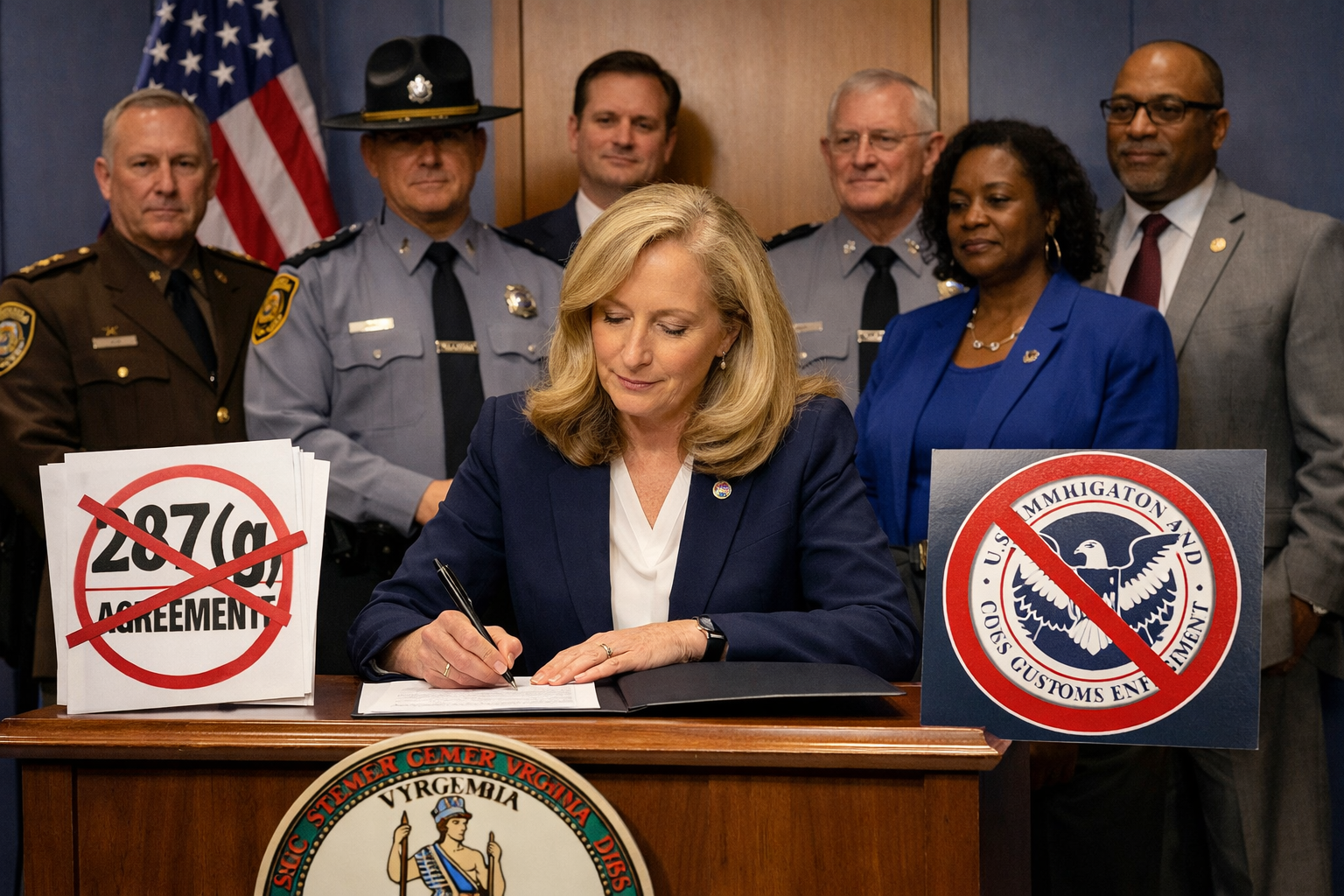
The executive directive Spanberger signed represents the culmination of a policy battle that began the moment she took office. Back on January 17, 2026, she had signed Executive Order 10, which rescinded former Republican Governor Glenn Youngkin’s February 2025 mandate requiring state agencies to establish 287(g) agreements with ICE.[2][4] But that earlier order had a critical limitation: it only prevented future partnerships while leaving existing agreements intact.
The February 4th directive closes that loophole entirely. It immediately terminates active agreements involving the Virginia State Police, Virginia Department of Corrections, Virginia Conservation Police, and Virginia Marine Police—four agencies that had been working under what investigators later determined were improper supervisory arrangements.[2]
What Are 287(g) Agreements?
These partnerships, authorized under Section 287(g) of the Immigration and Nationality Act, allow state and local law enforcement to perform immigration enforcement functions traditionally reserved for federal agents. Officers receive training from ICE and gain authority to identify, process, and detain individuals based on immigration status during routine law enforcement activities.
Supporters argue these agreements help remove dangerous criminals from communities. Critics counter that they transform every traffic stop into a potential deportation encounter, chilling cooperation between immigrant communities and police.
The Investigation That Changed Everything
What ultimately sealed the fate of Virginia’s ICE agreements wasn’t just political philosophy—it was a finding of improper federal control. An investigation led by Stanley Meador (Commonwealth Secretary of Public Safety and Homeland Security) and David Bulova (Virginia Secretary of Natural and Historic Resources) uncovered that existing 287(g) agreements improperly granted federal ICE agencies, rather than Virginia state government, supervisory power over Virginia law enforcement.[2]
The agreements required state officers to work “under the supervision or direction of” ICE—effectively making Virginia taxpayers fund federal immigration enforcement while ceding control of state personnel to federal authorities. For Spanberger, a former CIA officer who built her political career on government accountability, this arrangement violated basic principles of state sovereignty and fiscal responsibility.
Spanberger’s Rationale: Public Safety Through Community Trust
Governor Spanberger didn’t frame her decision as soft on crime or weak on immigration enforcement. Instead, she positioned it as essential to effective policing—a distinction that matters in understanding the progressive approach to immigration and public safety.
Simultaneously with the ICE directive, Spanberger signed Executive Order 12, which outlines foundational principles for state law enforcement. The order emphasizes that “public trust is a prerequisite to effective policing,” that law enforcement exists to preserve human life and protect vulnerable people, and that Virginia officers should not engage in “fear-based policing.”[2][3][5]
The Community Trust Argument
“When state and local law enforcement are pulled away from upholding our Virginia laws to do the job of federal agents, it weakens their ability to deepen trust—contributing to a culture of fear and distrust,” Spanberger explained.[2][4]
This isn’t abstract theory. Law enforcement agencies from Los Angeles to New York have documented how immigration enforcement by local police reduces crime reporting from immigrant communities. When a domestic violence victim fears calling 911 might result in deportation, she stays silent. When a witness to gang violence worries about immigration status checks, crimes go unsolved.
Fairfax Senator Saddam Salim echoed this concern, noting that the previous agreements affected not just undocumented immigrants but also legal residents with privilege cards rather than traditional driver’s licenses—creating a two-tiered system where some Virginians feared routine police interactions.[3]
Luis Aguilar of CASA, an immigrant advocacy organization, praised the rollback for refocusing law enforcement on public safety rather than immigration enforcement, arguing it would rebuild trust in communities where fear had replaced cooperation.[3]
What Cooperation Remains Permissible
Importantly, Spanberger’s order doesn’t create a sanctuary state or prohibit all federal-state cooperation. The directive explicitly permits cooperation between state agencies and ICE under limited circumstances, including:
- When judicial warrants are presented: If ICE agents arrive with a warrant signed by a judge, Virginia agencies can assist
- During multi-agency task forces: Joint operations targeting serious crimes can continue
- For non-immigration federal partnerships: Agreements between federal and state agencies for purposes other than immigration enforcement remain unaffected[3]
This middle-ground approach attempts to balance community trust with legitimate public safety cooperation—though whether it satisfies anyone remains to be seen.
Republican Criticism and the Politics Over Safety Debate
Sen. Glenn Sturtevant and other Republican lawmakers didn’t mince words in their criticism. They framed the termination as political theater that endangers Virginians.
Rep. John McGuire (R-05) condemned Executive Order 12 in a statement, arguing that terminating ICE agreements puts Virginians in danger by weakening immigration enforcement capabilities and allowing dangerous criminals to remain in communities.[2]
The Republican argument rests on several premises:
- Criminal removal: 287(g) agreements help identify and remove immigrants who commit serious crimes
- Federal resource limitations: ICE lacks the personnel to enforce immigration law without state assistance
- Political motivation: The timing and scope of Spanberger’s action suggests partisan politics rather than genuine policy concerns
- Public safety risk: Limiting cooperation creates gaps that criminals can exploit
Examining the Public Safety Claims
The debate over whether 287(g) agreements enhance or undermine public safety isn’t settled by rhetoric—it requires examining evidence.
In fiscal year 2025, ICE made 615 arrests in the Washington, D.C. area (which includes Virginia) and detained 596 of those individuals.[2] Proponents point to these numbers as evidence the agreements work. But critics note that the vast majority of ICE arrests nationally involve non-violent offenses or immigration violations rather than serious crimes.
Research from jurisdictions that ended similar agreements shows mixed results. Some studies find no increase in crime rates after termination; others suggest modest impacts in specific categories. What’s clearer is that immigrant crime reporting and cooperation with police tend to increase when communities don’t fear immigration enforcement during routine interactions.
For moderate voters trying to evaluate these competing claims, the question becomes: What kind of public safety do we prioritize? Immediate immigration enforcement, or long-term community trust that enables effective policing?
Lessons for New York and the Mohawk Valley
Virginia’s policy shift carries particular relevance for upstate New York communities navigating similar tensions between immigration enforcement and community policing.
The Upstate Context
The Mohawk Valley has seen demographic changes over recent decades, with immigrant communities—including refugees resettled in Utica—becoming integral parts of the regional economy and social fabric. Local law enforcement agencies face the same fundamental question Virginia just answered: Should limited police resources focus on local public safety or federal immigration enforcement?
New York State has taken a different approach than Virginia, with various sanctuary policies limiting cooperation with ICE in certain circumstances. But individual counties and municipalities retain some discretion, and the debate over appropriate federal-state-local cooperation continues.
What Virginians Learned
Several lessons emerge from Virginia’s experience that apply to communities everywhere:
Transparency matters: The investigation revealing improper federal supervisory control changed the conversation from ideology to accountability
Community input is essential: Immigration advocates, law enforcement, and affected communities all deserve seats at the table when these policies are crafted
Middle ground exists: Spanberger’s approach—ending routine cooperation while preserving warrant-based and task force collaboration—offers a model that neither creates sanctuary status nor deputizes every officer as an immigration agent
Local impacts vary: What works in Fairfax County may differ from what works in rural Virginia, just as Utica’s needs differ from New York City’s
Questions for Local Leaders
Mohawk Valley residents concerned about these issues might ask local officials:
- What agreements, if any, exist between local law enforcement and ICE?
- How do these agreements affect community trust and crime reporting?
- What oversight ensures state and local resources aren’t improperly diverted to federal priorities?
- How can we balance legitimate public safety cooperation with community policing principles?
The Broader Immigration Enforcement Landscape in 2026
Virginia’s decision doesn’t happen in isolation. It’s part of a national patchwork of state and local responses to federal immigration enforcement that’s grown increasingly fragmented.
The Trump Administration Legacy
Former Governor Youngkin’s February 2025 mandate to establish 287(g) agreements came during the final months of the Trump administration’s immigration enforcement expansion. That federal push encouraged states to maximize cooperation with ICE, offering training, resources, and political support to jurisdictions willing to partner.
Spanberger’s reversal represents a direct repudiation of that approach—and a fulfillment of her campaign promise to roll back state-level collaboration with Trump-era immigration policies.[4]
The Patchwork Problem
The result of competing state approaches is an immigration enforcement system that varies dramatically by geography. A person stopped for a traffic violation in one Virginia county under the old system might face immigration detention, while the same person in a neighboring jurisdiction would simply receive a ticket.
This inconsistency creates both practical and ethical problems. It makes federal immigration enforcement dependent on local politics. It creates confusion for immigrants and law enforcement alike. And it raises fundamental questions about federalism: Who should control immigration enforcement, and how should federal and state authorities divide responsibilities?
Economic and Fiscal Considerations
Beyond public safety and civil rights, these agreements carry fiscal implications. Virginia taxpayers funded state officers performing federal immigration enforcement functions. The terminated agreements free those resources for state priorities—or represent lost federal support, depending on perspective.
For cash-strapped states and localities, the question of who pays for immigration enforcement isn’t academic. Federal reimbursement rarely covers full costs, meaning local taxpayers subsidize federal policy priorities.
Moving Forward: Accountability, Service, and Safety

Governor Spanberger framed her action as reinforcing “accountability, public service, and safety”—three principles that transcend partisan divides even as their application remains contested.
Accountability in Action
The investigation that revealed improper federal supervisory control exemplifies accountability in practice. Rather than accepting agreements as given, Spanberger’s administration examined whether they served Virginia’s interests and complied with appropriate governmental structures.
This kind of scrutiny—asking whether policies actually work as intended and serve stated purposes—represents the accountability voters across the political spectrum claim to want.
Public Service Redefined
Spanberger’s emphasis on public service reframes what it means for law enforcement to serve communities. Rather than defining service as maximum enforcement, it prioritizes building trust that enables effective policing.
For immigrant communities, this shift from fear-based to trust-based policing could mean the difference between reporting crimes and suffering in silence. For all residents, it means law enforcement focused on local public safety rather than divided between state and federal priorities.
Safety Through Trust
The governor’s argument that safety requires trust challenges conventional tough-on-crime rhetoric without abandoning public safety as a priority. It recognizes that effective policing depends on community cooperation—and that cooperation evaporates when residents fear routine interactions with police.
Whether this approach actually enhances safety will depend on implementation and measurement. Does crime reporting increase? Do clearance rates improve? Do communities feel safer? These empirical questions deserve rigorous evaluation beyond political talking points.
What You Can Do: Civic Engagement on Immigration and Policing
Virginia’s policy shift demonstrates that elections have consequences and that state-level decisions profoundly affect how federal immigration policy operates on the ground. For Mohawk Valley residents concerned about these issues, several action steps make sense:
Learn About Local Policies
Contact your local police department, sheriff’s office, and county government to understand what agreements exist with federal immigration authorities. Public records requests can reveal cooperation agreements that aren’t widely publicized.
Attend Town Halls and Public Meetings
Immigration and policing policies often get decided in county legislature meetings, city council sessions, and police commission hearings that draw minimal public attention. Your presence and voice at these meetings matters, especially when elected officials claim to represent community consensus.
Support Community Organizations
Groups like the Mohawk Valley Resource Center for Refugees and other immigrant-serving organizations work daily on these issues. They need volunteers, donations, and advocates who can amplify immigrant voices in policy debates.
Engage Elected Officials
Contact your state legislators and congressional representatives to share your perspective on immigration enforcement and community policing. Whether you support Spanberger’s approach or Sturtevant’s criticism, elected officials need to hear from constituents beyond election season.
Register and Vote
Virginia’s policy reversal happened because voters elected a governor who campaigned on this issue. Voter registration drives, primary elections, and general elections all shape who makes these decisions. In New York, the 2026 gubernatorial race will likely feature similar debates about immigration enforcement and state-federal cooperation.
Bridge Divides Through Dialogue
Perhaps most importantly, these contentious issues benefit from good-faith dialogue across political differences. Community conversations that bring together law enforcement, immigrant advocates, and concerned citizens can find common ground that pure political combat obscures.
Conclusion
Gov. Abigail Spanberger’s termination of Virginia’s ICE agreements represents a significant shift in how one state balances immigration enforcement, community policing, and public safety. By ending arrangements that placed state officers under federal supervision while preserving cooperation in limited circumstances with judicial oversight, Virginia charts a middle course between sanctuary policies and maximum enforcement.
Sen. Glenn Sturtevant’s criticism that the order puts politics over public safety reflects genuine concerns about criminal removal and federal-state cooperation that deserve serious engagement rather than dismissal. The debate over whether community trust or immigration enforcement better serves public safety won’t be resolved by executive orders alone—it requires ongoing evaluation, community input, and willingness to adjust based on evidence.
For the Mohawk Valley and communities across America grappling with similar questions, Virginia’s experience offers valuable lessons about transparency, accountability, and the importance of aligning law enforcement practices with community values. The conversation about who belongs, who decides, and how we keep communities safe continues—and your voice in that conversation matters.
The path forward requires moving beyond simplistic politics-versus-safety framings to ask harder questions: What kind of communities do we want to build? How do we balance legitimate security concerns with equally legitimate civil rights and community trust? And how do we ensure that immigration policy serves human dignity alongside national interests?
Virginia has offered one set of answers. Now it’s up to communities everywhere—including right here in upstate New York—to determine our own.
References
[1] Abigail Spanberger Executive Order Immigration 287g Ice Youngkin Trump – https://www.vpm.org/news/2026-02-04/abigail-spanberger-executive-order-immigration-287g-ice-youngkin-trump
[2] Spanberger Signs Executive Directive Terminating Active Ice Agreements With Va Officials – https://www.cavalierdaily.com/article/2026/02/spanberger-signs-executive-directive-terminating-active-ice-agreements-with-va-officials
[3] Spanberger Ends Agreements Between Ice And Virginia Law Enforcement Agencies – https://www.wvtf.org/news/2026-02-04/spanberger-ends-agreements-between-ice-and-virginia-law-enforcement-agencies
[4] Virginia Spanberger Quits Ice Program 287g – https://boltsmag.org/virginia-spanberger-quits-ice-program-287g/
[5] Watch – https://www.youtube.com/watch?v=QeohFT8zp8k


