


Hims & Hers Launches $49 Wegovy Alternative: What This Means for Healthcare Access in 2026
The weight-loss medication market just experienced a seismic shift that could reshape healthcare access for millions of Americans struggling with obesity. Online telehealth company Hims and Hers Health announced it will start offering compounded copies of Novo Nordisk’s new Wegovy weight-loss pill at an introductory price of $49 per month, the company said on Thursday, about $100 less than the brand name. This bold move arrives at a critical moment when prescription drug prices continue to burden working families across upstate New York and beyond, potentially democratizing access to treatments that have remained financially out of reach for most Americans.
For residents of the Mohawk Valley and communities throughout Oneida County, this development represents more than just another corporate announcement—it signals a fundamental challenge to the pharmaceutical industry’s pricing power and raises important questions about healthcare equity, regulatory oversight, and the future of affordable medicine.
Key Takeaways
- Dramatic Price Reduction: Hims & Hers offers compounded semaglutide pills starting at $49/month (introductory rate), compared to Novo Nordisk’s $199/month branded Wegovy
- Same Active Ingredient: The compounded version contains identical semaglutide as branded Wegovy, but delivered in pill form rather than injection
- Regulatory Gray Area: The FDA has not approved compounded semaglutide pills and previously warned Hims about marketing claims
- Expanded Manufacturing: Hims doubled its Ohio compounding facility to over one million square feet to support lower-cost production
- Healthcare Access Impact: This pricing could make weight-loss treatment accessible to working families previously priced out of the market
Understanding the Hims & Hers Wegovy Alternative Pricing Structure
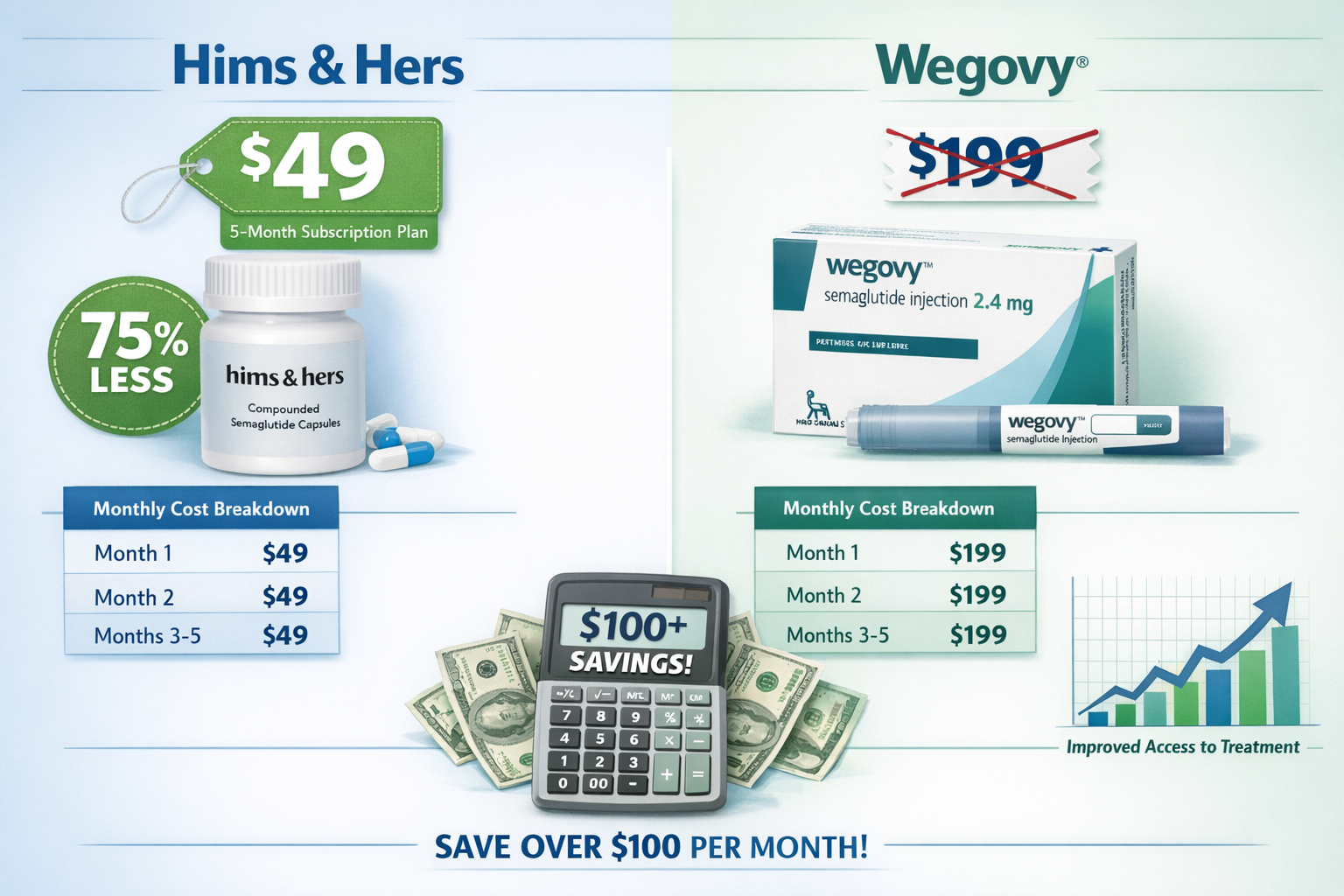
The pricing announcement from Hims & Hers Health deserves careful examination because it reveals both opportunity and complexity for consumers seeking affordable weight-loss medication.
New customers enrolling in a 5-month subscription plan pay just $49 for the first month, then $99 monthly for the remaining four months—totaling $544 for the complete five-month treatment cycle.[1] Compare this to Novo Nordisk’s branded Wegovy pill at $199 per month, which would cost $995 for the same period. That’s a savings of $451, or roughly 45% less than the brand-name option.
For those preferring shorter commitments, Hims offers 3-month plans totaling $277, though the per-month rate increases slightly.[1] One critical detail consumers must understand: all treatment costs require upfront payment in full rather than monthly installments.[1]
“This represents unprecedented pricing pressure on the pharmaceutical industry,” noted market analysts following Novo Nordisk’s February 4 warning about competitive threats from cash-pay markets.[1]
This pricing structure matters enormously for working families in communities like Utica, Rome, and New Hartford, where healthcare costs already strain household budgets. When a month’s supply of medication costs less than a week’s groceries, treatment suddenly becomes feasible for thousands who previously had no realistic access.
Breaking Down the Cost Comparison
| Provider | Monthly Cost | 5-Month Total | Delivery Method |
|---|---|---|---|
| Hims & Hers (Intro) | $49 (month 1) | $544 | Compounded pill |
| Hims & Hers (Standard) | $99 (months 2-5) | $544 | Compounded pill |
| Novo Nordisk Wegovy | $199 | $995 | Branded pill |
| Savings with Hims | $100-150/month | $451 | 45% reduction |
What Makes Compounded Semaglutide Different from Branded Wegovy?
Understanding the distinction between Hims & Hers’ compounded version and Novo Nordisk’s branded Wegovy requires navigating some complex pharmaceutical territory—but it’s essential for making informed healthcare decisions.
The active ingredient is identical: Both products contain semaglutide, the same pharmaceutical compound that works by mimicking hormones that regulate appetite and blood sugar.[1] This isn’t a different drug or a “similar” medication—it’s the exact same active ingredient that makes Wegovy effective.
The critical difference lies in how these medications are produced and regulated. Novo Nordisk’s Wegovy undergoes the FDA’s rigorous approval process, which includes extensive clinical trials, manufacturing oversight, and quality assurance protocols. The FDA has approved this version for safety, effectiveness, and quality.
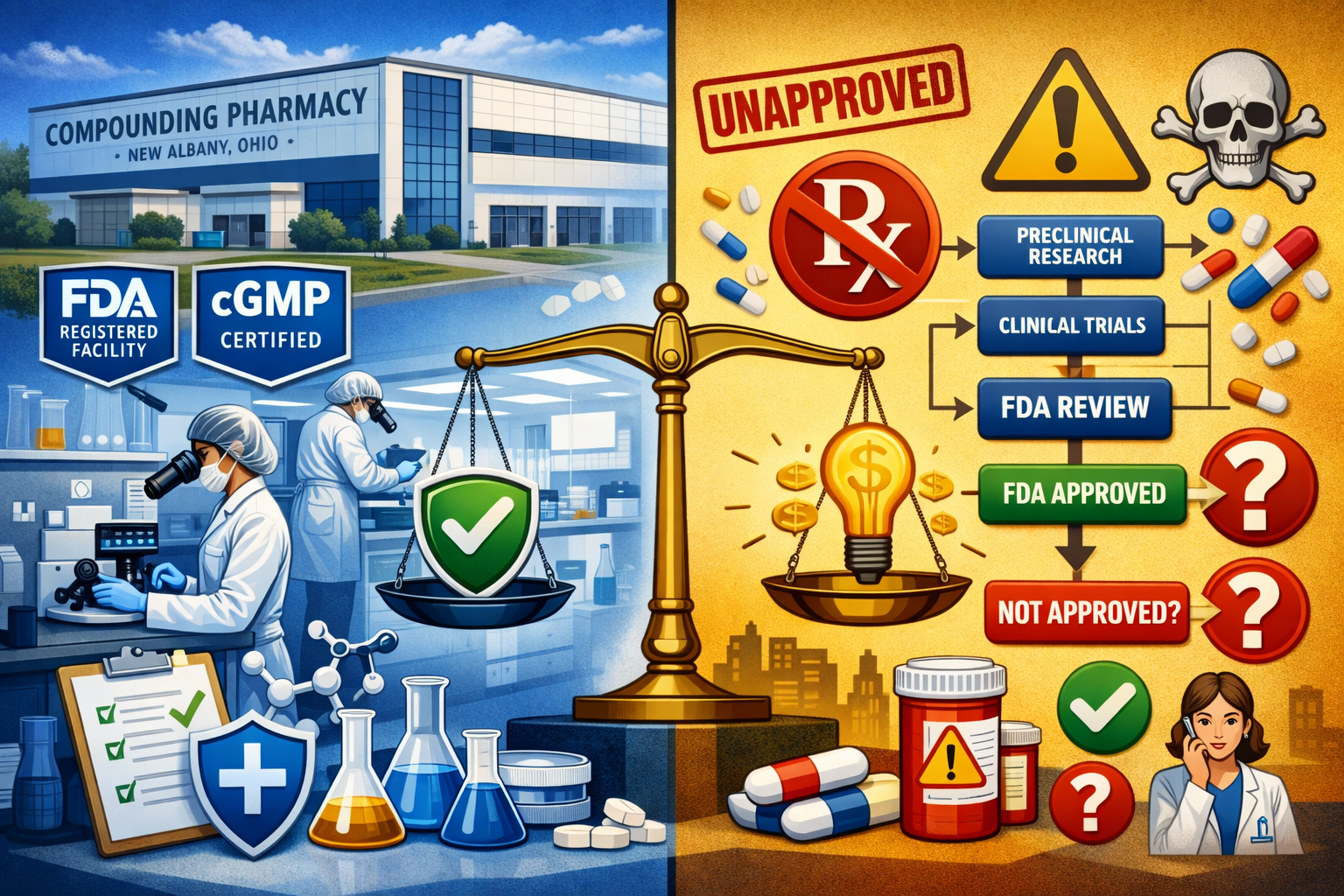
Hims & Hers’ compounded version, by contrast, is produced by compounding pharmacies—facilities that create customized medications by combining, mixing, or altering pharmaceutical ingredients.[2] While all active pharmaceutical ingredients sourced by Hims come exclusively from FDA-registered facilities, the final compounded product itself has not received FDA approval for safety, effectiveness, or quality.[2]
The Innovation: Pill Delivery System
Hims developed a specially formulated delivery system designed to protect the active semaglutide during digestion and support absorption.[2] This represents genuine pharmaceutical innovation—creating an oral delivery mechanism for a medication traditionally administered by injection.
This matters because many patients avoid weight-loss treatment specifically due to needle anxiety. The pill format removes that barrier entirely, potentially expanding access to people who would never consider injectable options.
Additionally, providers can tailor treatment dosages for individual patients, offering deeper personalization than standardized branded options.[2] This flexibility allows clinicians to adjust for side effects, body weight variations, and individual response patterns—the kind of customized care that represents healthcare at its best.
The Regulatory Landscape and FDA Concerns
The regulatory status of compounded semaglutide sits in complicated territory that consumers deserve to understand fully. Transparency about these issues reflects the kind of healthcare accountability that serves patients’ best interests.
In September, the FDA issued a warning letter to Hims & Hers regarding its marketing claims that compounded products are equivalent to FDA-approved versions like Ozempic and Wegovy.[1] This wasn’t a safety recall or a directive to stop production—it was specifically about how the company communicated about its products.
The FDA’s position centers on a fundamental regulatory principle: compounded medications exist in a different category than FDA-approved drugs. Compounding pharmacies serve an important role in healthcare, creating customized medications for patients with specific needs that mass-produced drugs can’t meet. However, they operate under different oversight standards than major pharmaceutical manufacturers.
What this means practically: The FDA hasn’t evaluated Hims’ compounded semaglutide pills through the same rigorous testing process that branded Wegovy underwent. That doesn’t automatically mean the medication is unsafe or ineffective—many compounded medications serve patients well—but it does mean consumers are making a different risk calculation.
The Hims-Novo Partnership Breakdown
The business relationship between these companies adds another layer to this story. Hims and Novo Nordisk ended their 2025 partnership amid significant disagreement about marketing practices.[1]
Novo accused Hims of wrongfully marketing Wegovy copycats, while Hims’ CEO Andrew Dudum countered that Novo was attempting to control clinical decisions that should remain between providers and patients.[1] This dispute reveals the tension between pharmaceutical companies protecting their market position and telehealth companies working to expand affordable access.
For progressive advocates of healthcare reform, this conflict illustrates exactly why prescription drug pricing remains such a critical issue. When a company can charge $199 monthly for a medication that competitors can profitably offer at $49-99, questions about fair pricing and corporate accountability become unavoidable.
Manufacturing Expansion and Production Capabilities
Hims & Hers didn’t stumble into this market opportunity—the company made substantial infrastructure investments specifically to enable lower-cost production at scale.
In 2025, Hims doubled its compounding facility in New Albany, Ohio to over one million square feet.[1][2] This massive expansion integrated pharmacy capabilities, laboratory testing, and research and development space under one roof, creating an end-to-end production system designed for efficiency.
This kind of vertical integration—controlling more of the production process internally—typically allows companies to reduce costs while maintaining quality standards. For a telehealth company to invest this heavily in physical pharmaceutical infrastructure signals serious long-term commitment to the compounded medication market.
The facility’s scale matters for another reason: production capacity. To offer medications at dramatically lower prices, companies need volume. A million-square-foot facility can produce enough medication to serve hundreds of thousands of patients, spreading fixed costs across a larger customer base and enabling the aggressive pricing we’re seeing.
Market Competition and Industry Response
The timing of Hims & Hers’ announcement reveals strategic awareness of competitive dynamics reshaping the weight-loss medication market in 2026.
Just one day before Hims made its announcement, Novo Nordisk warned investors on February 4 that pricing pressure is “unprecedented” due to cash-pay market shifts and demands for discounts.[1] The pharmaceutical giant had recently agreed to lower prices following requests from the Trump Administration, and competitive pressure from companies like Hims was clearly intensifying.
But Hims isn’t the only challenger. Eli Lilly is preparing to launch its own oral semaglutide pill in the coming months, further intensifying competition for Novo’s market share.[1] When multiple major players enter the same market segment simultaneously, prices typically decline—exactly what we’re witnessing.
Novo Nordisk’s CEO responded sharply to Hims’ announcement, stating that people taking Hims’ compounded pill would be “wasting $49” because the compound hasn’t undergone FDA approval processes.[5] This aggressive rhetoric suggests genuine concern about market share erosion.
What This Means for Healthcare Access
From a healthcare equity perspective, this competition delivers tangible benefits for patients who’ve been priced out of treatment. Obesity affects approximately 42% of American adults, with higher rates in working-class communities that face economic barriers to healthcare access.
When weight-loss medication costs $200 monthly—nearly $2,400 annually—it remains accessible primarily to affluent patients or those with exceptional insurance coverage. At $49-99 monthly, treatment suddenly becomes feasible for working families, potentially addressing health disparities that have persisted for decades.
For Mohawk Valley residents navigating healthcare costs alongside housing expenses, utilities, and other necessities, this price difference could determine whether treatment happens at all. That’s not hyperbole—it’s the reality of healthcare economics for working people in upstate New York.
Consumer Considerations and Healthcare Decision-Making
Anyone considering Hims & Hers’ compounded semaglutide should approach the decision with full information about both benefits and limitations.
Advantages of the Hims & Hers option:
✅ Dramatically lower cost ($49-99 vs. $199 monthly)
✅ Pill format eliminates injection anxiety
✅ Customizable dosing allows personalized treatment
✅ Telehealth convenience removes geographic barriers
✅ Same active ingredient as branded Wegovy
Important considerations and limitations:
⚠️ No FDA approval for the compounded formulation
⚠️ Upfront payment required (no monthly installments)
⚠️ Different regulatory oversight than branded medications
⚠️ Limited long-term data on this specific formulation
⚠️ Potential insurance complications (compounded drugs often aren’t covered)
Questions to Ask Your Healthcare Provider
Before starting any weight-loss medication, patients should have thorough conversations with healthcare providers about:
- Individual health history: Are there contraindications or risk factors specific to your situation?
- Treatment goals: What outcomes are realistic, and over what timeframe?
- Side effect management: How will potential gastrointestinal effects be monitored and addressed?
- Long-term planning: What happens after the initial treatment period?
- Alternative options: Are there other approaches—medication or otherwise—worth considering?
The telehealth model that Hims employs can provide excellent care, but it requires patients to be proactive communicators about their health status and any concerns that arise during treatment.
Broader Implications for Prescription Drug Pricing Reform
This development connects to larger conversations about prescription drug pricing that should matter deeply to anyone concerned about healthcare justice and economic fairness.
The pharmaceutical industry has long defended high U.S. drug prices by citing research and development costs, regulatory compliance expenses, and the need to fund innovation. Yet when a compounding pharmacy can offer the identical active ingredient at 75% less than the branded version, those justifications deserve scrutiny.
This isn’t about demonizing pharmaceutical companies—drug development genuinely requires massive investment, and innovation deserves reward. But the question remains: at what point does pricing cross from fair profit into exploitation of patients with limited alternatives?
For progressive advocates, this situation illustrates why prescription drug pricing reform remains essential policy work. When market forces alone can’t ensure affordable access to life-changing medications, government intervention becomes necessary to protect public health.
Policy Implications for New York
New York State has taken steps toward prescription drug affordability, but much work remains. State legislators could consider:
- Expanding compounding pharmacy oversight to ensure safety while preserving access
- Creating state-level drug pricing review boards with authority to challenge excessive costs
- Strengthening telehealth regulations that protect consumers without restricting access
- Investigating pharmaceutical pricing practices that create barriers to essential medications
Residents can support these efforts by contacting state representatives and demanding action on prescription drug affordability—the kind of civic engagement that translates awareness into change.
Looking Ahead: The Future of Weight-Loss Medication Access
The weight-loss medication market in 2026 looks dramatically different than even two years ago, and further evolution seems inevitable.
As competition intensifies among Hims & Hers, Novo Nordisk, Eli Lilly, and other entrants, prices will likely continue declining. This benefits consumers directly, but it also raises questions about sustainability and quality maintenance.
Regulatory agencies face important decisions about how to oversee compounded medications that serve millions of patients. The FDA’s traditional framework was designed for a different pharmaceutical landscape—one where compounding served niche needs rather than mass markets. Updating regulations to reflect current realities while protecting patient safety represents a genuine governance challenge.
Insurance coverage will evolve as these medications become more prevalent. Currently, many insurance plans don’t cover weight-loss medications or impose significant restrictions. As clinical evidence of long-term health benefits accumulates and costs decline, coverage policies may shift—though advocacy will be necessary to ensure equitable access.
Telehealth delivery models will likely expand beyond weight-loss medications to other treatment areas where traditional healthcare delivery creates unnecessary barriers. The convenience and cost-effectiveness that Hims demonstrates could reshape how Americans access routine medical care.
Conclusion: Healthcare Access, Corporate Accountability, and Consumer Empowerment
Online telehealth company Hims and Hers Health’s decision to offer compounded copies of Novo Nordisk’s Wegovy weight-loss pill at an introductory price of $49 per month represents more than a business strategy—it’s a direct challenge to pharmaceutical pricing practices that have kept essential medications out of reach for working families.
The $100+ monthly savings compared to branded Wegovy could mean the difference between treatment and no treatment for thousands of people struggling with obesity and its associated health complications. For communities throughout the Mohawk Valley, where economic pressures already strain household budgets, this kind of price reduction matters enormously.
Yet this opportunity comes with important caveats. The FDA’s lack of approval for compounded semaglutide pills, the regulatory warnings Hims has received, and the limited long-term data on this specific formulation all require careful consideration. Healthcare decisions should never be made on price alone—safety, effectiveness, and individual health circumstances must guide treatment choices.
What makes this development significant isn’t just the lower price—it’s what that price reveals about the pharmaceutical industry’s pricing flexibility when genuine competition emerges. If compounding pharmacies can profitably offer semaglutide at $49-99 monthly, the $199 branded price starts looking less like necessary cost recovery and more like market exploitation.
Take Action: What You Can Do
For those considering treatment:
- Consult with healthcare providers about whether semaglutide is appropriate for your health situation
- Ask specific questions about the differences between compounded and branded versions
- Research both Hims & Hers and traditional pharmacy options thoroughly
- Consider your budget realistically, including the upfront payment requirement
For healthcare advocates:
- Contact New York State legislators about prescription drug pricing reform
- Support policies that increase transparency in pharmaceutical pricing
- Advocate for expanded insurance coverage of weight-loss medications
- Engage in community conversations about healthcare access and affordability
For informed citizens:
- Stay updated on FDA regulatory decisions regarding compounded medications
- Follow developments in the weight-loss medication market
- Share information about affordable treatment options with those who might benefit
- Demand corporate accountability from pharmaceutical companies
The intersection of healthcare access, prescription drug pricing, and corporate accountability affects every community in upstate New York and beyond. When companies like Hims & Hers challenge established pricing norms, they create opportunities for expanded access—but also raise important questions about regulation, safety, and the role of market competition in healthcare.
This isn’t the end of the story. It’s the beginning of a larger conversation about who gets access to life-changing medications, at what cost, and under what regulatory framework. That conversation deserves the engagement of everyone who believes healthcare should be a right, not a privilege reserved for those who can afford premium prices.
The Mohawk Valley Voice will continue following this story as it develops, holding both pharmaceutical companies and telehealth providers accountable while advocating for policies that expand affordable healthcare access for working families throughout our region.
References
[1] Exclusive Hims Hers Health Launches Copy Wegovy Pill 49 – https://www.globalbankingandfinance.com/exclusive-hims-hers-health-launches-copy-wegovy-pill-49/
[2] Hims Hers Expands Personalized Weight Loss Portfolio With Access To Cbtwv3qxg770 – https://www.stocktitan.net/news/HIMS/hims-hers-expands-personalized-weight-loss-portfolio-with-access-to-cbtwv3qxg770.html
[3] Hims Hers Health Stock Rallies On Wegovy Copycat Launch – https://www.tipranks.com/news/hims-hers-health-stock-rallies-on-wegovy-copycat-launch
[4] Hims Hers To Offer Copy Of Novo S Wegovy Pill For 49 Per Month Reuters Reports Ce7e5ad8d98cf12c – https://www.marketscreener.com/news/hims-hers-to-offer-copy-of-novo-s-wegovy-pill-for-49-per-month-reuters-reports-ce7e5ad8d98cf12c
[5] Novo Nordisk Ceo Says People Taking Hims Compounded Pill Will Be Wasting 49 Because The Compound Ce7e5ad8d98df324 – https://www.marketscreener.com/news/novo-nordisk-ceo-says-people-taking-hims-compounded-pill-will-be-wasting-49-because-the-compound-ce7e5ad8d98df324


