


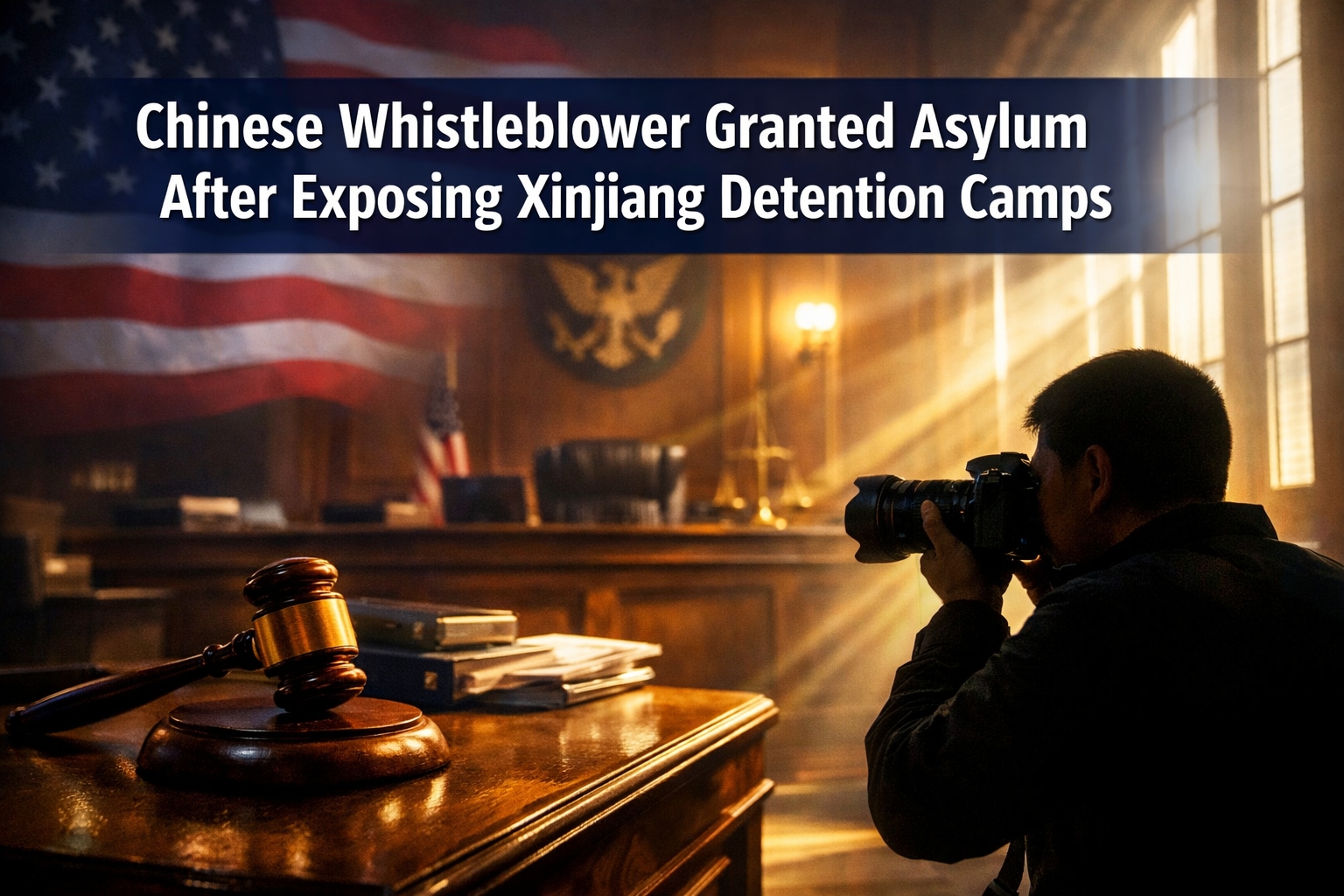
On Tuesday, Guan Heng was released from federal detention and reunited with his mother after an immigration judge granted him asylum earlier this month. The 38-year-old Chinese national’s case represents a remarkable intersection of human rights advocacy, immigration rights, and international accountability. Facing persecution in China, Guan said he secretly filmed Xinjiang detention facilities in 2020 and released most footage on YouTube shortly before arriving in Florida by boat in October 2021, knowing he had to leave China. His courage in documenting what the State Department now condemns as “genocide, religious persecution, and crimes against humanity” has made him both a hero to human rights advocates and a target of authoritarian retaliation.
At one point he faced possible deportation to Uganda, but the Department of Homeland Security dropped that plan in December following bipartisan congressional pressure. The journey that brought Guan to this moment of relief and reunion was anything but straightforward—he traveled through Hong Kong, Ecuador and the Bahamas before arriving in Florida by boat in October 2021. He is staying temporarily in Binghamton, New York, and Luo Yun, his mother, said she finally felt relieved, while Rep. Ro Khanna called the outcome a reminder of the rule of law. The case remains politically charged, given broader U.S.-China concerns, as DHS has 30 days to appeal the Jan. 28 ruling.
Key Takeaways
- Asylum granted: Immigration Judge Charles Ouslander ruled on January 28, 2026, that Guan Heng faced credible persecution in China for exposing Xinjiang detention camps[1][3]
- Crucial evidence: Guan’s 2020 footage helped journalists win a Pulitzer Prize and documented widespread human rights abuses against Uyghurs[2]
- Bipartisan support: Representatives Ro Khanna and Raja Krishnamoorthi successfully advocated against Guan’s deportation to Uganda[4]
- Temporary relief: DHS has 30 days to appeal the asylum ruling, meaning Guan’s legal status remains uncertain[5]
- Local connection: Guan is currently staying in Binghamton, New York, bringing this international human rights story to upstate New York communities
The Courage to Document: Guan Heng’s Dangerous Mission in Xinjiang
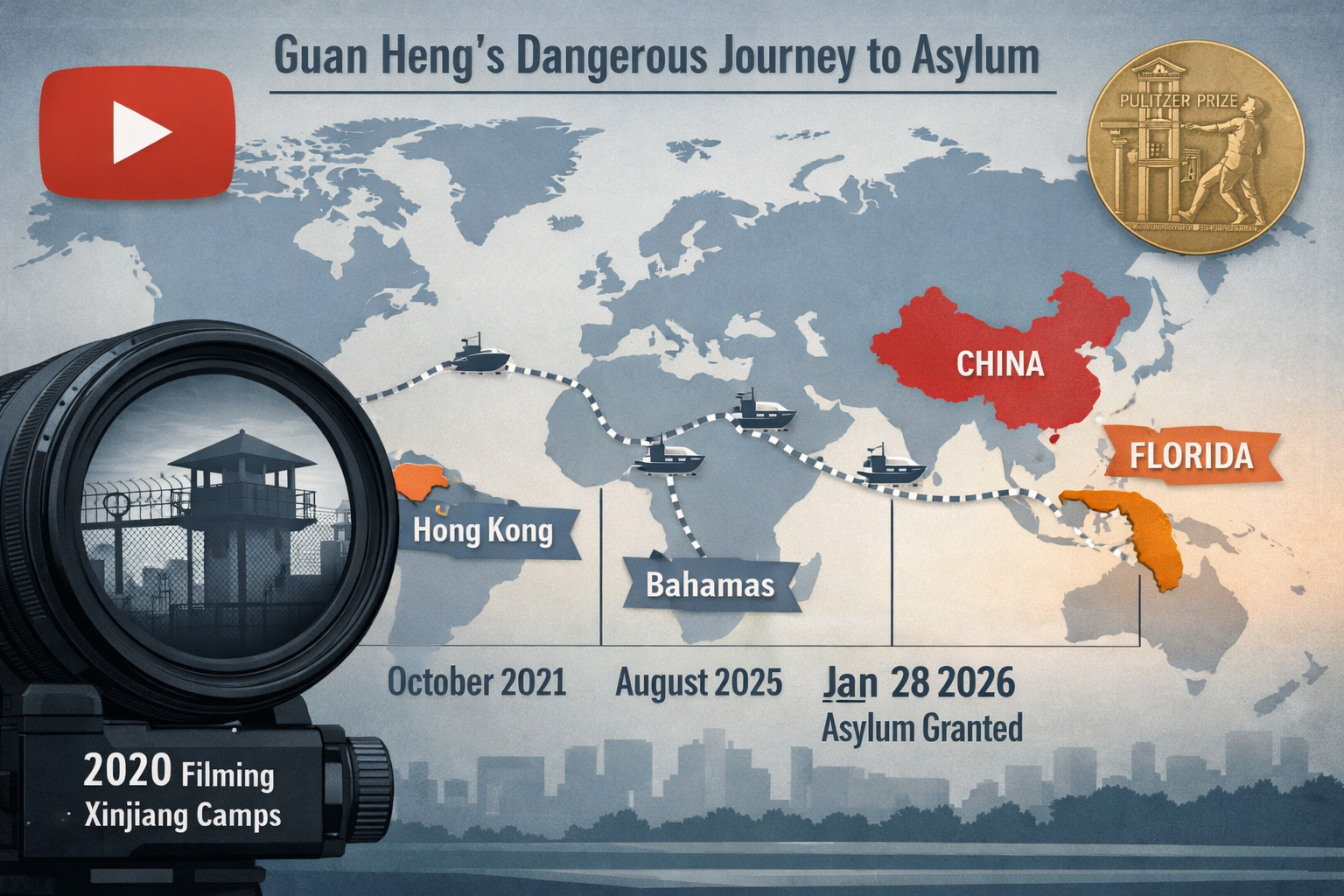
Guan Heng’s story begins not with his arrival on American shores, but in the Xinjiang region of China in 2020, where he made a decision that would change his life forever. Using a telephoto lens, the Henan province native secretly filmed detention facilities that held Uyghurs and other ethnic minorities, documenting what human rights organizations describe as systematic oppression and cultural genocide.[1][3]
Why would someone risk everything to take these videos? The answer reveals both the severity of the human rights crisis in Xinjiang and the extraordinary moral courage of ordinary people who refuse to look away.
Guan’s footage became crucial evidence for journalists, including the BuzzFeed News team that won a Pulitzer Prize for their reporting on the camps.[2] His documentation provided visual proof of facilities that the Chinese government had long denied existed or claimed were merely “vocational training centers.”
The risks Guan faced were immense and immediate. He understood that publishing this footage from within China would result in arrest, imprisonment, or worse. That’s why he made the difficult decision to release most of his footage on YouTube shortly before beginning his perilous journey to the United States.[1][3]
The Journey to Freedom Through Four Countries
Guan’s path to asylum illustrates the desperate lengths people will go to escape persecution. He traveled through Hong Kong, Ecuador, and the Bahamas before arriving in Florida by boat in October 2021.[1][3] This circuitous route reflects the limited options available to Chinese nationals seeking refuge, particularly those who have directly challenged the Chinese Communist Party’s narrative.
Each leg of this journey carried its own dangers:
- Evading surveillance in Hong Kong, where Beijing’s security apparatus has tightened dramatically
- Navigating immigration systems in Ecuador and the Bahamas
- Undertaking a dangerous boat journey to Florida
- Arriving in the U.S. without proper documentation, knowing he would face detention
When Guan arrived in Florida in October 2021, he applied for asylum, beginning a legal process that would take more than four years to resolve and include five months in federal detention.[1]
From Detention to Deportation Threat: A Case That Nearly Went Wrong
Despite the clear evidence of persecution Guan faced, his case nearly ended in tragedy. In August 2025, as part of the Trump administration’s mass deportation campaign, immigration enforcement detained Guan at the Broome County Correctional Facility in New York.[3] He would remain in custody for approximately five months, separated from his mother and uncertain of his future.
The Department of Homeland Security initially sought to deport Guan to Uganda—a plan that shocked human rights advocates and members of Congress alike.[1][3] Uganda has no connection to Guan’s case; the choice appeared arbitrary and potentially dangerous, as it would place him in a country where he had no ties, no support network, and potentially limited protection from Chinese government pressure.
“This case reminds us that the rule of law still matters in America, even when political winds shift.” — Rep. Ro Khanna
Bipartisan Advocacy Saves a Whistleblower
What saved Guan Heng from deportation to Uganda was something increasingly rare in 2026 politics: genuine bipartisan cooperation on a matter of principle. Representative Ro Khanna and Ranking Member Raja Krishnamoorthi of the House Select Committee on U.S.-China Competition publicly advocated for Guan’s asylum.[4]
On December 13, 2025, Krishnamoorthi sent a formal letter to DHS pressing the department to grant asylum to Guan, emphasizing his role in documenting human rights abuses and the clear danger he would face if returned to China or placed in a vulnerable third country.[4]
The pressure worked. In December 2025, DHS dropped its plan to deport Guan to Uganda, allowing his asylum case to proceed through the immigration court system.[1][3]
This intervention demonstrates several important principles:
- Congressional oversight can protect vulnerable individuals from bureaucratic decisions
- Human rights advocacy transcends partisan politics when members of Congress choose principle over politics
- Public pressure and transparency matter in immigration cases
- The rule of law can prevail even during periods of aggressive immigration enforcement
Judge Ouslander’s Ruling: Finding Credibility and Fear
On January 28, 2026, Immigration Judge Charles Ouslander issued a ruling that would finally bring Guan Heng’s long ordeal to a positive conclusion. Presiding over the case in Napanoch, New York, Judge Ouslander found Guan to be a “credible witness” with a “well-founded fear” of persecution if returned to China.[1][3]
This legal language carries significant weight in asylum law. To win asylum, applicants must demonstrate:
- Past persecution or a well-founded fear of future persecution
- Persecution based on race, religion, nationality, political opinion, or membership in a particular social group
- Government involvement or inability/unwillingness of the government to protect them
- Credibility in their testimony and evidence
Judge Ouslander’s finding that Guan met these standards represents a rare successful outcome in the current immigration climate, where asylum approval rates have declined significantly.[2]
What the Asylum Grant Means (and Doesn’t Mean)
Guan’s asylum approval is significant, but it’s not yet final. The case remains politically charged, given broader U.S.-China concerns, as DHS has 30 days to appeal the Jan. 28 ruling.[5] This 30-day window means that as of February 2026, Guan’s legal status remains technically uncertain.
If DHS chooses not to appeal—or if an appeal is unsuccessful—Guan will be able to:
- Remain in the United States legally
- Apply for work authorization
- Eventually apply for permanent residency (green card)
- Travel internationally with proper documentation
- Potentially apply for citizenship after meeting residency requirements
For now, Guan is staying temporarily in Binghamton, New York, where he was reunited with his mother, Luo Yun, who said she finally felt relieved after years of worry.[5] This reunion in upstate New York brings an international human rights story directly to Mohawk Valley communities and demonstrates how global justice issues intersect with local lives.
The Broader Context: U.S.-China Relations and Human Rights
Guan Heng’s case doesn’t exist in a vacuum. It unfolds against the backdrop of increasingly tense U.S.-China relations and mounting evidence of systematic human rights abuses in Xinjiang. The State Department’s condemnation of Beijing’s actions as “genocide, religious persecution, and crimes against humanity” represents one of the strongest official characterizations of another government’s conduct.[5]
What’s Happening in Xinjiang?
The region Guan documented has become the site of what human rights organizations describe as cultural genocide against Uyghurs and other predominantly Muslim ethnic minorities. Evidence compiled by journalists, researchers, and whistleblowers like Guan indicates:
- Mass detention: Estimates suggest over one million people have been detained in “re-education” facilities
- Forced labor: Systematic programs forcing detainees to work in factories producing goods for global supply chains
- Cultural erasure: Destruction of mosques, prohibition of religious practices, suppression of Uyghur language and culture
- Surveillance state: Comprehensive digital and physical monitoring of Uyghur communities
- Family separation: Children removed from families and placed in state-run facilities
Guan’s footage provided visual evidence that helped substantiate these claims and counter Chinese government denials.
The Political Tightrope of Immigration and Foreign Policy
Guan’s case highlights the complex intersection of immigration policy and foreign policy. His asylum claim is strengthened by:
- Official U.S. government recognition of genocide in Xinjiang
- Bipartisan congressional support for holding China accountable
- The value of his testimony and evidence to U.S. foreign policy objectives
- Public pressure from human rights organizations
Yet he also faced detention and potential deportation as part of broader immigration enforcement priorities that don’t always account for individual circumstances or foreign policy implications.
This tension raises important questions for voters and policymakers:
- How should immigration enforcement balance security concerns with humanitarian obligations?
- What protections should exist for whistleblowers who expose human rights abuses?
- How can the U.S. maintain credibility on human rights while managing complex diplomatic relationships?
- What role should Congress play in oversight of individual immigration cases with foreign policy implications?
What This Means for Upstate New York and Beyond

Guan Heng’s temporary residence in Binghamton connects this international story directly to upstate New York communities. His presence in the region offers opportunities for:
🏛️ Community Education: Local organizations can host discussions about refugee and asylum issues, helping residents understand the human stories behind immigration policy debates.
⚖️ Legal Advocacy: Immigration attorneys and advocates in the Mohawk Valley region can use this case as an example of successful asylum claims based on political persecution and whistleblowing.
🤝 Refugee Support: Community members can connect with organizations supporting asylum seekers and refugees, offering practical assistance with housing, employment, and integration.
📰 Media Literacy: Guan’s documentation work demonstrates the crucial role of citizen journalism and whistleblowing in exposing human rights abuses.
Lessons for Immigration Rights Advocates
Guan’s case offers several important lessons for those working on immigration rights and asylum issues:
- Congressional advocacy works: Direct intervention by elected officials can influence DHS decisions
- Public attention matters: Media coverage and public pressure helped prevent deportation to Uganda
- Documentation is crucial: Guan’s video evidence strengthened his credibility and asylum claim
- Bipartisan support is possible: Human rights issues can transcend partisan divisions when framed around shared values
- The process is lengthy: From arrival in October 2021 to asylum grant in January 2026, Guan waited over four years
Taking Action: How Citizens Can Support Asylum Seekers
Guan Heng’s successful asylum claim shouldn’t be seen as an isolated happy ending, but as a reminder of what’s possible when the rule of law, congressional oversight, and public advocacy align. Here’s how Mohawk Valley residents and others can support asylum seekers and refugees:
Immediate Actions
📞 Contact Your Representatives: Let your members of Congress know you support protecting asylum seekers and whistleblowers. Specifically mention cases like Guan Heng’s when discussing immigration policy.
💰 Support Local Organizations: Groups like the Mohawk Valley Resource Center for Refugees and other immigrant services organizations need financial support and volunteers.
📚 Educate Yourself: Learn about asylum law, the immigration court system, and the experiences of asylum seekers in your community.
Long-Term Engagement
🗳️ Vote for Immigration Reform: Support candidates who advocate for fair asylum processes, adequate funding for immigration courts, and protection for whistleblowers.
👥 Volunteer: Many asylum seekers need help with English language learning, job searches, housing, and navigating American systems.
🏘️ Build Community: Welcome refugees and asylum seekers into community spaces, houses of worship, and civic organizations.
📢 Amplify Stories: Share stories like Guan’s that humanize asylum seekers and demonstrate why protection matters.
Conclusion: The Rule of Law and the Power of Courage
Guan Heng’s journey from secretly filming detention camps in Xinjiang to reuniting with his mother in Binghamton, New York, represents both an individual triumph and a broader test of American values. His case demonstrates that the rule of law can still protect vulnerable people, even in a political climate often hostile to asylum seekers.
Representative Ro Khanna’s characterization of the outcome as “a reminder of the rule of law” carries particular weight in 2026, when immigration enforcement priorities sometimes seem to override individual justice.[5] Guan’s successful asylum claim shows that judges can still evaluate cases on their merits, that congressional oversight can make a difference, and that public advocacy matters.
The next 30 days will determine whether this victory stands. DHS’s decision on whether to appeal Judge Ouslander’s ruling will signal how the government balances immigration enforcement priorities against foreign policy objectives and humanitarian obligations.
For Luo Yun, Guan’s mother, the relief she feels after years of separation and worry is palpable.[5] For human rights advocates, Guan’s case represents vindication of the risks whistleblowers take. For upstate New York communities, his presence in Binghamton offers an opportunity to demonstrate the values of welcome and protection that make America a refuge for those fleeing persecution.
What happens next depends partly on all of us. Whether you’re in Utica, Binghamton, or anywhere else in the Mohawk Valley region, you can make your voice heard on immigration rights, support local refugee services, and ensure that cases like Guan Heng’s end in justice rather than deportation.
The rule of law still matters. Congressional oversight still matters. Public pressure still matters. And individual courage—like Guan’s decision to document human rights abuses knowing it would upend his life—still has the power to change the world.
References
[1] Judge Grants Asylum To Chinese Whistleblower – https://www.newser.com/story/382777/judge-grants-asylum-to-chinese-whistleblower.html
[2] Whistleblower Who Exposed Uyghur Camps Granted Asylum – https://freedom.press/issues/whistleblower-who-exposed-uyghur-camps-granted-asylum/
[3] Chinese Man Who Exposed Rights Abuses Against Uyghurs Granted Asylum To Live In Us 13973765 – https://www.firstpost.com/world/chinese-man-who-exposed-rights-abuses-against-uyghurs-granted-asylum-to-live-in-us-13973765.html
[4] Krishnamoorthi Presses Dhs Grant Asylum Guan Heng Whistleblower Who Documented – http://democrats-selectcommitteeontheccp.house.gov/media/press-releases/krishnamoorthi-presses-dhs-grant-asylum-guan-heng-whistleblower-who-documented
[5] 3794176 Exposing Truth And Securing Freedom Guan Hengs Fight For Justice – https://www.devdiscourse.com/article/law-order/3794176-exposing-truth-and-securing-freedom-guan-hengs-fight-for-justice?amp


