


On Wednesday morning, Tom Homan, White House border czar, ordered an immediate drawdown of 700 federal officers from Minnesota, citing cooperation from local and state officials. Protests escalated last month after immigration agents shot and killed Renee Good, mother of three, and ICU nurse Alex Pretti while ICE and CBP carried out Operation Metro Surge. After meeting local leaders, Homan said, “If we get these agreements in place, that means less agents on the street,” and Security Secretary Kristi Noem announced Monday that Minneapolis officers will receive body-worn cameras with nationwide expansion planned. The drawdown removes officers who were part of Operation Metro Surge, reducing the Minnesota federal enforcement presence and affecting its focus on undocumented immigrants with criminal records.
The announcement marks a significant shift in federal immigration enforcement strategy following weeks of mounting pressure from community activists, local officials, and civil rights organizations. What began as an aggressive enforcement operation in December 2025 has transformed into a national conversation about accountability, transparency, and the proper role of federal agents in local communities.
Key Takeaways
- 700 federal officers are being withdrawn from Minnesota as part of a strategic drawdown following community protests and negotiations with local officials
- Two civilian deaths—Renee Good and Alex Pretti—sparked widespread outrage and legal challenges against Operation Metro Surge
- Body-worn cameras will be implemented for Minneapolis officers, with plans for nationwide expansion across federal immigration enforcement
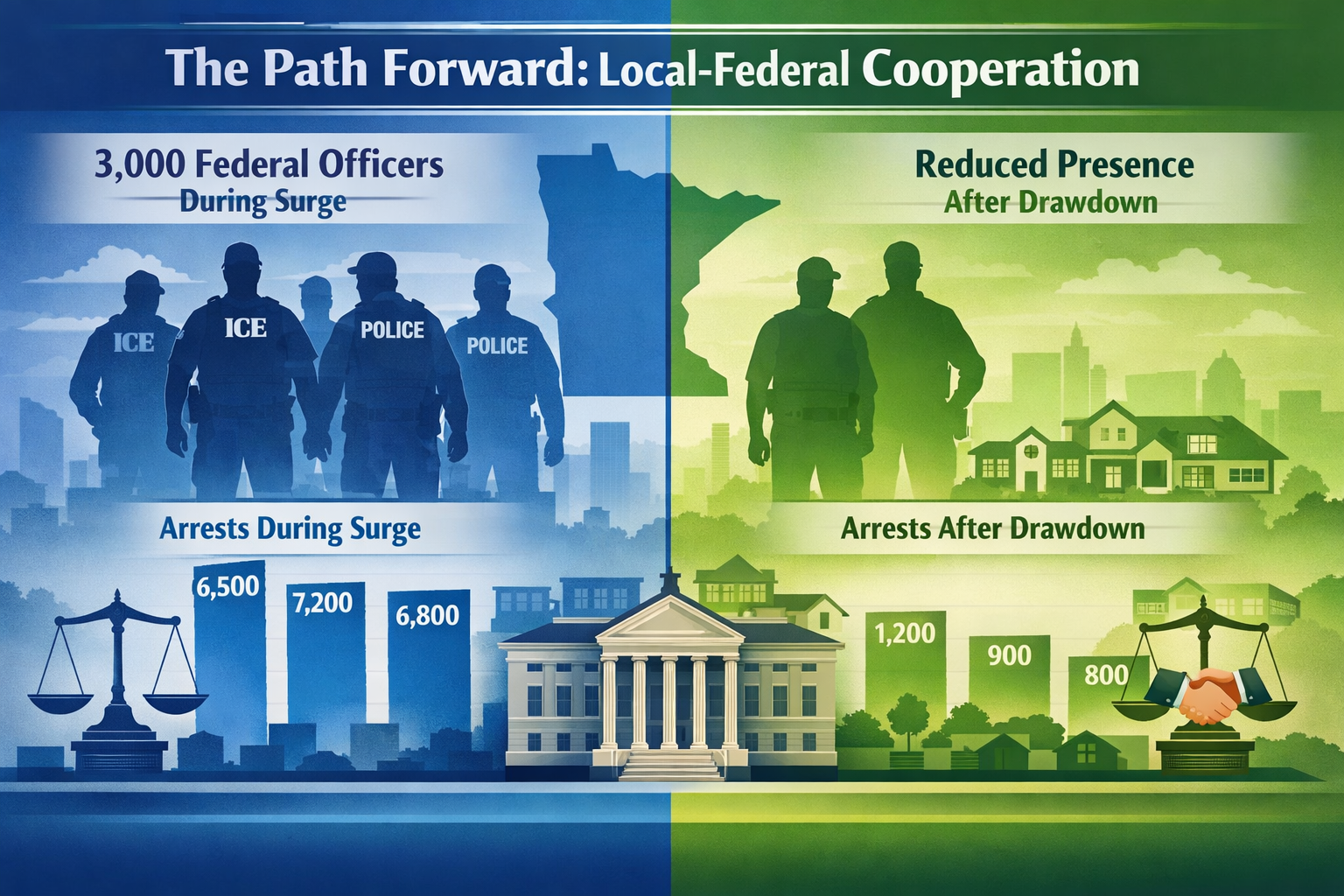
- Operation Metro Surge deployed approximately 3,000 federal officers to Minnesota, a massive increase from the typical 80 officers covering Twin Cities immigration operations
- The drawdown represents a shift toward local-federal cooperation rather than unilateral federal enforcement actions
Operation Metro Surge: Background and Escalation
Operation Metro Surge launched on December 1, 2025, representing one of the largest federal immigration enforcement deployments in recent history[1]. The operation brought approximately 3,000 federal officers to Minnesota—a staggering increase from the typical 80 officers who normally cover Twin Cities immigration operations[1].
The stated goal was targeting undocumented immigrants with criminal records. However, the massive scale of the deployment raised immediate concerns among immigrant rights advocates, local officials, and community organizations who questioned both the necessity and the methods employed.
More than 3,000 arrests were made since the surge began, according to DHS Secretary Kristi Noem[1]. But the operation’s aggressive tactics and overwhelming presence created fear throughout immigrant communities, regardless of criminal history or documentation status.
“The sheer scale of this operation was unprecedented. Families were afraid to send their kids to school. People stopped going to work. The community impact went far beyond any stated enforcement goals.” — Community organizer speaking at Minneapolis town hall
The operation fundamentally disrupted daily life across the Twin Cities, creating a climate of fear that extended well beyond its stated targets.
Tragedy Strikes: The Deaths That Changed Everything
The trajectory of Operation Metro Surge changed forever on January 7, 2026, when ICE officers fatally shot Renee Good, a mother of three[1]. The circumstances surrounding her death immediately sparked outrage and demands for accountability.
Just over two weeks later, on January 24, 2026, immigration agents shot and killed Alex Pretti, an ICU nurse[1]. These two deaths—occurring within weeks of each other during the same enforcement operation—ignited protests throughout the Twin Cities and beyond.
Both victims were civilians with families, jobs, and deep community ties. Their deaths raised fundamental questions about the use of force, officer training, and the accountability mechanisms governing federal immigration enforcement.
Community Response and Protests
The protests that followed were among the largest demonstrations Minneapolis has seen in recent years. Thousands gathered demanding:
- Immediate accountability for the officers involved in both shootings
- Transparency regarding use-of-force policies and incident investigations
- Body-worn cameras for all federal immigration enforcement officers
- An end to Operation Metro Surge and the withdrawal of federal officers
Healthcare workers held vigils for Alex Pretti, while Renee Good’s family became the face of a movement demanding justice and reform. The deaths transformed what had been a policy debate into a deeply personal tragedy that galvanized community action.
Legal Challenges and Government Response
In January 2026, the State of Minnesota, Minneapolis, and Saint Paul filed a joint lawsuit seeking to halt the operation[1][2]. The lawsuit argued that Operation Metro Surge violated constitutional rights, exceeded federal authority, and created a public safety crisis through its aggressive tactics.
The legal challenge represented a significant escalation in the conflict between local and federal authorities. Minneapolis officials argued that the massive federal presence undermined local law enforcement, eroded community trust, and created more problems than it solved.
However, a federal judge denied the emergency request to halt the surge, ruling that the state failed to meet the legal bar required[3]. The court decision was a setback for opponents of the operation, but it didn’t end the pressure campaign.
The Turning Point: Negotiations Begin
Following the court ruling, a different strategy emerged. Rather than relying solely on legal challenges, local officials began direct negotiations with federal authorities. These conversations focused on finding common ground and establishing frameworks for cooperation that could reduce the federal presence while still addressing legitimate enforcement priorities.
On January 29, Border Czar Tom Homan indicated that the strategy “could lead to a drawdown,” saying “More agents in the jail means less agents on the street”[1]. This statement suggested that if local authorities cooperated with federal immigration enforcement at jails and detention facilities, the massive street-level presence could be reduced.
Homan indicated that ICE and CBP staff were “working on a drawdown plan” at that time[1], signaling a shift in federal strategy following the deaths and sustained community pressure.
The Drawdown Announcement and Body Camera Initiative
Wednesday’s announcement of a 700-officer drawdown represents the culmination of these negotiations. After meeting with local leaders, Homan emphasized the cooperative framework: “If we get these agreements in place, that means less agents on the street.”
This approach represents a significant departure from the unilateral enforcement strategy that characterized Operation Metro Surge’s initial deployment. The federal government is essentially acknowledging that community cooperation produces better outcomes than overwhelming force.
Body-Worn Camera Implementation
Perhaps equally significant is Security Secretary Kristi Noem’s announcement that Minneapolis officers will receive body-worn cameras, with nationwide expansion planned. This policy change directly responds to community demands following the deaths of Renee Good and Alex Pretti.
DHS announced that all officers in the field in Minneapolis will wear body cameras moving forward[1]. This represents a major accountability measure that immigration enforcement agencies have historically resisted.
Body cameras serve multiple purposes:
- Accountability: Creating an objective record of officer interactions and use-of-force incidents
- Transparency: Providing evidence for investigations and public oversight
- Officer protection: Documenting threats and justifications for actions taken
- Community trust: Demonstrating commitment to transparency and accountability
The nationwide expansion plan suggests this isn’t merely a Minneapolis-specific concession but rather a broader policy shift in how federal immigration enforcement operates.
What the Drawdown Means for Minnesota Communities
The removal of 700 officers who were part of Operation Metro Surge significantly reduces the Minnesota federal enforcement presence. This drawdown affects the operation’s focus on undocumented immigrants with criminal records by shifting from street-level enforcement to a more targeted, cooperative approach.
Practical Implications
For Minnesota communities, particularly immigrant families, the drawdown offers several tangible changes:
Reduced street presence: Fewer federal agents conducting operations in neighborhoods, at workplaces, and in public spaces
Shift to targeted enforcement: Greater focus on individuals in custody rather than community-wide sweeps
Local oversight: Increased role for local officials in determining enforcement priorities and methods
Accountability measures: Body cameras providing documentation of federal enforcement actions
However, questions remain about implementation. The drawdown doesn’t end federal immigration enforcement in Minnesota—it restructures it. The approximately 3,000 officers deployed during the surge will be reduced, but enforcement will continue through cooperation with local jails and targeted operations.
Community Concerns and Ongoing Vigilance
Immigrant rights advocates welcome the drawdown while maintaining skepticism about long-term commitments. Key concerns include:
- Will cooperation agreements protect community members without criminal records?
- How will body camera footage be accessed and used for accountability?
- What oversight mechanisms ensure federal agents follow agreed-upon protocols?
- Will the drawdown be permanent or temporary?
These questions highlight the need for continued community engagement and oversight as the new framework is implemented.
Broader Implications for Immigration Enforcement Policy
The Minnesota situation offers important lessons for immigration enforcement policy nationwide. The trajectory from aggressive deployment to community tragedy to negotiated drawdown illustrates both the limitations of enforcement-only approaches and the potential for cooperative frameworks.
The Failure of Overwhelming Force
Operation Metro Surge demonstrated that deploying massive federal resources doesn’t necessarily produce better enforcement outcomes. The 3,000-officer deployment created:
- Community fear that extended far beyond enforcement targets
- Erosion of trust between immigrant communities and all law enforcement
- Economic disruption as workers stayed home and businesses suffered
- Tragic loss of life that could have been avoided with different tactics
These consequences suggest that enforcement strategies must consider community impact, not just arrest numbers.
The Promise of Cooperation
The emerging cooperative framework between federal and local authorities offers an alternative model. By focusing enforcement at jails and detention facilities rather than in communities, this approach potentially:
- Reduces community disruption while maintaining enforcement capability
- Builds trust through transparency and local oversight
- Improves targeting by focusing on individuals already in custody
- Enhances accountability through body cameras and local involvement
Whether this model proves effective and sustainable remains to be seen, but it represents a significant departure from previous approaches.
Accountability for Renee Good and Alex Pretti
While the drawdown and body camera initiative represent important policy changes, they don’t address the fundamental question of accountability for the deaths of Renee Good and Alex Pretti.
Families and community members continue demanding:
- Full investigations into both shootings with public transparency
- Accountability for officers who used deadly force
- Compensation for families who lost loved ones
- Policy changes to prevent future tragedies
The body camera initiative helps prevent future incidents, but it doesn’t provide justice for past actions. This distinction matters deeply to families and communities seeking accountability, not just policy reform.
The Role of Local Journalism and Civic Engagement
Stories like this demonstrate why local journalism and community organizing remain essential for government accountability. The policy changes announced this week didn’t happen automatically—they resulted from:
- Sustained community protests demanding change
- Local officials willing to challenge federal overreach
- Legal challenges that forced negotiations
- Media coverage keeping the story in public consciousness
- Grassroots activism maintaining pressure for accountability
This progression shows how civic participation and community engagement can influence even federal policy decisions. When communities organize, demand transparency, and hold officials accountable, change becomes possible.
What Upstate New York Communities Can Learn
While Operation Metro Surge occurred in Minnesota, the lessons apply to communities across the country, including here in upstate New York. The Mohawk Valley, Utica, and surrounding areas have significant immigrant populations who contribute to our economy, schools, and community life.
Relevant Questions for Local Communities
How would our community respond to a similar federal enforcement operation?
What agreements exist between local law enforcement and federal immigration authorities?
Do we have mechanisms for community oversight and accountability?
Are local officials prepared to advocate for community interests if federal enforcement escalates?
These aren’t hypothetical questions. Immigration enforcement policy can shift rapidly, and communities benefit from proactive planning rather than reactive crisis management.
Building Community Resilience
Upstate New York communities can strengthen resilience by:
Know Your Rights education: Ensuring immigrant community members understand their constitutional protections
Local policy clarity: Demanding transparency about local law enforcement cooperation with federal immigration authorities
Community networks: Building support systems that can respond quickly to enforcement actions
Government accountability: Engaging local officials on immigration policy and enforcement practices
Coalition building: Connecting immigrant rights organizations, faith communities, labor unions, and other stakeholders
These steps help communities prepare for potential challenges while building the social capital necessary for effective advocacy.
The Path Forward: Cooperation, Accountability, and Reform
The Minnesota drawdown represents a potential turning point in immigration enforcement policy, but significant work remains. The shift from Operation Metro Surge’s aggressive tactics to a cooperative framework offers hope for more humane and effective approaches.
However, meaningful reform requires sustained attention to several key areas:
Accountability Mechanisms
Body cameras represent an important step, but comprehensive accountability requires:
- Independent investigations of use-of-force incidents
- Public access to body camera footage in cases of community concern
- Consequences for officers who violate policies or constitutional rights
- Community oversight boards with real authority to review enforcement practices
Policy Reform
Beyond individual operations, broader immigration policy reform remains necessary:
- Pathways to citizenship for undocumented immigrants contributing to communities
- Protection for Dreamers and long-term residents facing deportation
- Humane enforcement that prioritizes public safety over arrest quotas
- Due process protections ensuring fair treatment under law
Community-Centered Approaches
Effective immigration policy must center community wellbeing:
- Family unity as a core principle in enforcement decisions
- Economic contribution recognized in policy frameworks
- Community integration valued alongside enforcement concerns
- Human dignity respected in all enforcement actions
Conclusion: From Tragedy to Transformation
The story of Operation Metro Surge—from its aggressive launch through tragic deaths to Wednesday’s drawdown announcement—illustrates both the worst and potentially the best of how immigration enforcement can operate.
The deaths of Renee Good and Alex Pretti represent failures that can never be fully remedied. Their families lost loved ones. Their communities lost valued members. These tragedies resulted from policy choices that prioritized enforcement over community impact.
Yet the response to these tragedies—sustained protests, legal challenges, community organizing, and ultimately negotiated reforms—demonstrates the power of civic engagement to drive change. The 700-officer drawdown and body camera initiative didn’t happen because officials suddenly decided to change course. They happened because communities demanded accountability and refused to accept business as usual.
What You Can Do
Whether you live in Minnesota, the Mohawk Valley, or anywhere else, you can contribute to more just and humane immigration policy:
Stay informed: Follow local news coverage of immigration enforcement and policy
Engage locally: Attend town hall meetings and ask local officials about their positions on immigration enforcement cooperation
Support immigrant communities: Volunteer with immigrant services organizations or contribute to legal defense funds
Advocate for reform: Contact your congressional representatives supporting comprehensive immigration reform
Build community: Participate in coalition efforts connecting diverse stakeholders around shared values
Vote: Support candidates committed to humane immigration policy and government accountability
The Minnesota experience shows that change is possible when communities organize, demand accountability, and refuse to accept policies that harm families and undermine community wellbeing. That lesson applies everywhere.
As we move forward in 2026, the question isn’t whether immigration enforcement will continue—it will. The question is whether that enforcement respects human dignity, operates with transparency and accountability, and serves genuine public safety interests rather than political theater.
The answers to those questions depend on continued civic engagement, community organizing, and the willingness of ordinary people to demand that their government serve justice, not just power.
References
[1] 2 Months Operation Metro Surge End Date Remains Unclear – https://www.fox9.com/news/2-months-operation-metro-surge-end-date-remains-unclear
[2] Ag Lawsuit – https://www.minneapolismn.gov/news/2026/january/ag-lawsuit/
[3] Watch – https://www.youtube.com/watch?v=1hmhNHzG7SM
SEO Meta Title: Minnesota Immigration Enforcement Drawdown After Metro Surge
SEO Meta Description: Federal officers withdraw from Minnesota following Operation Metro Surge deaths. Body cameras announced as enforcement shifts to cooperation model.


