


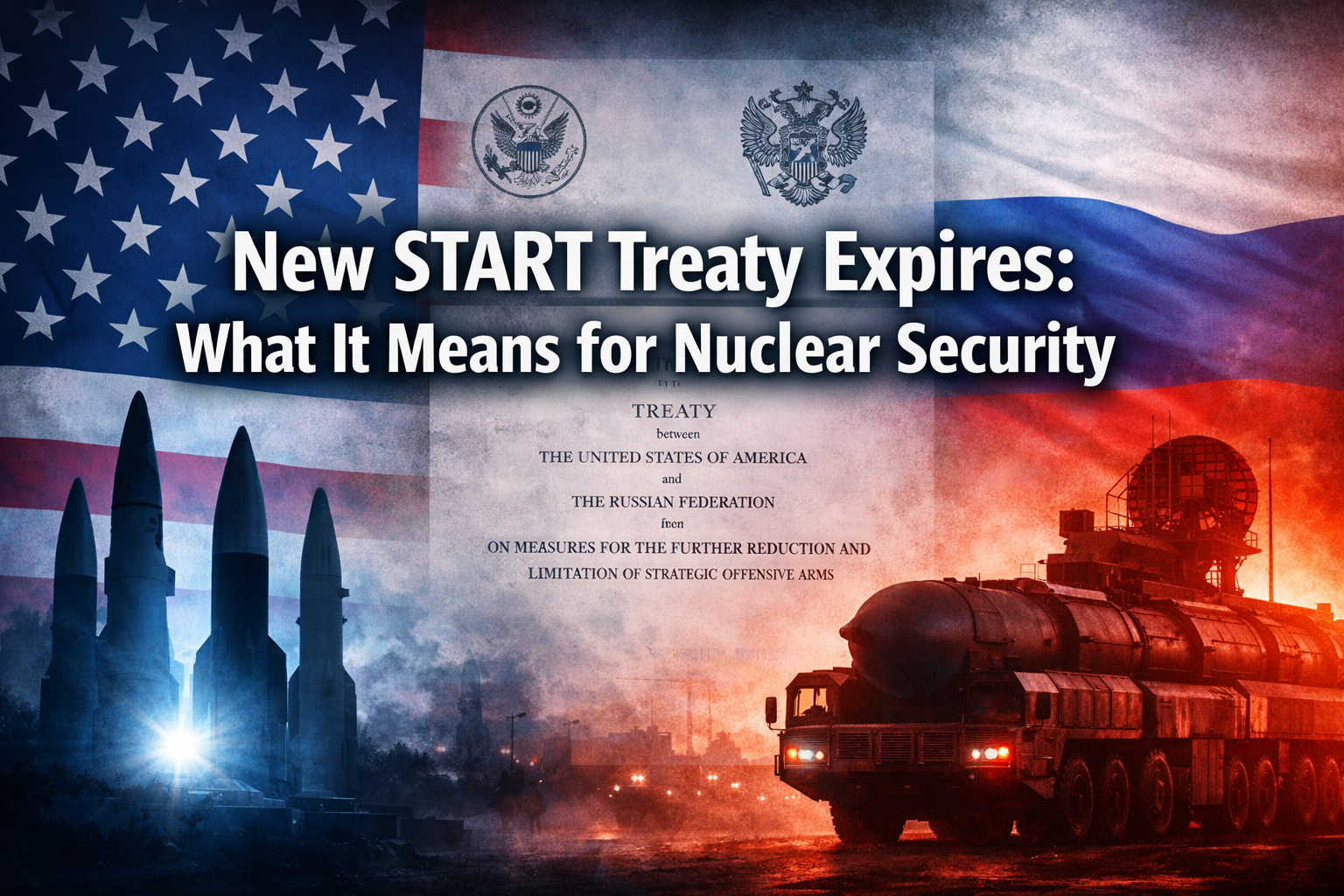
This week, the New START treaty expires on Thursday, removing limits and verification on U.S.-Russian deployed strategic nuclear weapons. For the first time in more than 50 years, the world’s two largest nuclear powers will operate without legally binding constraints on their arsenals—a development that arms control experts warn could trigger an unchecked nuclear arms race with global consequences.
The treaty’s collapse didn’t happen overnight. Suspended inspections during the Covid-19 pandemic and Russia’s 2023 suspension halted verification, while talks collapsed after Russia’s invasion of Ukraine, deepening mistrust and complicating treaty extensions. The U.S. and Russia collectively hold most nuclear warheads while China’s arsenal has doubled in recent years, as Russia maintains new weapons like Burevestnik and Poseidon amid U.S. signals to let the treaty expire.
The stakes couldn’t be higher. Dmitry Medvedev, former Russian official, warned the world should be alarmed if the treaty expires without clarity; arms-control supporters say expiry risks an unrestrained arms race and urge U.S. Congress to intervene, as former President Barack Obama and other leaders have emphasized. Putin suggested Russia’s conditional offer, proposing to extend limits if verification resumes, while U.S. Stratcom emphasizes targeting Russian and Chinese forces simultaneously—a strategic posture that signals America’s shifting nuclear priorities.
Key Takeaways
- 🚨 New START expires February 6, 2026, ending all legal limits on U.S. and Russian strategic nuclear weapons for the first time since 1972
- 📊 Current caps disappear: The treaty limited each nation to 1,550 deployed warheads, 800 launchers, and 700 deployed delivery systems
- 🔍 Verification regime already dead: Inspections and data exchanges ended in 2023 when Russia suspended participation
- 🌍 Global implications: Treaty expiration undermines the Nuclear Non-Proliferation Treaty ahead of April 2026 review conference
- ⚖️ Political deadlock: Putin offered conditional extension, but Trump administration shows little interest in negotiations
Understanding New START: The Last Nuclear Treaty Standing
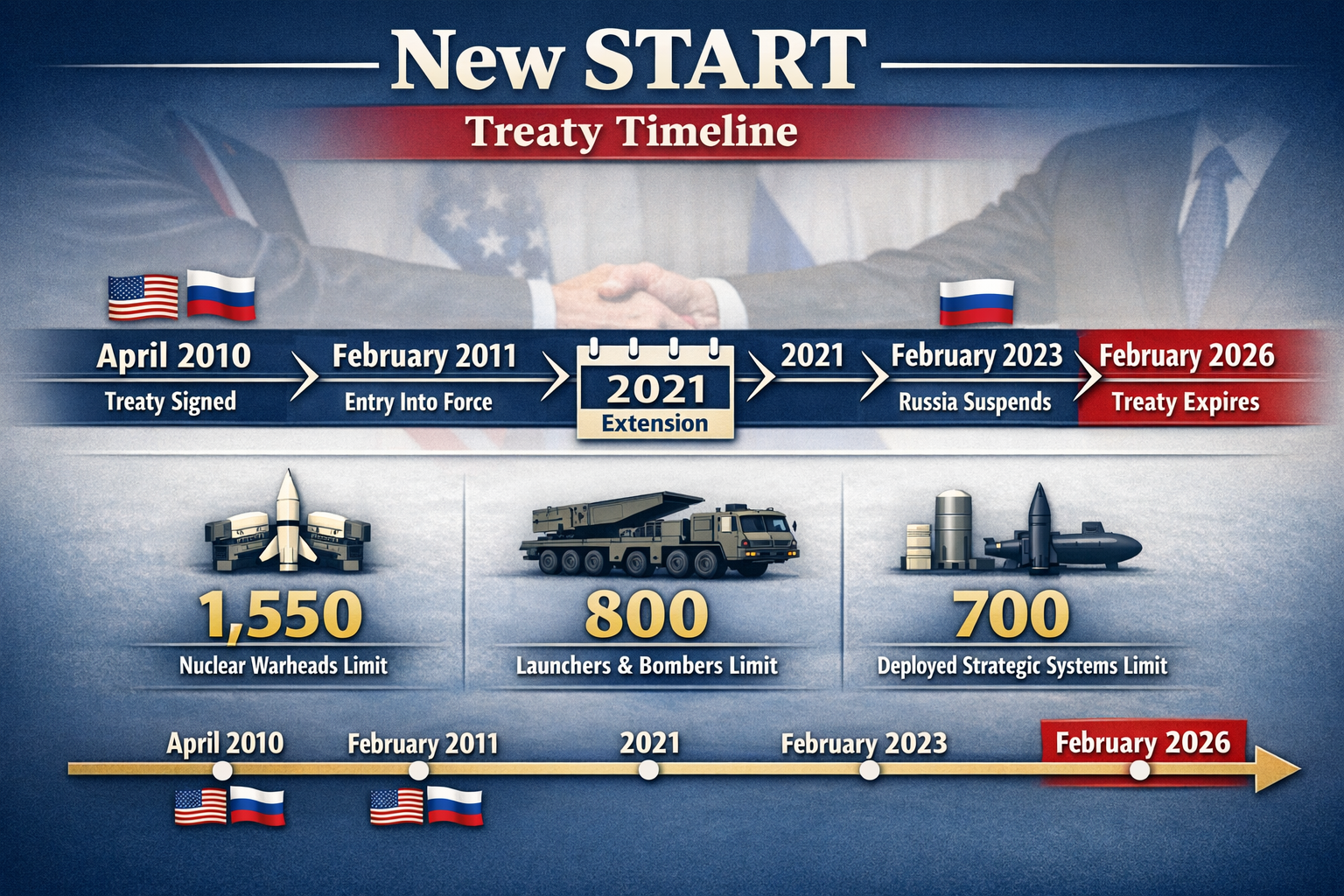
The New Strategic Arms Reduction Treaty—commonly called New START—represented the final thread connecting decades of U.S.-Russian nuclear diplomacy. Signed on April 8, 2010, and entering into force on February 5, 2011, the agreement established clear numerical limits on the world’s two largest nuclear arsenals.[3]
The treaty’s core provisions were straightforward but significant:
- 1,550 deployed strategic nuclear warheads per nation
- 800 deployed and non-deployed strategic launchers (missiles and bombers)
- 700 deployed intercontinental ballistic missiles, submarine-launched ballistic missiles, and heavy bombers[2]
These numbers weren’t arbitrary. They represented carefully negotiated reductions from Cold War-era stockpiles that once numbered in the tens of thousands. The treaty was designed for a 10-year term with one optional five-year extension, which was exercised in 2021, pushing the expiration date to February 2026.[3]
But here’s the critical detail many Americans don’t realize: the treaty cannot be extended again through formal procedure. Any continuation would require complete re-ratification by both governments, including a two-thirds majority vote in the U.S. Senate—a political impossibility in 2026’s polarized environment.[1]
Why This Treaty Mattered Beyond Numbers
New START wasn’t just about counting warheads. The treaty established a comprehensive verification regime that allowed each nation to monitor the other’s compliance through:
- On-site inspections of military facilities
- Regular data exchanges about force composition
- Notifications of missile tests and movements
- Telemetry information from missile launches
This transparency reduced the risk of miscalculation during crises. When military planners in Washington and Moscow could verify what the other side actually possessed, they didn’t need to plan for worst-case scenarios. That verification regime is what made the treaty valuable—and its loss is what makes the expiration so dangerous.[2]
How We Got Here: From Pandemic Suspension to Complete Collapse
The treaty’s demise followed a predictable but tragic trajectory. Understanding this timeline helps explain why diplomatic efforts failed and what obstacles any future agreement would face.
The Covid-19 Pause That Never Resumed
When the pandemic hit in early 2020, both nations suspended on-site inspections for health and safety reasons. This seemed reasonable at the time—a temporary pause during extraordinary circumstances. But those inspections never fully resumed.[2]
The pandemic pause revealed how fragile the verification system had become. Without regular contact between inspectors and military officials, trust eroded. Questions arose about compliance. Neither side could definitively answer whether the other was adhering to treaty limits.
Russia’s 2023 Suspension: The Point of No Return
On February 21, 2023, Russian President Vladimir Putin announced Russia would suspend its participation in New START, citing Western military support for Ukraine and what Moscow called “aggressive” NATO policies.[2] This wasn’t a formal withdrawal, but it effectively gutted the treaty’s verification provisions.
The U.S. responded by suspending its own participation, ending mutual inspection visits and data exchanges entirely. From that moment forward, the treaty existed only on paper. Both sides claimed continued adherence to numerical limits, but without verification, those claims became impossible to confirm.[2]
Ukraine Invasion: The Diplomatic Dead End
Russia’s full-scale invasion of Ukraine in February 2022 poisoned the diplomatic well. Arms control negotiations require a baseline of trust and predictability. When one party launches a major war of aggression, continuing technical discussions about nuclear weapons becomes politically untenable.
The Biden administration faced intense domestic pressure not to appear “soft” on Russia by engaging in arms control talks while Russian forces committed atrocities in Ukraine. Moscow, meanwhile, viewed Western sanctions and military aid to Kyiv as proof that the U.S. sought Russia’s strategic defeat. In this environment, meaningful treaty extension talks never had a chance.[1]
The Strategic Landscape: Three Nuclear Powers, Zero Agreements
The expiration of New START occurs against a dramatically changed strategic backdrop. This isn’t the bipolar Cold War world of U.S.-Soviet competition. Today’s nuclear landscape involves multiple powers with divergent interests.
China’s Rapid Arsenal Expansion
While the U.S. and Russia negotiated limits, China’s nuclear arsenal has doubled in recent years. The Pentagon estimates China now possesses over 500 operational nuclear warheads and is on track to exceed 1,000 by 2030.[2]
Beijing has never participated in bilateral arms control agreements, arguing its arsenal remains far smaller than those of the U.S. and Russia. But China’s rapid expansion changes the strategic calculus for both Washington and Moscow. U.S. Strategic Command now emphasizes the need to deter and, if necessary, target both Russian and Chinese nuclear forces simultaneously—a mission far more complex than Cold War-era planning.[1]
This three-way dynamic complicates any future arms control framework. Russia has suggested it won’t accept limits unless China participates. China refuses to join negotiations until the U.S. and Russia reduce their arsenals to levels closer to Beijing’s. The result: diplomatic gridlock.
Russia’s New Strategic Weapons
Moscow has developed and deployed weapons systems that didn’t exist when New START was negotiated:
- Burevestnik: A nuclear-powered cruise missile with theoretically unlimited range
- Poseidon: A nuclear-powered, nuclear-armed underwater drone designed to create radioactive tsunamis
- Avangard: A hypersonic glide vehicle that can maneuver to evade missile defenses
Some of these systems fall outside New START’s definitions of “strategic delivery vehicles,” creating ambiguity about whether they would count against treaty limits even if the agreement continued. Russia maintains these weapons as responses to U.S. missile defense systems and conventional strike capabilities.[2]
Putin’s Conditional Offer and Trump’s Ambivalence
In September 2025, Vladimir Putin announced Russia would continue adhering to New START’s quantitative and qualitative limits for one year after expiration—if the United States did the same. He suggested this arrangement could be extended further through mutual agreement.[1]
On the surface, this seemed like an opening for diplomacy. But the details revealed significant obstacles.
What Putin’s Proposal Actually Offered
Putin’s offer was conditional on resuming verification measures, including inspections and data exchanges. But Russia showed no willingness to allow American inspectors back into sensitive military facilities while the Ukraine conflict continued. Moscow reportedly indicated it no longer had “clear interlocutors” within the U.S. administration willing to negotiate seriously.[2]
The proposal also didn’t address the fundamental question: what happens after one year? Without a pathway to a new treaty, Putin’s offer looked more like a temporary pause than a solution.
The Trump Administration’s Response: “If It Expires, It Expires”
President Donald Trump initially called Putin’s extension proposal “good” but quickly walked back any enthusiasm. In subsequent statements, Trump remarked “if it expires, it expires” and promised a “better agreement” without providing specifics about what that would entail or how it would be negotiated.[1]
The administration’s ambivalence reflects several factors:
- Focus on China: Trump officials view Beijing as the primary long-term threat and want any future agreement to include Chinese participation
- Skepticism of Russia: Deep distrust following Ukraine makes bilateral deals politically toxic
- Domestic politics: Arms control agreements require Senate ratification, and Republicans show little appetite for constraining U.S. nuclear modernization
No formal negotiations have followed Putin’s proposal. As of early February 2026, no diplomatic process exists to prevent the treaty’s expiration or negotiate a replacement.
What Happens Now: Life Without Limits or Verification
When the treaty expires on February 6, 2026, the immediate practical changes may seem minimal. Both nations have indicated they’ll continue observing numerical limits, at least initially. No evidence suggests either side is preparing large-scale treaty violations.[2]
But the absence of verification changes everything.
The Transparency Crisis
Without inspections and data exchanges, neither side can confirm the other’s compliance. This creates several dangerous dynamics:
Worst-case planning: Military planners must assume the other side might be cheating, leading to inflated threat assessments and demands for larger arsenals.
Upload potential: Both nations maintain missiles that could carry more warheads than currently deployed. Without verification, suspicions will grow that the other side is “uploading” additional warheads onto existing missiles.[2]
New systems ambiguity: As both nations modernize their nuclear forces, questions will arise about whether new weapons count against old limits—limits that no longer legally exist but that both claim to observe.
The Arms Race Risk
Arms control supporters warn that treaty expiration risks an unrestrained arms race driven by uncertainty rather than actual threats. When you can’t verify what the other side has, you build more to be safe. When they see you building more, they do the same. This action-reaction cycle defined the early Cold War before arms control agreements imposed discipline.[2]
The risk isn’t immediate mass expansion. Both nations face budget constraints and technical challenges. But over years and decades, the absence of agreed limits will likely produce larger, more diverse, and more dangerous arsenals.
Impact on Crisis Management
Perhaps most dangerously, the loss of transparency makes crises harder to manage. During the Cuban Missile Crisis, the 1973 Arab-Israeli War, and other tense moments, U.S. and Soviet leaders used established communication channels and shared understandings about nuclear forces to prevent escalation.
Without regular contact between nuclear establishments, without shared data about force postures, the next crisis will be more opaque and more dangerous. Misunderstandings that might have been quickly resolved through verification channels could instead spiral toward catastrophe.[2]
Global Implications: The NPT Review Conference and Nuclear Order
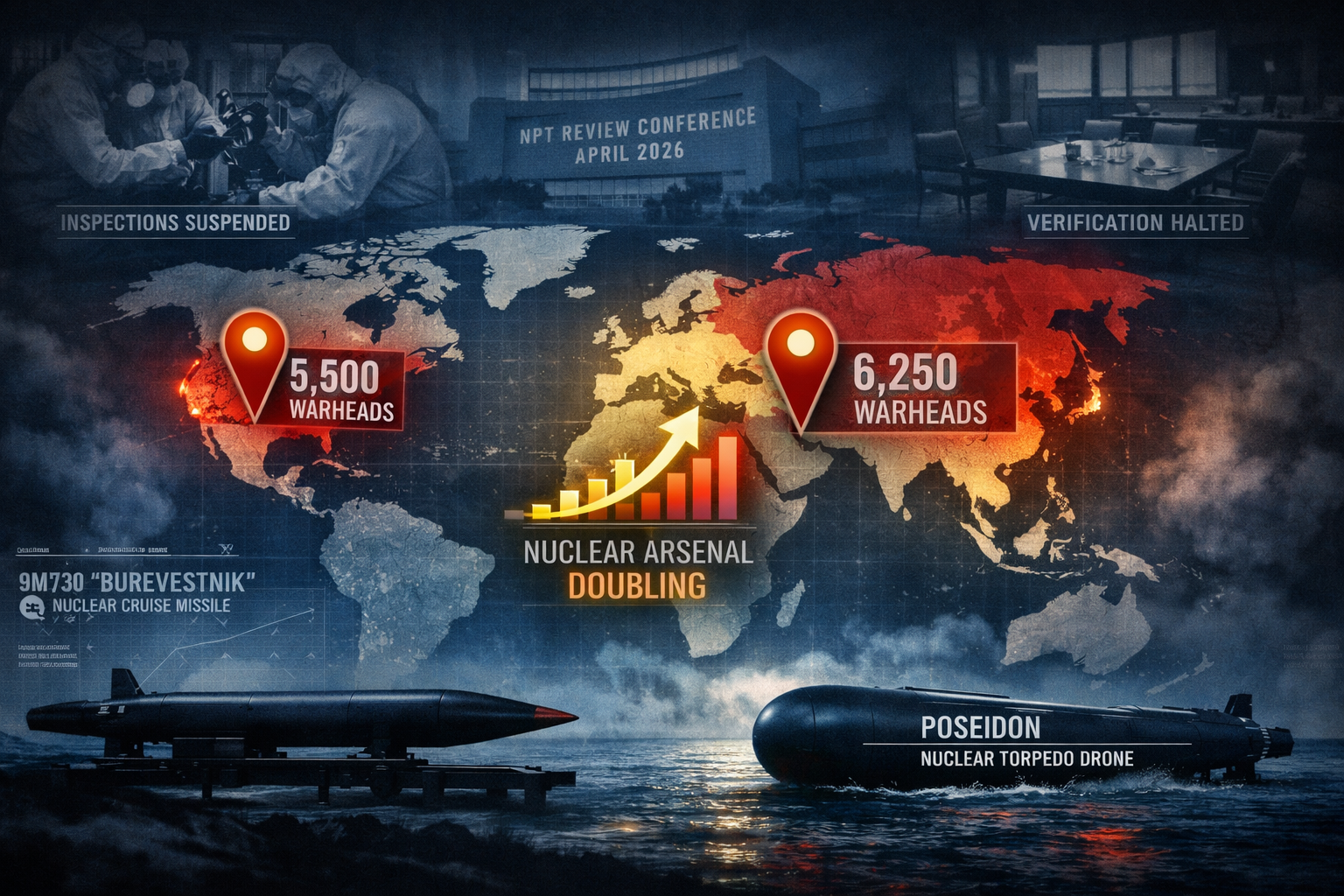
The treaty’s expiration carries consequences far beyond U.S.-Russian relations. The timing is particularly unfortunate: the Nuclear Non-Proliferation Treaty (NPT) Review Conference begins April 27, 2026, in New York—less than three months after New START expires.[1][2]
Undermining the NPT Bargain
The NPT rests on a grand bargain: non-nuclear states agree not to develop nuclear weapons, while nuclear-armed states commit to eventual disarmament. Article VI of the NPT requires nuclear powers to pursue negotiations “in good faith” toward nuclear disarmament.
When the world’s two largest nuclear arsenals operate without any agreed limits, it sends a clear message: nuclear powers are abandoning restraint. Non-nuclear states will ask why they should continue honoring their commitments when the U.S. and Russia won’t honor theirs.[2]
This could weaken NPT credibility at a moment when the treaty faces other challenges, including North Korea’s continued weapons development, Iran’s nuclear program, and questions about the treaty’s relevance in a multipolar world.
The Medvedev Warning
Dmitry Medvedev, former Russian president and current deputy chairman of Russia’s Security Council, warned that “the world should be alarmed if the treaty expires without clarity” about what comes next. While Medvedev is known for inflammatory rhetoric, his core point resonates: uncertainty about nuclear competition creates global instability.[1]
Smaller nations, regional powers, and allies of both the U.S. and Russia will face difficult questions about their own security in a world without nuclear constraints. Some may pursue their own nuclear capabilities. Others may seek new security guarantees. The result could be a more fragmented and dangerous international order.
What Former Leaders and Experts Are Saying
The treaty’s expiration has prompted warnings from across the political spectrum.
Barack Obama’s Intervention
Former President Barack Obama, who negotiated and signed New START in 2010, has urged Congress to intervene and push the current administration toward negotiations. Obama argues that arms control serves American interests by providing transparency, predictability, and constraints on adversary capabilities.[1]
Obama’s involvement reflects the bipartisan tradition of arms control that prevailed for decades. Republican and Democratic presidents alike—from Richard Nixon to Ronald Reagan to George H.W. Bush—pursued nuclear agreements as tools of national security, not partisan politics.
Arms Control Community Consensus
Organizations like the Arms Control Association, the Nuclear Threat Initiative, and academic experts at institutions from Stanford to Tufts University have issued warnings about the treaty’s expiration.[5][6][7][8]
Their consensus: the expiration represents a historic failure of diplomacy that increases nuclear risks, reduces transparency, and undermines global security architecture. Many urge immediate efforts to negotiate a follow-on agreement, even if imperfect, to maintain some framework for managing nuclear competition.
Congressional Response: Mostly Silence
Despite these warnings, Congress has shown little inclination to intervene. Senate Republicans generally support letting the treaty expire, viewing it as outdated and insufficient to address China’s rise. Senate Democrats lack the votes to force action, and many are reluctant to challenge a Democratic administration’s foreign policy decisions during an election year.
This congressional silence reflects broader American public disengagement from nuclear issues. Unlike during the Cold War, when nuclear weapons dominated public consciousness, most Americans in 2026 focus on other concerns: the economy, healthcare, immigration, climate change. Nuclear policy remains an elite issue, debated by specialists but largely invisible to voters.
What This Means for Mohawk Valley Residents and American Citizens
It’s easy to view nuclear arms control as an abstract issue far removed from daily life in Utica, New Hartford, or Rome. But the treaty’s expiration carries concrete implications for working families across upstate New York and the nation.
Federal Budget Priorities
Nuclear weapons modernization is expensive. The U.S. plans to spend over $1.5 trillion over 30 years upgrading its nuclear arsenal. Without treaty limits, pressure will grow to spend even more.
Every dollar spent on nuclear weapons is a dollar not spent on infrastructure investment, affordable housing, healthcare access, education reform, or the other priorities that matter to Mohawk Valley families. The absence of arms control agreements makes it easier for defense contractors and military planners to justify ever-larger budgets.
Global Stability and Economic Security
Nuclear tensions affect global markets, trade relationships, and economic stability. Increased U.S.-Russia-China competition raises the risk of regional conflicts, economic sanctions, and supply chain disruptions that ripple through the American economy.
For a region like the Mohawk Valley that depends on manufacturing jobs, small business support, and economic opportunity, global instability threatens the investments needed for Rust Belt revival and workforce development.
The Ultimate Risk
Most fundamentally, the treaty’s expiration increases—however slightly—the risk of nuclear war. That risk remains low, but it’s higher than it was with verification and limits in place.
For residents of Utica and surrounding communities, this matters. Nuclear weapons don’t distinguish between coastal elites and rural America, between red states and blue states. The consequences of nuclear conflict would be universal and catastrophic.
Paths Forward: What Could Happen Next
The treaty expires Thursday, but the story doesn’t end there. Several scenarios could unfold over the coming months and years.
Scenario 1: Informal Continuation
Both sides might continue observing numerical limits informally, as they’ve claimed they will, while avoiding formal negotiations. This “zombie treaty” approach maintains some restraint without the political costs of negotiation or ratification.
Likelihood: Moderate. This seems to be the current trajectory.
Risks: Without verification, informal limits become increasingly meaningless over time. Trust erodes, suspicions grow, and eventually one side or both abandons restraint.
Scenario 2: Trilateral Negotiations
The U.S. might pursue negotiations that include China, creating a new framework that addresses the three-way nuclear competition. This would be unprecedented and extraordinarily complex.
Likelihood: Low in the near term. China shows no interest in participating, and the technical challenges are immense.
Potential: If achieved, this would represent a historic breakthrough in arms control.
Scenario 3: Bilateral Replacement Treaty
After the 2026 or 2028 elections, a new U.S. administration might prioritize negotiating a replacement bilateral treaty with Russia, even without Chinese participation.
Likelihood: Depends entirely on future political leadership and U.S.-Russia relations.
Challenges: Senate ratification would require 67 votes, a high bar in today’s polarized environment.
Scenario 4: Unrestrained Competition
Without diplomatic intervention, both sides might gradually abandon even informal adherence to limits, leading to steady arsenal expansion and new weapons deployments.
Likelihood: Increases over time if no diplomatic process begins.
Consequences: Higher costs, reduced security, increased crisis risks, and global instability.
Conclusion: The Choice Ahead
The expiration of New START this Thursday marks the end of an era—but it doesn’t have to mark the beginning of unchecked nuclear competition. The choice belongs to political leaders in Washington, Moscow, and Beijing, but also to citizens who can demand better.
For residents of the Mohawk Valley and Americans across the country, this moment calls for civic engagement and informed action. Nuclear policy may seem distant from local concerns, but it affects federal spending priorities, global stability, and the ultimate security of our communities.
What You Can Do
Contact your representatives: Call or write to Senate Majority Leader Chuck Schumer and your House representative. Urge them to support renewed arms control negotiations and to hold hearings on the treaty’s expiration and its implications.
Stay informed: Follow coverage from credible sources about nuclear policy developments. Organizations like the Arms Control Association and the Nuclear Threat Initiative provide accessible analysis.
Support local journalism: Media outlets like the Mohawk Valley Voice that connect national issues to local impacts help citizens understand how distant policy decisions affect their lives.
Engage in community conversations: Raise these issues at town hall meetings, in letters to the editor, and in discussions with neighbors. Democracy works when citizens demand accountability.
Vote: Support candidates who take nuclear arms control seriously and who commit to pursuing diplomacy over unchecked competition.
The end of New START doesn’t have to mean the end of nuclear restraint. But preventing an arms race will require political will, diplomatic creativity, and citizen pressure. The world our children inherit depends on the choices we make—or fail to make—in the months and years ahead.
The clock has run out on this treaty. But it’s not too late to start building the next framework for nuclear security. That work begins with awareness, continues with engagement, and succeeds through sustained civic action.
References
[1] End Of New Start – https://vcdnp.org/end-of-new-start/
[2] Us And Russias Nuclear Weapons Treaty Set Expire Heres Whats Stake – https://www.chathamhouse.org/2026/01/us-and-russias-nuclear-weapons-treaty-set-expire-heres-whats-stake
[3] New Start – https://en.wikipedia.org/wiki/New_START
[5] Life After New Start Navigating New Period Nuclear Arms Control – https://www.armscontrol.org/act/2025-01/features/life-after-new-start-navigating-new-period-nuclear-arms-control
[6] The End Of New Start From Limits To Looming Risks – https://www.nti.org/analysis/articles/the-end-of-new-start-from-limits-to-looming-risks/
[7] New Start Treaty Ending What Does Mean Nuclear Risk – https://now.tufts.edu/2026/01/29/new-start-treaty-ending-what-does-mean-nuclear-risk
[8] Responding Putins Proposal Extend New Start – https://fsi.stanford.edu/news/responding-putins-proposal-extend-new-start
SEO Meta Title: New START Treaty Expires 2026: Nuclear Arms Control Ends
SEO Meta Description: The New START treaty expires Feb 6, 2026, ending limits on U.S.-Russian nuclear weapons for the first time since 1972. What it means for global security.


