



In an era where seeing is no longer believing, a disturbing case of AI-generated misinformation targeted New York City’s progressive Mayor Zohran Mamdani in early 2026. Fabricated images showing Mamdani alongside convicted sex offender Jeffrey Epstein spread rapidly across social media platforms, despite carrying clear watermarks identifying them as artificial creations. The incident highlights a troubling reality: even when digital forgeries announce themselves as fake, they can still poison public discourse and damage reputations.
The AI-generated photos falsely depicted New York City Mayor Zohran Mamdani and others with Jeffrey Epstein and were shared widely on social media. The images are clearly watermarked as AI-generated and contain elements that do not add up. Google’s Gemini app detected the images were created or edited using AI models, and the account that posted them acknowledged generating them. Yet thousands shared the fabricated content anyway, demonstrating how confirmation bias and political motivation can override critical thinking.
This case serves as a critical lesson for Mohawk Valley residents and citizens everywhere about the importance of media literacy, fact-checking, and digital skepticism in protecting our democracy.
Key Takeaways
- AI-generated images falsely showing NYC Mayor Zohran Mamdani with Jeffrey Epstein spread widely despite visible “DFF” watermarks proving their artificial origin
- Google’s Gemini AI detection technology (SynthID) confirmed all three circulating images were created using Google AI models, not genuine photographs
- The source account (@DumbFckFinder) is a known parody account that regularly posts AI-generated content and explicitly identifies itself as such
- Real connections exist between Mamdani’s mother (filmmaker Mira Nair) and Epstein’s social circle through publicist Peggy Siegal, but newly released DOJ documents “do not allege criminal wrongdoing”
- The incident demonstrates how misinformation exploits legitimate news (the January 30, 2026 Epstein document release) to spread fabricated narratives that damage political figures
How the AI-Generated Deepfakes Spread Despite Clear Watermarks
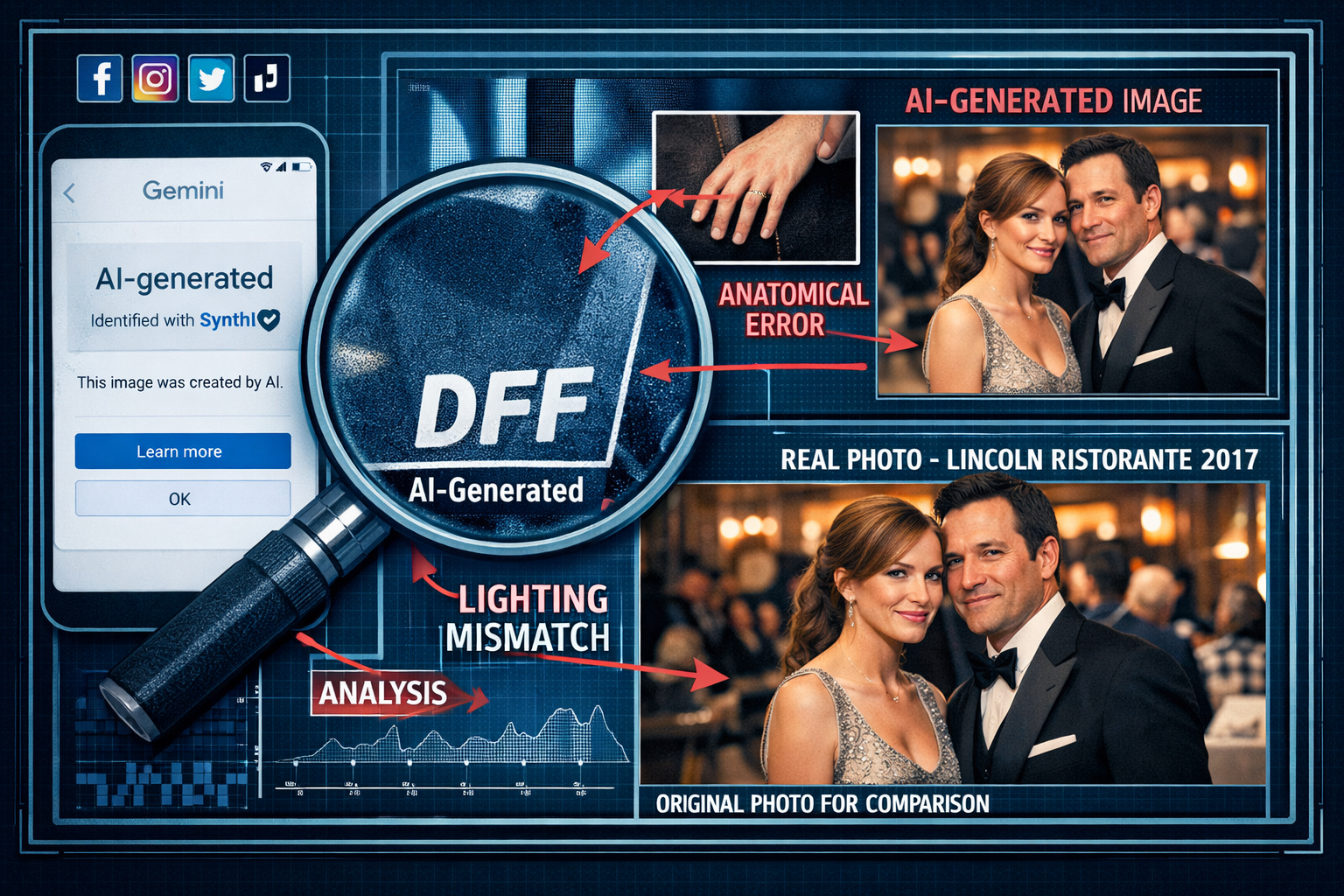
The fabricated images began circulating shortly after the Department of Justice released millions of previously sealed Epstein-related documents on January 30, 2026. This timing was no coincidence. The perpetrators strategically exploited legitimate news coverage to inject false narratives into the information ecosystem.
The Technical Evidence Was Hiding in Plain Sight
Google’s Gemini AI tool, utilizing advanced SynthID detection technology, verified that all three circulating images were created with Google AI.[1] These weren’t sophisticated deepfakes designed to evade detection. They were clearly marked as artificial creations.
Each AI-generated image carried a watermark reading “DFF,” visible upon close inspection.[1] This watermark served as technical proof of artificial creation—a digital signature that should have stopped the misinformation in its tracks.
But it didn’t.
Why watermarks failed to stop the spread:
- 📱 Mobile viewing habits: Most social media users scroll quickly on smartphones, where small watermarks are nearly invisible
- 🧠 Confirmation bias: People who wanted to believe the worst about Mamdani didn’t look closely enough to spot the markers
- ⚡ Emotional reaction: Outrage spreads faster than verification, especially with inflammatory content involving figures like Epstein
- 🔄 Screenshot culture: As images were re-shared and screenshotted, quality degraded and watermarks became harder to detect
The Source Made No Secret of Creating Fake Content
The images originated from a parody X account named ‘@DumbFckFinder,’ which regularly posts AI-generated visuals.[1] The account’s bio explicitly states it shares “high quality AI videos and memes.”[1]
This wasn’t a sophisticated disinformation operation hiding its tracks. The creator openly acknowledged generating the images. Yet the content still spread to thousands of users who either didn’t check the source or didn’t care about its authenticity.
“When people see something that confirms what they already believe, they stop asking questions,” explains media literacy expert Dr. Sarah Chen. “That’s exactly what happened here. Progressive Mayor targeted with Epstein connections? For some audiences, that was too good to fact-check.”
The Misleading Caption Weaponized Real Events
The AI-generated photos were accompanied by a caption falsely claiming that Zohran Mamdani’s mother, acclaimed filmmaker Mira Nair, had helped Epstein and Ghislaine Maxwell facilitate “pedophile rings.”[1] This allegation has absolutely no factual basis.
The caption strategically mixed truth with lies—a classic misinformation technique:
✅ True: Mira Nair’s name appears in newly released Epstein documents
✅ True: She attended events organized by Epstein-connected publicist Peggy Siegal
❌ False: She facilitated criminal activity
❌ False: The photographs showing her son with Epstein are genuine
This blending of verifiable facts with fabricated claims makes the misinformation more credible and harder to debunk for casual readers.
Understanding the Real Connections and What the Evidence Actually Shows
While the AI-generated images were completely fabricated, Mira Nair does appear in legitimate Epstein-related documents. Understanding the actual evidence is crucial for separating fact from fiction.
What the January 2026 Document Release Actually Revealed
The Department of Justice released millions of Epstein documents after President Trump signed the Epstein Files Transparency Act in November 2025.[2] These newly unsealed records, released on January 30, 2026, named filmmaker Mira Nair in connection with Epstein’s social network.[2]
However—and this is critical—these documents “do not allege criminal wrongdoing by those mentioned.”[2]
What the documents actually show:
- 📧 A 2009 email from publicist Peggy Siegal to Epstein documented an after-party for Mira Nair’s film “Amelia” held at Ghislaine Maxwell’s Manhattan townhouse
- 👥 High-profile attendees included former President Bill Clinton, Amazon founder Jeff Bezos, and Nair
- 📝 The correspondence “documents attendance only and does not allege misconduct”[2]
- 🎬 Multiple emails in the Epstein Library reference Nair in connection with film industry events
These documents reveal that Nair moved in elite social circles that intersected with Epstein’s network—particularly through Hollywood publicist Peggy Siegal. But attendance at industry events does not equal participation in criminal activity.
The Role of Peggy Siegal: Hollywood’s Connector
Understanding Peggy Siegal’s role is essential to understanding how many legitimate film industry professionals ended up in Epstein’s orbit without knowledge of his crimes.
Siegal was a powerful Hollywood publicist and longtime associate of Epstein who hosted industry events.[2] She organized exclusive screenings, after-parties, and networking events that brought together celebrities, filmmakers, business leaders, and—unfortunately—Epstein.
Important context about Siegal:
- 🎭 She was a legitimate industry professional with decades of connections
- ⚖️ She “was never charged with a crime”[2]
- 📰 Following reporting about her association with Epstein, Netflix, FX, and Annapurna Pictures cut ties with Siegal in 2019, according to Variety[2]
- 💼 Many professionals attended her events without knowing about Epstein’s criminal activities
This is how social networks function in elite circles. Attending an event organized by someone who also knew a criminal does not make you complicit in those crimes.
Verified Photographs Show Legitimate Film Industry Events
Two genuine photographs document Mira Nair’s participation in film industry events:
November 15, 2017: A verified photograph shows Zohran Mamdani attending a Universal Pictures “Get Out” luncheon hosted by Peggy Siegal at Lincoln Ristorante in Manhattan, alongside his mother Mira Nair, actor Daniel Kaluuya, and filmmaker Shimit Amin.[2]
December 5, 2016: A second verified photograph shows Mira Nair attending a private residence film event with Siegal for “Queen of Katwe.”[2]
These were legitimate film industry promotional events. There is no evidence Epstein attended either event. The AI-generated images falsely inserted Epstein into scenarios that never occurred.
What We Should—and Shouldn’t—Conclude
The evidence shows that Mira Nair attended film industry events organized by a publicist who also knew Jeffrey Epstein. That’s the extent of what the documents prove.
Reasonable conclusions:
- Nair moved in elite social circles that included problematic figures
- The film industry’s networking culture created connections between many people
- Attending events does not equal knowledge of or participation in crimes
Unreasonable conclusions:
- Nair facilitated criminal activity (no evidence supports this)
- Her son Zohran Mamdani has any connection to Epstein (he doesn’t)
- The AI-generated photographs depict real events (they absolutely don’t)
This distinction matters enormously for government transparency, accountability, and fair political discourse.
The Broader Implications for Democracy and Media Literacy
This incident represents far more than one politician being targeted with fake images. It reveals systemic vulnerabilities in how we process information in the digital age.
When Technology Outpaces Critical Thinking
AI image generation technology has become remarkably accessible. Tools that once required specialized knowledge now operate through simple text prompts. This democratization of creation has a dark side: democratization of deception.
The current landscape:
- 🤖 Free AI tools can generate photorealistic images in seconds
- 📱 Social media algorithms prioritize engagement over accuracy
- ⚡ Viral spread happens faster than fact-checking organizations can respond
- 🎯 Political targeting uses AI to manufacture scandals from whole cloth
Even when creators watermark their work and platforms develop detection tools, human psychology remains the weakest link. We want to believe stories that confirm our worldview. We share first and verify later—if at all.
The Timing Exploit: Weaponizing Legitimate News
The perpetrators timed their fabricated images to coincide with the January 30, 2026 DOJ document release. This strategic timing exploited a well-documented phenomenon: when legitimate news breaks, misinformation piggybacks on the attention.
How the timing exploit works:
- ⏰ Real news breaks (Epstein documents released)
- 📰 Media coverage creates public attention and search interest
- 🎨 Bad actors inject fabricated content into the conversation
- 🔄 Algorithms amplify whatever generates engagement, regardless of truth
- 😤 Emotional reactions spread false content before corrections can catch up
This technique has been used to spread misinformation about everything from natural disasters to election results. The Mamdani case demonstrates how it works in political contexts.
What This Means for Progressive Politics and Accountability
Mayor Zohran Mamdani represents a new generation of progressive leadership in New York City. His election signaled a shift toward policies addressing economic inequality, affordable housing, and workers rights—issues that matter deeply to working families in communities like Utica and throughout upstate New York.
Targeting him with fabricated Epstein connections serves multiple purposes for those opposed to progressive governance:
- 🎯 Character assassination without evidence
- 🗳️ Voter suppression through manufactured scandal
- 💰 Distraction from policy discussions about economic justice
- 📉 Demoralization of progressive voters and activists
This isn’t just about one mayor. It’s about whether we’ll allow digital fabrications to determine which leaders can effectively serve their communities.
The stakes for local government accountability:
When fake scandals crowd out real issues, voters lose the ability to hold elected officials accountable for actual policy decisions. If we’re arguing about fabricated photographs, we’re not discussing municipal budgets, affordable housing requirements, or infrastructure investment.
Progressive journalism and fact-checking become essential democratic infrastructure—not partisan exercises, but civic necessities.
Building Community Resilience Against Misinformation
The Mohawk Valley and communities across upstate New York need strategies to resist digital manipulation:
Individual actions:
- 🔍 Check sources before sharing inflammatory content
- ⏸️ Pause and verify when something triggers strong emotions
- 🏷️ Look for watermarks and other authenticity indicators
- 🔎 Use reverse image search to find original context
- 📱 Report misinformation on social platforms
Community actions:
- 📚 Support local journalism that investigates and fact-checks
- 🎓 Demand media literacy education in schools
- 🤝 Build coalitions across political differences to combat shared threats
- 🗣️ Speak up when friends and family share questionable content
- 💪 Strengthen civic institutions that verify information
Systemic solutions:
- ⚖️ Platform accountability for algorithmic amplification of misinformation
- 🏛️ Government transparency that makes official records easily accessible
- 🔬 Investment in detection technology and fact-checking infrastructure
- 📊 Research funding to understand how misinformation spreads
- 🎯 Consequences for deliberate disinformation campaigns
What Readers Can Do: Practical Steps for Media Literacy

Understanding this case intellectually isn’t enough. Mohawk Valley residents and citizens everywhere need practical tools to navigate the misinformation landscape.
The Five-Second Verification Check
Before sharing any inflammatory content, especially about political figures, take five seconds to ask:
- Who created this? Check the account bio and posting history
- What’s the source? Look for original reporting from credible outlets
- Does it seem too perfect? Scandalous content that confirms every bias deserves skepticism
- Are there watermarks? Look closely for AI generation markers
- What do fact-checkers say? Search “[topic] fact check” before sharing
These five seconds can stop misinformation chains before they start.
Using Technology to Fight Technology
Several free tools help verify image authenticity:
- Google Gemini: Can detect AI-generated images using SynthID technology
- Reverse image search: Google Images, TinEye, and Yandex help find original sources
- InVID/WeVerify: Browser extension for video and image verification
- Snopes and FactCheck.org: Established fact-checking organizations
- NewsGuard: Browser extension rating news source credibility
These tools aren’t perfect, but they’re significantly better than relying on gut feeling alone.
Supporting Accountability Journalism
Quality journalism costs money. Investigative reporting, fact-checking, and accountability journalism require trained professionals with time to verify information.
Ways to support:
- 💵 Subscribe to local and national news outlets
- 🎁 Donate to nonprofit journalism organizations
- 📢 Share quality reporting to increase its reach
- 💬 Engage constructively in comment sections
- ✉️ Contact journalists with tips and story ideas
The Mohawk Valley Voice exists because communities need progressive journalism that combines factual accuracy with thoughtful analysis. Supporting outlets that prioritize truth over clicks strengthens democratic discourse.
Teaching the Next Generation
Parents, educators, and community leaders have a responsibility to build media literacy in young people who’ve never known a world without digital manipulation.
Key lessons for youth:
- 📸 Photographs can lie: Technology makes fabrication easy
- 🧠 Emotions are exploited: Outrage spreads faster than truth
- 🔍 Verification is essential: Always check before sharing
- 👥 Sources matter: Who created content and why
- ⚖️ Fairness requires skepticism: Even about people you dislike
These aren’t just technical skills—they’re civic virtues essential for democratic participation.
Conclusion: Truth, Technology, and Democratic Resilience
The case of AI-generated photos falsely depicting New York City Mayor Zohran Mamdani with Jeffrey Epstein reveals uncomfortable truths about our information ecosystem. Technology has made fabrication trivially easy. Social media algorithms reward engagement over accuracy. Human psychology makes us vulnerable to confirmation bias.
Yet this incident also demonstrates reasons for hope. Detection technology identified the fakes. Fact-checkers documented the truth. The account that created the images didn’t hide its artificial nature. The tools for verification exist—we simply need the collective will to use them.
For Mohawk Valley residents and citizens across upstate New York, this case offers a clear lesson: democracy requires informed citizens, and being informed requires active effort. We can’t passively consume whatever appears in our feeds. We must verify, question, and think critically about information—especially when it confirms what we already believe.
Mayor Mamdani’s experience should concern everyone, regardless of political affiliation. Today’s target is a progressive leader in New York City. Tomorrow’s could be a local school board member in Utica, a county legislator in Oneida County, or any citizen whose voice threatens powerful interests.
Your next steps:
- 🔍 Practice verification before sharing any political content
- 📚 Learn to use AI detection and fact-checking tools
- 💰 Support journalism that investigates and verifies
- 🎓 Teach media literacy to family and community members
- 🗳️ Stay engaged in local elections and government accountability
- 📢 Speak up when you see misinformation spreading
- 🤝 Build coalitions with others committed to truth
The fight against misinformation isn’t someone else’s responsibility. It’s a civic duty we all share. Every time we pause to verify before sharing, we strengthen democratic discourse. Every time we support quality journalism, we invest in accountability. Every time we teach critical thinking, we build resilience.
Technology will continue advancing. AI will generate ever-more convincing fabrications. But human communities built on trust, verification, and shared commitment to truth can withstand these challenges.
The question isn’t whether misinformation will target our leaders and institutions. It will. The question is whether we’ll be ready—informed, skeptical, and committed to defending truth in the digital age.
That work starts now, with each of us, in communities like the Mohawk Valley and across the nation.
References
[1] Mira Nair Nyc Mayor Zohran Mamdani Jeffrey Epstein Viral Images Fact Check – https://www.thequint.com/news/webqoof/mira-nair-nyc-mayor-zohran-mamdani-jeffrey-epstein-viral-images-fact-check
[2] Resurfaced Photo Links Mamdani Epstein Connected Publicist New York City Event – https://www.foxnews.com/politics/resurfaced-photo-links-mamdani-epstein-connected-publicist-new-york-city-event


