


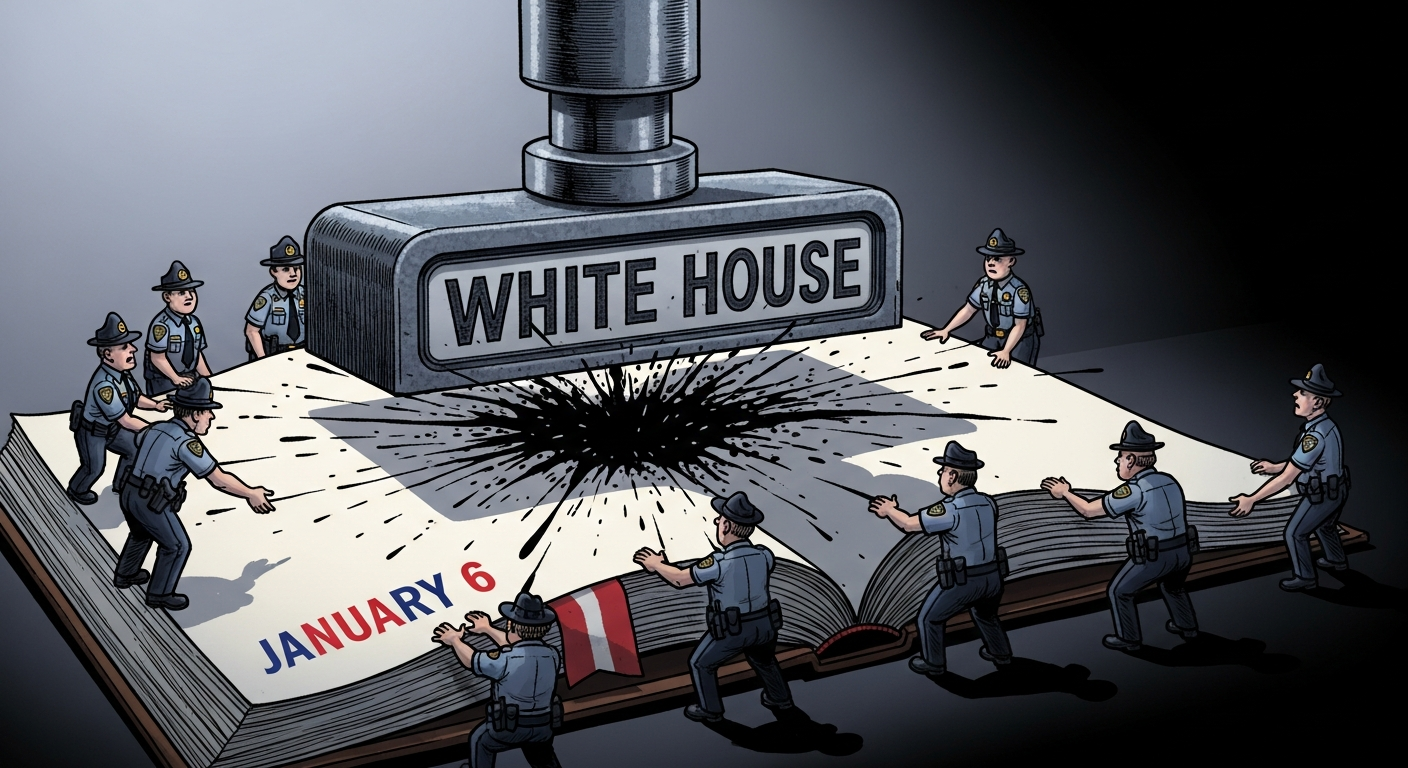
A new official page reframes a violent day—and asks Americans to forget what police lived.
The White House has published a new January 6 webpage that reads less like a factual public record and more like a defense brief—calling many participants “peaceful protesters,” implying the “insurrection” label was fabricated, and framing prosecutions as a political plot. But the record of January 6 is not a matter of branding. It is documented in court filings, bipartisan and nonpartisan reviews, and—most importantly—in the injuries and trauma reported by the law enforcement officers who fought to hold the line that day. This post breaks down the White House Jan 6 website claims, identifies major points of misinformation or distortion, and contrasts them with credible source material.
What the new White House Jan. 6 page claims
The page at The White House — “January 6: A Date Which Will Live in Infamy” argues, among other things, that:
- Many defendants were “mere trespassers or peaceful protesters” treated like insurrectionists.
- The “insurrection narrative” was a manufactured storyline by Democrats.
- Democrats “staged the real insurrection” by certifying a “fraud-ridden” election.
- Prosecutors “weaponized” the justice system, and pardons were needed to correct a “historic wrong.”
- It emphasizes selective source documents, including a House Administration Subcommittee interim report and a DOJ OIG report, to support a broader political conclusion.
Source: The White House (Jan 6 page)
Some of the page’s links are real government documents. That’s part of what makes the presentation effective—and dangerous. A credible citation can be used to launder an incredible conclusion.
Misinformation and distortions—cross-checked against credible sources
Distortion #1 — “Peaceful protesters” as the dominant frame
The White House page repeatedly casts January 6 as mostly peaceful and suggests the “insurrection” label was invented. But even the DOJ Inspector General report—focused on FBI intelligence handling, not prosecutorial politics—uses plain language about what occurred: “the riot and breach of the U.S. Capitol on January 6, 2021.”
Source: DOJ OIG Report 25-011 (Dec 2024)
That framing matters because it reflects baseline institutional fact: a breach happened; a riot happened. You can argue about security planning failures without erasing the violence that unfolded once the perimeter collapsed.
Featured snippet definition (scannable)
What happened on January 6, 2021?
January 6 was a day when a pro-Trump crowd rioted and breached the U.S. Capitol during the electoral vote certification, forcing evacuations and triggering a major law enforcement response.
Source: DOJ OIG Report 25-011
Distortion #2 — “No evidence” of intent or coordinated violence
The White House page says the event was branded a coup “despite no evidence of armed rebellion or intent to overthrow the government.” That is a sweeping claim presented without careful legal or factual boundaries. The reality is more precise:
- Not every person in the crowd had the same intent.
- But the federal government prosecuted hundreds for violent or obstructive conduct, and pursued major conspiracy cases against militia leaders.
- The day’s purpose—stopping or delaying certification—was openly discussed by many participants in real time.
Even the White House page itself underscores that the government charged and prosecuted at massive scale, while reframing that as persecution. It cites “nearly 1,600” people receiving pardons/commutations and repeats the idea of overcharging.
Source: The White House (Jan 6 page) and the related proclamation: White House Proclamation (Jan 20, 2025)
A mass pardon does not prove innocence. It proves power.
Distortion #3 — Election fraud as a settled fact
The White House page describes certification of a “fraud-ridden election” and calls that the “real insurrection.” That’s not just interpretation; it implies a factual foundation that courts and election officials repeatedly rejected after 2020. The webpage provides no court-validated evidentiary record to justify treating the election as “stolen” in an official historical account.
Source: The White House (Jan 6 page)
Journalistic balance requires acknowledging what some voters believe. But factual balance requires stating clearly: belief is not proof, and government communications should not present disputed claims as established reality.
Distortion #4 — Cherry-picking oversight reports to imply a cover-up narrative
The White House page heavily relies on a House Administration Subcommittee interim report (a partisan committee product) and uses it to accuse others of deliberate delay, deception, and narrative engineering. It also cites the DOJ OIG report on FBI confidential sources.
Here’s what the DOJ OIG report actually supports—and what it does not.
What the DOJ OIG report DOES say (relevant facts)
- The FBI did not canvass field offices before Jan 6 for threat intelligence and CHS reporting—an internal “basic step” that was missed.
- The OIG found no evidence the FBI had undercover employees in the protest crowds or at the Capitol on Jan 6.
- The OIG found 26 FBI confidential human sources were in DC connected to Jan 6 events; 4 entered the Capitol, 13 entered a restricted area; none were prosecuted (and the DC USAO explained it often declined cases where the only act was restricted-grounds entry).
Source: DOJ OIG Report 25-011
What the DOJ OIG report does NOT prove
- It does not conclude January 6 was peaceful.
- It does not conclude the attack narrative was “fabricated.”
- It does not support claims that Democrats “staged” events.
- It does not validate a blanket claim that defendants were broadly “political hostages.”
The OIG report is the kind of document serious readers respect because it’s careful and limited. The White House page uses it like a prop to support a much larger storyline.
What law enforcement officers said—and why it matters
When politics gets slippery, listen to the people who stood in the doorway.
One of the most widely cited statements from that day comes from then–U.S. Capitol Police Officer Daniel Hodges, who described the fight in blunt terms:
“I got called a traitor and a disgrace… I got told to go die.”
Source: (Congressional testimony commonly reported and referenced in coverage of Jan. 6 officer accounts; for the White House page context see The White House (Jan 6 page))
Officers reported being crushed, beaten, sprayed, and hunted through the building. Their accounts align with the plain-language description in federal oversight reporting of a riot and breach.
Source: DOJ OIG Report 25-011
The political betrayal: “Back the blue” until the blue tells the truth
For years, Republican messaging has leaned hard on respect for police and the military. Yet on January 6, the story now being elevated by official channels turns the officers into supporting characters—or worse, obstacles in a morality play where the “real victims” are defendants.
That contradiction is the heart of the outrage: You cannot claim to champion law enforcement while minimizing the violence done to law enforcement. If you honor the uniform, you honor the testimony—even when it complicates your politics.
Addressing counterarguments fairly
A fact-based critique doesn’t pretend there were no legitimate questions after January 6. There were—and still are—serious issues worth discussing:
- Security failures: Why wasn’t the perimeter stronger? Why were resources delayed?
- Consistency in charging: Were some lower-level cases overcharged? Were sentences consistent?
- Civil liberties: How do we protect First Amendment rights while prosecuting violence?
Those debates can be real. But they do not justify an official government page that:
- frames the day as mostly peaceful,
- treats election fraud as settled truth, and
- implies the central story was invented rather than documented.
Accountability can include reviewing mistakes by leadership. It cannot include rewriting what the public watched unfold.
Why this “history rewrite” is happening now
This webpage isn’t just about January 6. It’s about the next election cycle—and the one after that. If a government can normalize the idea that political violence is “patriotism” and consequences are “persecution,” then the guardrails weaken.
And if Americans accept that, the target won’t stay fixed on one party’s enemies. The tool will be used again—because it worked.
What readers can do (Call to action)
This is not a “both sides” moment where truth sits politely in the middle. You don’t have to be a Democrat to reject propaganda. You just have to be a citizen who believes facts matter and that law enforcement officers are not disposable.
5 practical actions you can take this week
- Read the source page yourself and document misleading claims with screenshots and archived links.
Source: The White House (Jan 6 page) - Share a short, factual summary with friends who don’t follow politics closely.
- Call your elected officials (local, state, federal) and demand they publicly reject revisionism.
- Support Capitol Police and DC officers’ wellness charities and advocacy efforts.
- Vote like memory matters. Tell candidates directly: attempts to divide Americans against the truth will cost them at the ballot box.
Political division won’t work on this topic. The country watched. The officers lived it. And if leaders insist on rewriting history, voters can—and should—write a response.
Conclusion
The White House’s new January 6 webpage is not simply a different interpretation of a hard day. It is an official attempt to reframe accountability, soften violence into “peaceful protest,” and shift blame in ways that don’t hold up under careful scrutiny. Even the government’s own inspector general language—“riot and breach”—cuts through the spin.
Source: DOJ OIG Report 25-011
If we want a democracy that survives its worst days, we have to tell the truth about them. The officers deserve that. The country needs that. And the politicians trying to sell a rewritten past should learn a simple lesson: Americans can disagree on policy. But we don’t have to accept a lie as the price of belonging.


